SCIENCE

What Makes Soap Good at Killing Germs?

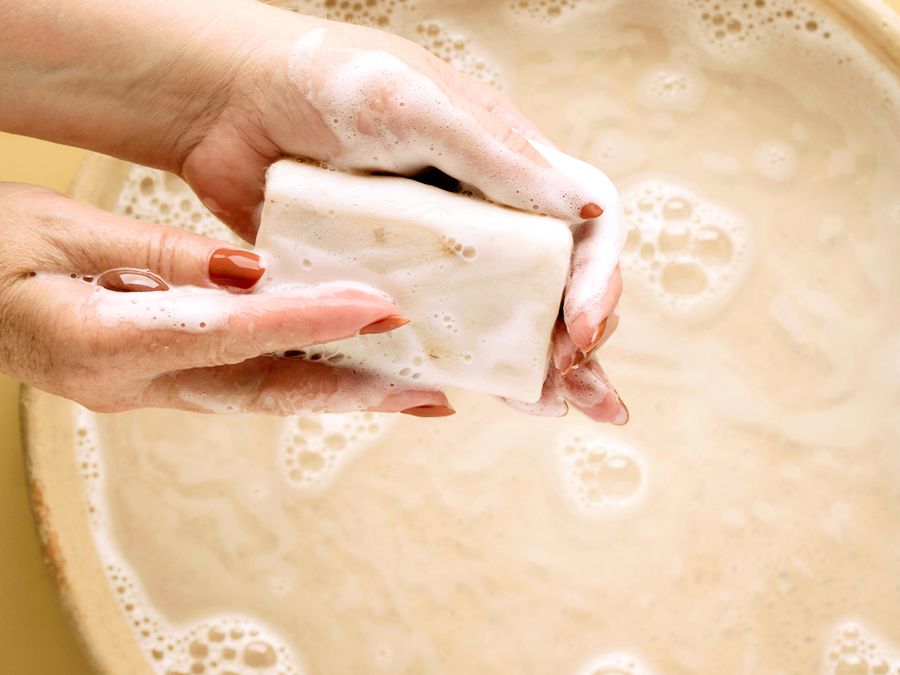
Soapy suds on a wet hand
Credit: Karolina Grabowska/Unsplash.com
Bess Lovejoy
Author
Bess Lovejoy is a writer and editor who lives in Seattle. She is the author of the book Rest in Pieces: The Curious Fates of Famous Corpses, and her writing has also appeared in The New York Times, The Boston Globe, The Wall Street Journal, Time, Lapham’s Quarterly, The Public Domain Review, Atlas Obscura, and elsewhere. She was formerly an editor at Mental Floss and SmithsonianMag.com, and currently teaches classes on research.

Soap seems gentle enough. It smells nice, comes in soothing pastel colors, and some versions can even moisturize your skin. It doesn’t exactly scream “microscopic destroyer.” And yet, from the perspective of bacteria and viruses, soap is astonishingly violent.

When you wash your hands with soap and water, you’re not just rinsing germs off your skin — you’re effectively dismantling them, tearing each one apart piece by piece. The reason soap makes for such a master assassin of microbes? It comes down to a quirk in its chemical structure.

The Split Personality of Soap

Soapy water bubbles
Credit: ohlamour studio/Unsplash.com

Part of the destructive magic of a good lather lies in the strange shape of a soap molecule. Each one looks somewhat like a pin or tadpole, with a round head and a long tail. But its two ends behave very differently. The head is hydrophilic, meaning it loves water. The tail is hydrophobic, meaning it avoids water — preferring fats and oils instead.

That split personality is what makes soap so effective.

Many bacteria and viruses, such as coronaviruses and influenza, are wrapped in fatty outer films called lipid membranes. When you wash your hands, the hydrophobic tails of soap molecules wedge themselves into those lipid membranes like tiny crowbars. As more tails push in, the membrane becomes unstable and eventually breaks down. Critical proteins spill out, and the pathogen falls apart.

Illustration of how soap kills germs
Credit: stock.adobe.com; Illustration How Everything Works

But not every microbe is so easy to destroy. Some bacteria and viruses have sturdier outer structures that can better withstand soap’s molecular assault. That’s where soap’s second trick comes in.

When soap encounters these hardier pathogens, such as dirt and oil stuck to your skin, its molecules begin surrounding them. Their hydrophobic tails latch onto the greasy or fatty material, while their water-loving heads point outward. The result is a tiny floating sphere called a micelle: essentially a very tiny soap bubble wrapped around the unwanted particle.

Once trapped inside a micelle, the pathogen can easily be lifted from your skin. This is why soap works best alongside scrubbing and rinsing. The soap loosens, destroys, or traps microbes, but the water carries them down the drain.

Soap needs time to do its thing — but not much.  It takes around 20 seconds (or singing “Happy Birthday” twice) for soap molecules to fully interact with oils, grime, and pathogens on your skin. A quick, halfhearted splash under the faucet may leave many particles intact, though.

Interestingly, humans have been making soap thousands of years before germs were ever discovered. Nobody had heard of lipid membranes or micelles — they just knew that somehow, soap mysteriously made people cleaner and healthier.

It turns out it was performing molecular warfare all along.

Short Answer

While one end of a soap molecule loves water, the other end actually avoids it. As the hydrophobic “tails” of soap molecules try to escape water, they physically dig into the membranes of many bacteria and viruses, causing them to disintegrate. Soap can also trap particles inside tiny bubble-like molecular structures, which are then easily rinsed off your skin. That’s why washing with soap and water together is so effective at removing germs.