HEALTH
Why Do Your Eyes Need to Adjust to the Dark?

You know the drill: You wake up in the middle of the night, stumble toward the bathroom, and wait for your eyes to adjust. It feels like it takes a few seconds, but in reality, your night vision doesn’t hit its peak until about 30 minutes after the lights go out. Even then, one glance at your blindingly bright phone resets the whole process.
That’s because your eyes adjusting to low light isn’t a mechanical process, and you’re not just “getting used to” the dark. Instead, there’s a specific chemical your eyes spend all day using up — and all night trying to rebuild.
In Rods We Trust
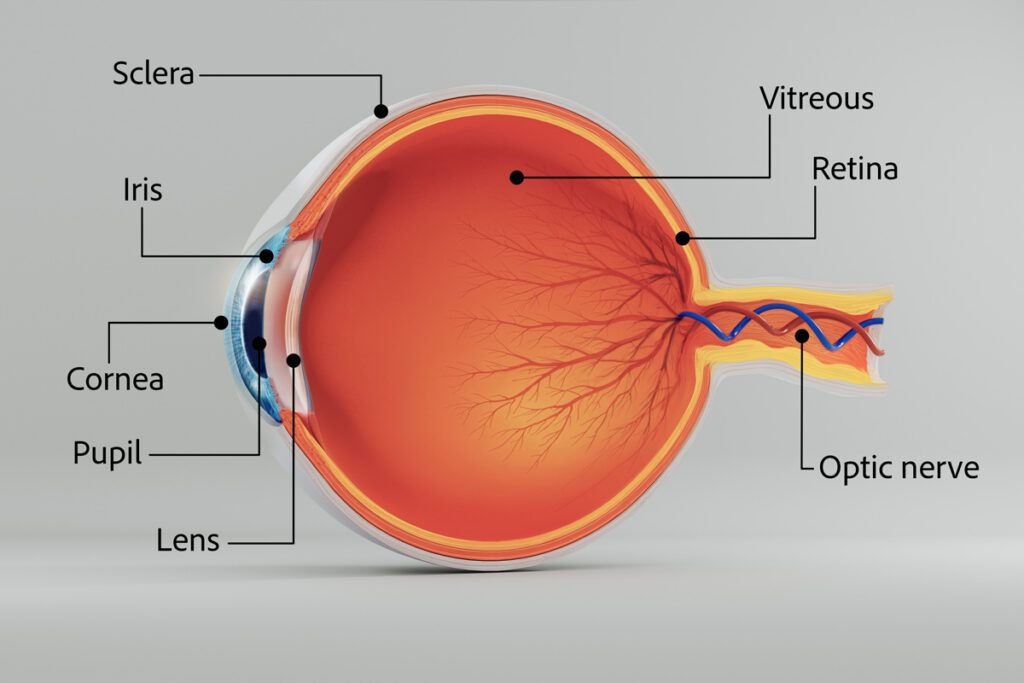
Light enters your eye through the pupil, the dark “hole” in the middle. Located in the back of your eyeball, the retina is the part of your eye that converts the light into the images we see. The retina has a light-sensitive layer lined with two types of photoreceptor cells: cones, which handle color and detail in bright light, and rods, which take over in the dark.
A whopping 95% of photoreceptors are rods, which are far more sensitive to light than cones. They can’t see color at all, though, and aren’t great with details, which is why our night vision is never as good as our day vision). Rods rely on a protein called rhodopsin to do their magic, while cones use one called photopsins.
Here’s the problem: Both of these proteins break down when they’re exposed to light, in a process known as photobleaching. You’ve likely experienced concentrated bouts of photobleaching — for instance, after a day at the beach. Step inside after hours of practically staring at the sun and even an adequately lit room will seem dim and hard to see.
That’s because you’ve essentially overfed your light-sensitive rods, making those cells essentially offline until your eyes have a chance to rebuild their supply of rhodopsin. Even if you’re not at the beach, the same thing happens throughout the day, only more gradually.
The Speed of Dark

Your eyes get to work adjusting as soon as you step into the dark. First, muscles in your eye dilate, or widen, your pupils to let in as much light as possible. Your cones kick into gear first, reaching their peak sensitivity (which isn’t very much compared to rods) within about five to ten minutes.
At this point, the rods — the ultrasensitive cells that actually make night vision possible — are still warming up. They need about 20 to 30 minutes to fully recharge. Until then, you’re working with a limited night vision. Once your rods are fully recharged, the difference is dramatic.
Think about when you first walk outside at night and look at the sky (assuming you’re not in a bright city). At first, it just looks like a flat, black ceiling. But as time goes by, you’ll start to see stars and other details. That’s because after about 30 minutes outside, your eyes have become around 10,000 times more sensitive to light than they were when you first stepped outside.
Now you can see why waiting a half hour for your rods to get ready to work is worth it. But the downside is that all of that progress can be wiped out in seconds. A single bright light — including a glimpse at your cell phone screen, which is usually set to a brightness meant for daytime — breaks down the rhodopsin your rods just spent all that time rebuilding.
Your night-vision goes down the drain and there’s no way to speed up the recovery. You just have to wait — or turn on a lamp.
Your eyes contain two kinds of cells: cones, which detect color and detail, and rods, which are highly sensitive to light and enable you to see in the dark. Rods rely on a protein called rhodopsin to function, which gets depleted in bright light. Your eyes need darkness to rebuild it, so when you walk into a dark room, it takes about 20 to 30 minutes for the rods to fully adjust. Looking at a bright phone screen at night will immediately deplete the rods’ rhodopsin, forcing your eyes to adjust all over again.
Short Answer