HEALTH
Why Can’t You Taste Food With a Stuffy Nose?


At the first sneeze and sniffle of cold season, get ready for a few inevitabilities ahead of you. Tossing and turning at night? Check. A mountain of tissues piled up on your nightstand? Check. Every meal until you feel better tasting blah? That too.
When a head cold hits, even your grandma’s famous chili recipe may suddenly taste like flavorless mush. You might pick up on a hint of saltiness from the beans or sweetness from the tomatoes, but the layered, savory richness you normally crave a bowl (or two) of is gone.
That’s because your tongue is only partly responsible for what you experience as flavor.
Tasting With Your Nose
Your tongue detects five basic tastes: sweet, salty, sour, bitter, and savory (umami). Flavor, however, is a much bigger sensory experience, much of which is built in your nose. That’s why you can immediately know what to expect when walking into a steakhouse or an Italian restaurant without having to lick the walls.
In fact, smell is responsible for as much as 80% of what we perceive as flavor, according to smell and taste researchers.
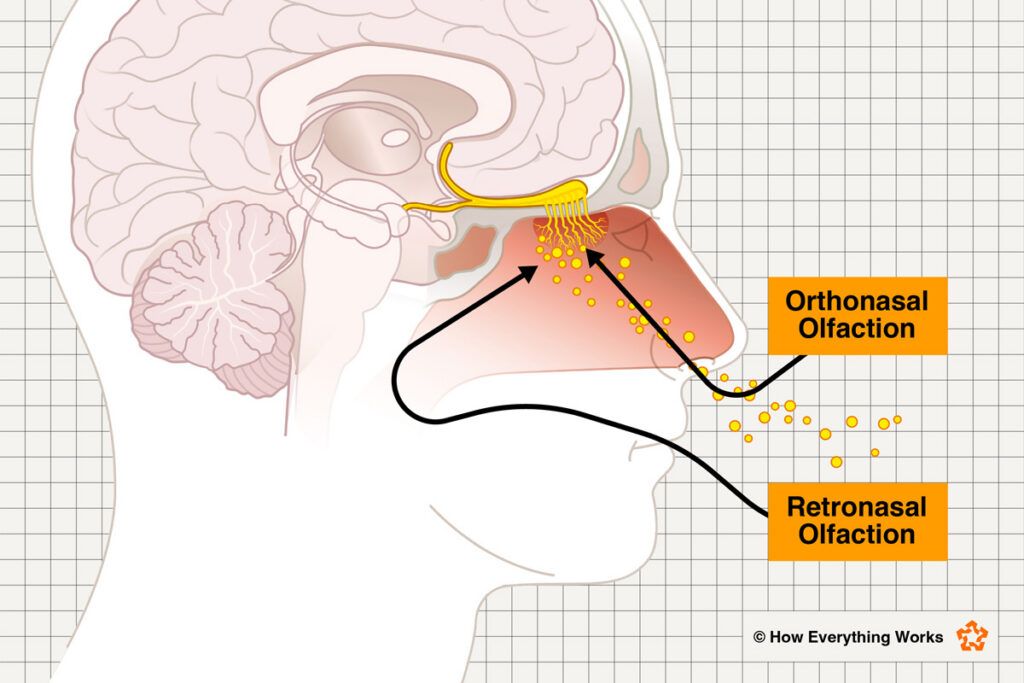
Your nose contributes to flavor in two ways. The first is orthonasal olfaction, which is a fancy way of describing what happens when you smell something through your nostrils before eating it. That’s the aroma you notice when you sniff a pile of pancakes, for instance.
When you’re eating those pancakes, a second pathway called retronasal olfaction kicks in. As you chew and swallow, you’re not just cutting your food up into smaller bites to swallow — you’re also breaking it down on a microscopic level, allowing tiny odor molecules to escape.
These molecules travel from your mouth up through the pharynx (the back of your throat) and into the nasal cavity. There, they reach the olfactory epithelium, a patch of tissue containing the nerve receptors that detect smells. Your brain combines that information with the basic tastes coming from your tongue to create the perception of flavor.

Nasal congestion severs that connection. Swollen nasal tissue and excess mucus clog the passage, so air — and the odor molecules along for the ride — can’t circulate up the back of your throat. Your tongue can still detect the five basic tastes, but without as much information from your nose, the brain has fewer sensory details to work with.
Think of it like a band missing half its instruments. The tongue is the rhythm section, laying down a steady beat: sweet, sour, salty. The nose supplies the complex melody; it’s the strings and horns that make a song memorable. Block the nose, and all you’re left with is the basic beat.
When smell is impaired, your brain compensates by relying more on the somatosensory system to receive information about what you’re eating. Somatosensory nerves detect stimuli such as touch (texture), temperature, and pain.
That’s why chemical irritation caused by certain foods, such as the burning sensation from chili peppers or the cooling snap from mint, may still have some kick when you’re congested. Those sensations can’t replace flavor, but they can help a bland meal taste a little less flat.
So when you’re treating your cold with chicken soup, feel free to add a dash of chili powder.
Your tongue detects the five basic tastes: sweet, salty, sour, bitter, and savory (umami). But the more complex, recognizable qualities of flavor mostly come from your sense of smell. Nasal congestion physically blocks odor molecules released by the food you chew from reaching sensory nerves in your nose that tell your brain what you’re eating. So a stuffy nose often leaves food tasting flat.
Short Answer