SCIENCE
Why Does Metal Feel So Cold?


Imagine touching a piece of wood and then a piece of metal — both sitting in front of you at room temperature. What do you think you’d notice? The metal would feel colder than the wood, right?
Now imagine you have a laser thermometer, the type constantly used on our wrists during the height of COVID. Aim that bad boy to measure both the wood and the metal and you might be surprised to see that both are actually the same temperature. This raises the question: How can one object have the same temperature as another but feel much cooler to the touch?
To understand the answer to this mystery, first you have to realize that not only is the metal not actually colder, but by touching it, you’re the one becoming colder — or rather, you’re losing your body heat by the second.
Heat Goes With the Flow
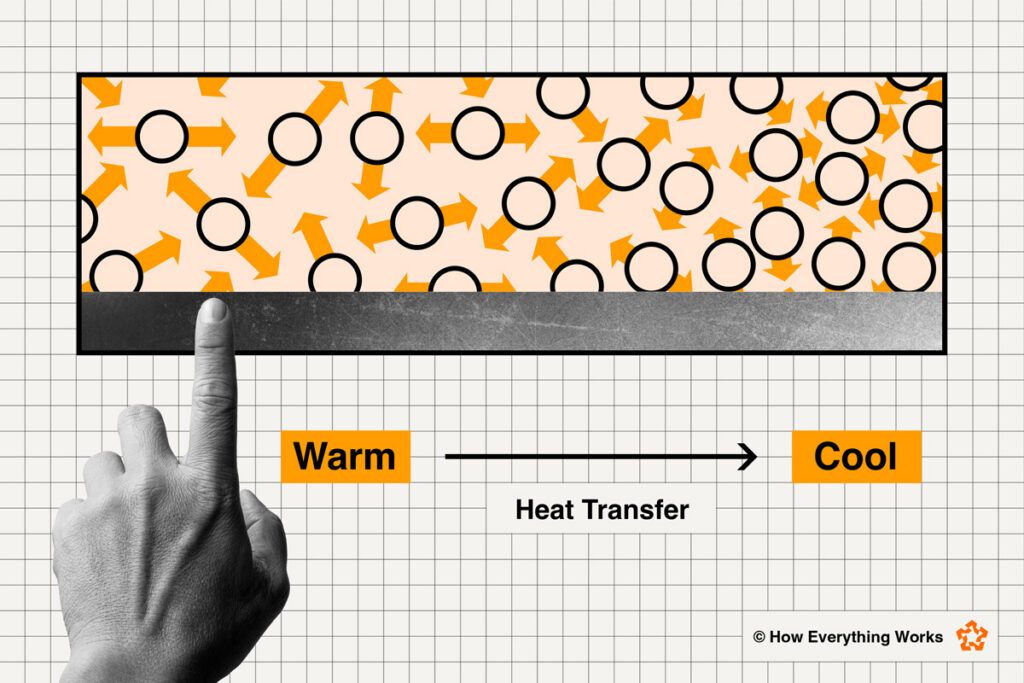
When you touch something metal, the heat from your body is being transferred from you to the object through your fingers. The same thing happens when you touch the wood, but because metal is much more efficient at drawing heat from your body, it feels colder to the touch. Just as metal conducts electricity better than wood (which is why we don’t use trees to make power cables), it’s also a better conductor for heat. This process, known as thermal conductivity, occurs on the atomic scale.
Let’s take a closer look at atoms. Electrons are arranged in a series of shells orbiting the nucleus, which is itself made of neutrons and protons. The outermost shell of any atom is known as the valence shell — the one furthest away from the nucleus. The number of electrons typically found in the valence shell depends on the element.
The valence shell is important because it’s where metals gain their conductive properties. Copper, famously one the very best conductors, contains only one weakly bound electron in its outermost shell. When taken together, these free subatomic particles create a “sea of delocalized electrons” throughout the metal.
When one side of the metal is heated, free electrons gain kinetic energy and quickly move to the colder (less-energetic) part of the metal. That’s because nature prefers equilibrium, so energy flows from warmer regions to cooler ones. Heat a pan with an uninsulated metal handle, and it won’t take long for that handle to also reach scalding temperatures.

When your hand touches a piece of metal, and the fixed temperature of your body is warmer, electrons gain kinetic energy from that body heat. We experience this as “cold.” The reverse is also true. Ever accidentally touch a seatbelt buckle that’s been sitting in the sun? Electrons quickly rush from the hot metal to your cool skin and can even cause a burn if it’s hot enough.
Wood, on the other hand, is a natural insulator, as the elements it’s composed of lack free electrons. Plus, it contains small air pockets in its cellular structure that are devilishly difficult for heat energy to pass through. Eventually, electrons and heat will spread throughout any material to reach equilibrium, but some are a lot more conductive than others.
In conductive materials such as metal, the electrons located in the outermost shell of its atoms easily move to where there is less kinetic energy (or heat). When your hand, which is naturally warm, touches a cold piece of metal, heat from your hand is transferred to the metal so both can reach equilibrium. This process literally feels cool to the touch, which is why metal, being an excellent thermal conductor, feels colder than something like wood — even when both are the same temperature.
Short Answer