HEALTH
Why Do You Jump When You’re Startled?


A book crashes to the floor, a balloon pops, or someone speaks when you thought you were all alone. Before you even know what’s happened, your eyes squeeze, your shoulders shoot upward, and your entire body jerks. Your hands may fly up, and anything you were holding may make a break for freedom.
Even when you know the toaster is about to pop, your body can behave as though the bread is coming out of a cannon. What produces that sudden full-body punctuation mark?
A Reflex From Head to Toe

The culprit is the startle reflex, a rapid series of involuntary muscle contractions triggered by an abrupt, intense sensation. Loud noises are particularly effective (especially more than 110 decibels — about the roar of a chainsaw 3 feet away), but an unexpected touch or sudden movement can also set it off.
In humans, the response begins around the eyes and spreads downward. You blink, muscles in your face and neck contract, your shoulders rise, and muscles in your trunk and limbs flex. When enough of those muscles contract almost simultaneously, you don’t merely blink or flinch: You appear to jump, as if you’re a marionette and someone just yanked your string.
The eye blink is the reflex’s fastest and most reliable component. Those muscles can react within 35 milliseconds of a startling sound, followed shortly afterward by muscles in the neck. The sequence happens far too quickly for you to consciously decide what to do — which means you didn’t mean to shoot out of your chair like it was spring-loaded.
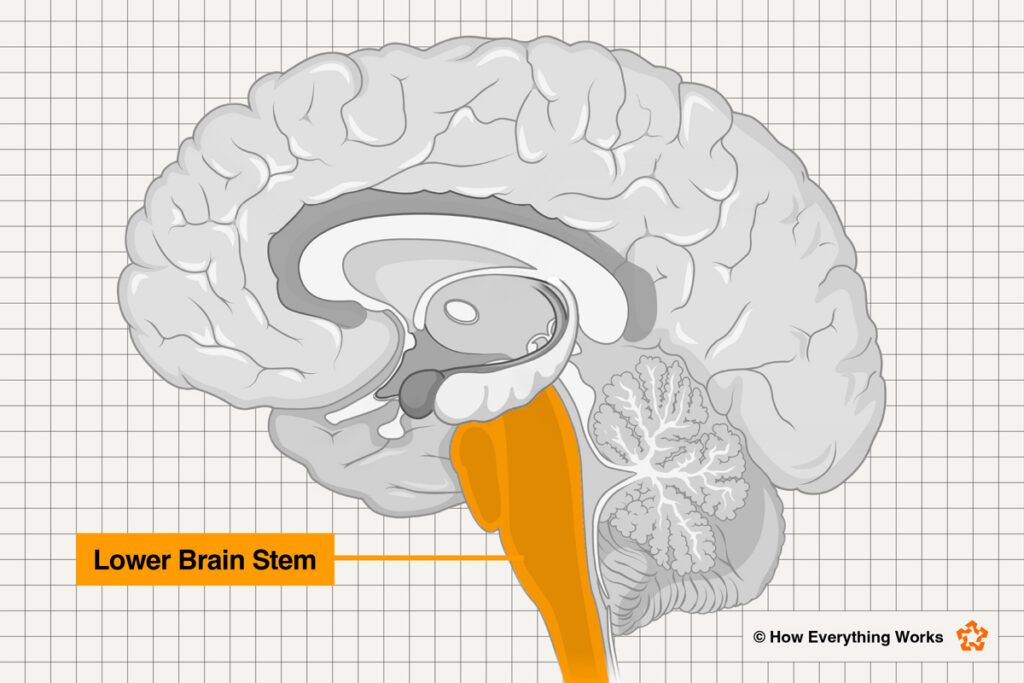
That speed is possible because the basic response is coordinated primarily in the lower brainstem. It’s not just physically closer to your spine and the rest of your body, giving signals less distance to travel, but — unlike the higher parts of the brain that interpret the situation — it doesn’t rely on more complicated, time-consuming neurological mechanisms.
This relatively short route lets your muscles react more quickly and without stalling or second-guessing as the rest of your brain works out whether the crash came from an intruder or just a pan sliding off the dish rack. Basically, the more primal parts of your instincts have you shooting up from your seat first, and asking questions (milliseconds) later.
Scientists have proposed that this pattern may have evolved to protect against predators or attacks by quickly shielding vulnerable areas, minimizing injury, and preparing the body for fight or flight. Scrunching your face and tightly closing your eyes, for instance, may help protect your eyes, which are not only easy to injure but are also needed to help defend yourself against whatever comes next. But the true evolutionary purpose of the human startle reflex remains more of a theory than a settled fact.
Fortunately, a healthy nervous system generally learns to turn down the volume after the first jump. If the same harmless noise occurs repeatedly, the reflex usually weakens through a process called habituation. That’s why the first bang may send you airborne, while the fifth earns only an irritated glance.
Sudden sounds, movements, or sensations activate an extremely fast, involuntary reflex that makes muscles in your face, neck, trunk, and limbs contract in a sequence so rapid that it seems instantaneous — and makes you appear to jump. The part of your brain controlling these movements acts more quickly than the part that interprets the situation for you to respond consciously. Scientists theorize that the instinctive movement evolved to help protect vulnerable body parts and prepare you to deal with possible danger.
Short Answer