SCIENCE
Are You Really Made of Stardust?

Astronomer Carl Sagan once said, “The cosmos is also within us. We’re made of star stuff. We are a way for the cosmos to know itself.” It’s a beautiful idea connecting humanity and the universe across time, but is it scientifically true, or just poetry?
It’s poetic and it’s true. Nearly everything in your body — along with every other object on Earth — was created inside a long-dead star before even the sun came into being.
Where Do Atoms Come From?
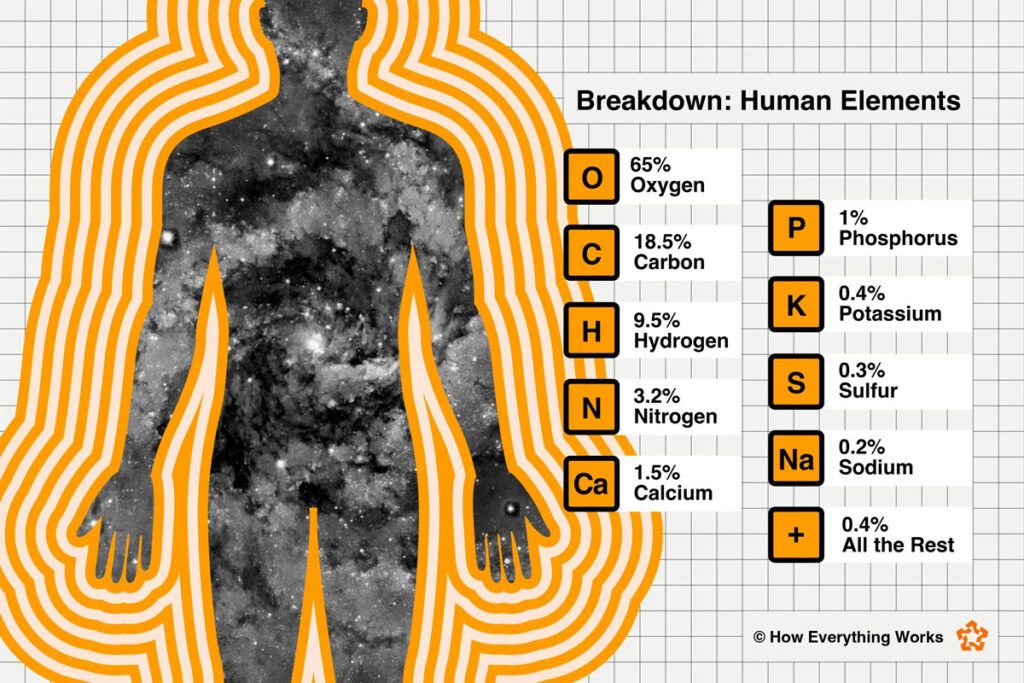
Humans are primarily made of six elements, including oxygen, carbon, and hydrogen. So what did Sagan mean when he said we’re made of “star stuff”? How can we get water (hydrogen and oxygen), or other elements from a big ball of gas that’s millions of miles — or light-years — away? To answer that, we first have to look at the most basic ingredients that make up both stars and humans: atoms.
The big-bang theory (the theory, not the sitcom) suggests that about 13.8 billion years ago, a dense, hot dot tinier than the head of a pin rapidly expanded and stretched like a balloon to an unfathomable size. As it cooled, that energy turned into atoms, the smallest building blocks of matter. Everything that has mass and takes up space, including you, is matter, and all the matter and energy that exists was created simultaneously from the big bang, meaning it’s a fixed amount that can’t be increased or decreased.
The human body contains about 7 octillion atoms — that’s a 7 followed by 27 zeroes. Every one of those atoms has a nucleus that houses positively charged protons as well as neutrons, which have no charge at all. Zooming around the nucleus are negatively charged particles called electrons.
An element is a pure substance in which every atom has the same number of protons. For example, hydrogen atoms are the simplest, as they each have just one proton. Sodium atoms have 11. Iron atoms have 26. The atoms of plutonium, the heaviest naturally occurring element, have 94 protons — every element heavier than that has been made in a lab within the past 90 years or so.
The number of protons is known as an element’s atomic number, and it’s how elements are ordered on the periodic table, from 1 to 118. (The heaviest element, oganesson, atomic number 118, was first created in 2002, meaning any periodic tables from before then are out of date).
Atoms are the basic building blocks of chemistry — they can’t be broken down into simpler substances. There are subatomic particles out there, including incredibly tiny ones smaller than even an electron, but that’s getting into much more advanced physics — when it comes to everyday, tangible chemistry, the buck basically stops with atoms.
“Building blocks” is a surprisingly apt term, as atoms can bond with other atoms during chemical reactions, or when they share electrons, coming together to make increasingly larger structures. You’re basically made of atomic Legos.
A molecule forms when two or more atoms bond together. These atoms can either be the same element, such as two oxygen atoms, or different elements, such as water, which consists of two hydrogen atoms and one oxygen atom (H2O).
Elements have different properties from one another — they have different boiling points and melting points, for example, which is why iron is solid at room temperature while mercury is liquid. For complex life to exist, several elements must come together (hence why you won’t find a solid gold animal that isn’t jewelry).
The reason life — and nearly all matter, really, including asteroids and planets — exists is because nearly all of the elements on the periodic table are forged by stars.
Stars Are Element Factories
Without stars, the periodic table would be much smaller (and easier to memorize), as the entire universe would consist of just hydrogen and helium. There’d be no oxygen or carbon, which means there’d be no you.
Stars create elements, but they can’t create matter out of thin air (or whatever was around before oxygen existed), because the amount of matter and energy in the universe is fixed. So instead of making elements from scratch, they change one element into a different one by changing its atomic structure.
While atoms frequently bond and swap electrons, they rarely change the number of protons they contain. If an atom did give away one or more protons, it would mean becoming an atom of another element, as its atomic number would literally change.
Such a change requires a tremendous amount of energy, which is why nuclear fusion (fusing atoms together) and nuclear fission (breaking atoms apart) are very difficult for humans to do — and extremely explosive when we do it. However, stars have a lot of energy, and elements changing into other elements is exactly what’s going on inside a star.
Stars are balls of hot gas, made when gravity pulls dust and hydrogen gas together into clumps. As gravity squeezes the growing clumps tighter and tighter, the material inside gathers pressure and heat. Once hot enough, nuclear fusion occurs.
Hydrogen atoms — which each have one proton, remember — collide to create helium, which has two protons. This nuclear reaction releases a burst of energy that we can see from all the way down here on Earth as a tiny prick of starlight (or, if it’s from our own sun, as much brighter sunlight).
The very first stars in the universe began as just hydrogen and helium because these two simplest elements were all that existed after the big bang. But as stars age, helium atoms fuse into larger carbon atoms, carbon can become oxygen, and so on, all the way up the periodic table until iron, which has an atomic number of 26.
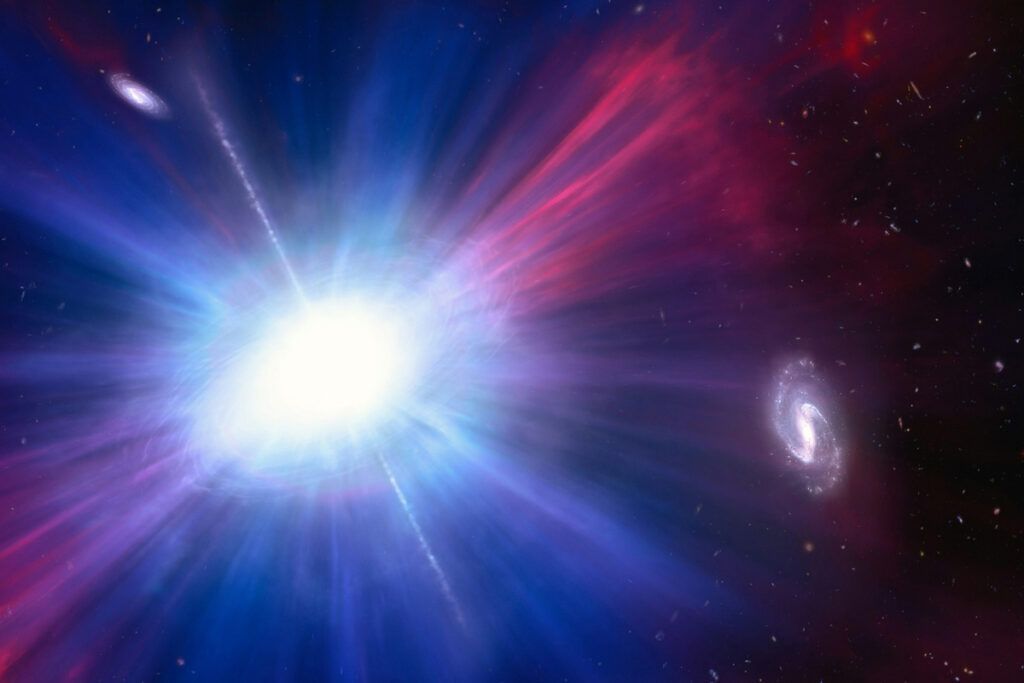
Why does it stop there, if at least 118 elements exist? Because iron doesn’t release energy when it fuses. So when a star becomes so massive that its core becomes iron, that core collapses, creating a huge explosion known as a supernova. This is considered the death of a star.
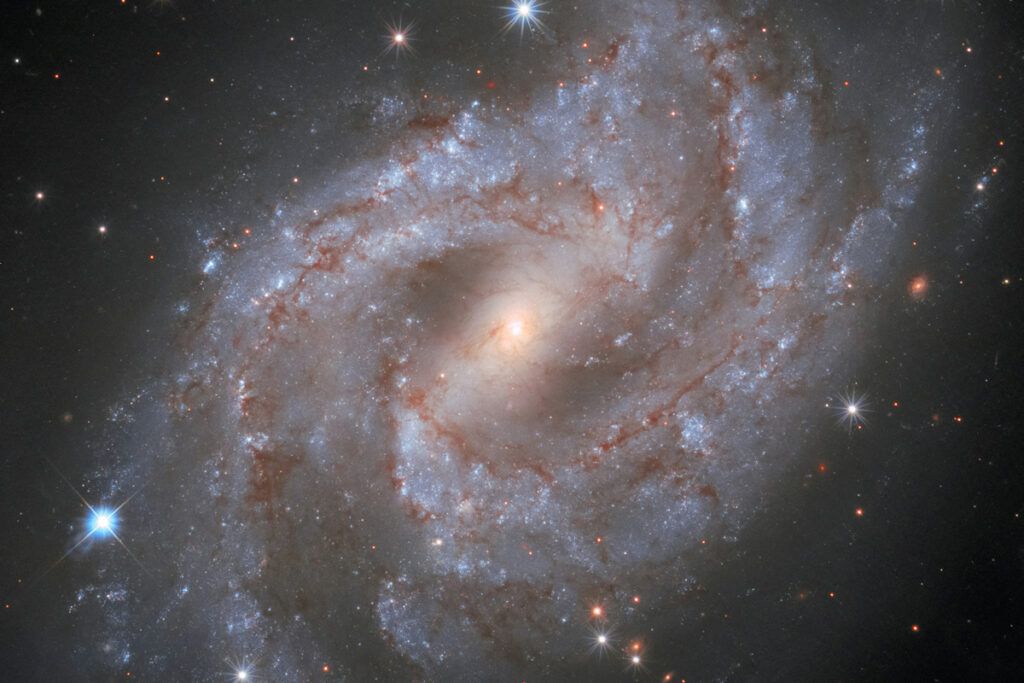
A supernova is so powerful that it can create heavier elements, such as gold, silver, and uranium. (Note that atoms with an atomic number of 104 or higher are known as superheavy elements, and they’re all synthetic. They never occur in nature, not even in a supernova.)
A supernova explosion sends all these newly made atoms careening into space. The drifting atoms, countless little specks, are not unlike dust, and some of this stardust clumps into balls to become asteroids, moons, and planets. New stars also form, but this time with sprinklings of heavy elements as opposed to just light elements. This is how astronomers can figure out how old a star is: A star with almost no heavy elements at all is ancient, but a star with more must have formed later.
Our sun is the latter kind of star, forming relatively recently — about 4.5 billion years ago. It amassed when the solar nebula — a spinning cloud of gas and dust containing hydrogen and helium left over from the big bang, along with material scattered by generations of dead stars — collapsed and flattened.
Earth and all the planets in our solar system formed at the same time, as smaller clumps from this same cosmic sandbox. The iron in your cookware, the salt you use to season food, and the oxygen and other heavy elements that make up your body all originated this way. So Carl Sagan was 100% accurate when he observed that “we’re made of star stuff.”