SCIENCE
Are You Safe if Lightning Hits Your Car?


Earth experiences roughly 8.6 million lightning strikes every day. And every day, at least 1.5 billion cars snake along the various highways and byways that crisscross the planet. You don’t need a calculator to do the math: It’s only a matter of time before the two collide in an incredible display of electromagnetism.
Conventional wisdom is that if you happen to be inside a car when it’s struck by lightning, you’re inherently safe thanks to the vehicle’s rubber tires. That’s not entirely the case, though, as rubber only acts as an electrical insulator for low voltages, and lightning is anything but. A typical lightning strike delivers roughly 300 million volts (a standard electrical outlet, by comparison, delivers 120 volts).
With such high voltages, tires alone won’t protect you in a lightning strike — they likely won’t even survive themselves. Lightning can raise the temperature of surrounding air by as much as 50,000 degrees Fahrenheit — more than five times as hot as the surface of the sun — sometimes causing car tires to explode.
But even if that happens, you may be just fine sitting inside your vehicle. Here’s why.
A Metal Shield
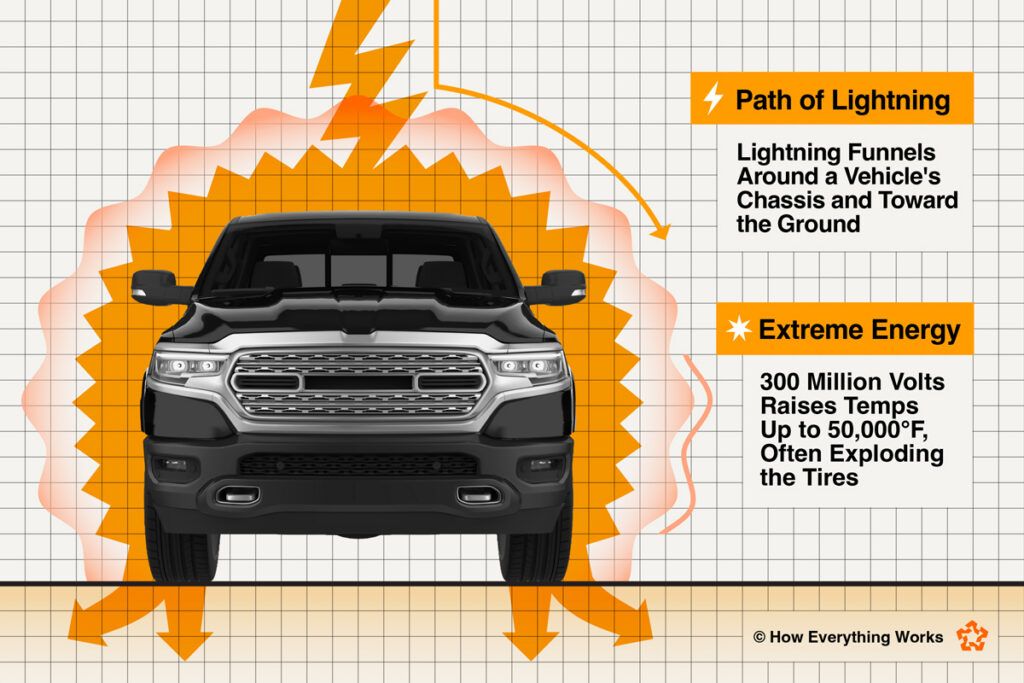
Because lightning is attracted to the tallest metal objects in the vicinity, cars are basically big fat lightning rods, so it wouldn’t be a total shock if a vehicle was struck. (Well, it would in one sense.) But cars are also sort of like a Faraday cage on wheels — and this offers some protection.
Named after English physicist Michael Faraday in the early 1800s, a Faraday cage is a fully enclosed box made from an electrically conductive material. This material allows a Faraday cage to isolate what’s inside from electromagnetic radiation outside of it. You may carry a small Faraday cage in your pocket — it’s how anti-theft sleeves block thieves from remotely scanning your credit cards or cloning your key fob. Free electrons in the outer shell of a Faraday cage create an electromagnetic field that essentially cancels out other fields.
So when lightning strikes a vehicle, it’s the metal chassis of the car — not its rubber tires — that funnels the energy away from the cabin to the ground, protecting the passengers inside. (Technically, a car is only similar to a Faraday cage because it still has openings in the metal chassis, such as the windows, which allow other forms of electromagnetic radiation inside. That’s why your phone still gets a signal even when you’re driving inside a metal box.)
This effect provides some protection, but it certainly doesn’t mean you should go barreling into severe lightning storms on a whim. While the people inside the car may not get electrocuted, a lightning strike can still fry onboard electronics. The antenna may melt, the windows may shatter, and fires can break out. And there’s also the whole exploding tires problem.
And of course, this chassis-based shield only applies to fully enclosed vehicles — meaning motorcycles, bikes, or convertibles do not share the same level of safety. That’s why it’s really important to remember that having rubber tires does not make your vehicle immune to lightning.
The metal chassis of a typical automobile creates a partial Faraday cage, meaning electricity from a lightning strike is directed around the body of the car and into the ground. While rubber tires are insulators for lower voltages, lightning, which produces voltages in the hundreds of millions, can explode tires and cause other damage to the vehicle, so you should take thunderstorms very seriously even when inside a car.
Short Answer