NATURE
Is Fog Really Just a Cloud?


Much like alligators and crocodiles or yams and sweet potatoes, it can be hard to discern fog from clouds by appearance alone. Sure, fog hovers close to the ground while clouds soar overhead, but the two look strikingly similar. This raises the question: Is fog just what we call a cloud that’s at a lower elevation, or are they two distinct phenomena?
You might reply that you haven’t the foggiest idea. But unlike the weather in question, the answer is rather clear.
How Do Clouds and Fog Form?

Clouds and fog form the same way, and it’s connected to something you may find on your weather app: the dew point. You can’t always see it, but the atmosphere holds a lot of invisible moisture — a gas form of water known as vapor. It can only hold so much, though, depending on air pressure and temperature.
When either or both of those change, the air can no longer contain the vapor, and the vapor turns to either liquid or ice crystals. The temperature at which this critical mass is reached is called the dew point.
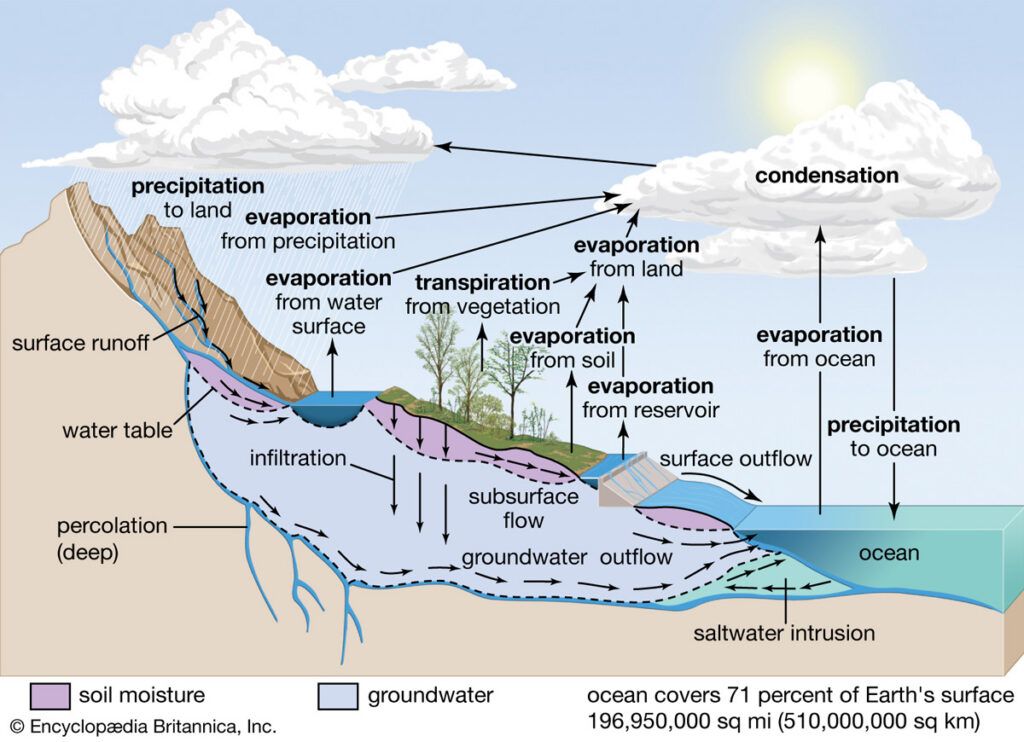
Also in the atmosphere are countless tiny particles floating in the sky — such as dust, salt, smog, and other biological specks. When vapor turns to liquid — a process called condensation — the droplets form around these particles.
It’s no different from what occurs around a can of soda: The cold metal disrupts the air’s ability to hold its moisture and the vapor condenses into droplets that form on the surface of the can. (When the can is warm, no condensation occurs, since it’s not messing with the air around it.)
As individual droplets or crystals condense around particles in the sky, they clump together. This results in dense visual moisture that takes the form of fog or clouds, which may be thin or as thick as pea soup.
You Must Be This High To Become a Cloud
This phenomenon can happen at ground level (fog) or high in the sky (clouds). In fact, the only difference between fog and a cloud is the altitude at which it forms. The National Weather Service defines visible moisture as fog if it starts lower than 50 feet above the ground, while anything at a higher elevation is considered a cloud.
Think of it as the meteorological equivalent of having to be 4 feet tall or above to ride a roller coaster at an amusement park. Anything that doesn’t make the altitude cutoff doesn’t get to be a cloud and is relegated to fog status instead.
Generally, for fog to form the weather needs to be notably humid with lots of water vapor in the air. And just as there are different kinds of clouds, several types of fog can form, depending on weather conditions. Radiation fog, which is not as hazardous as it sounds, occurs when heat radiates off the ground. Radiation fog is common and usually happens overnight, since that’s when the ground is giving off the heat it absorbed during the day.
There’s also valley fog, which forms when cold air settles into a valley while warm air remains overhead. Coastal fog is another type when moist air comes off the water and passes over cooler terrain. As for clouds, they can form as high as 12 miles above sea level and consist of water vapor evaporated from oceans, rivers, lakes, and other water sources.
High Density Means Low Visibility
Clouds and fog can be made of billions of droplets — up to 300 per cubic centimeter. Most of that space is air, though, as one droplet is just 10 microns in diameter. A micron is one-millionth of a meter — in other words, you could line up 1,900 individual droplets across a single penny.
The more droplets per cubic centimeter, the more dense the cloud or fog. The more dense they are, the harder it is for light to pass through them, which is why they reduce visibility. When visibility is under 100 meters (around 328 feet), it’s considered dense fog, and you really want to slow down if you have to drive through it.
Mist, on the other hand, is far less dense than fog or clouds — it can reduce visibility, but only down to 1 kilometer (0.62 miles). For pilots, this can be rough, but it’s generally not a concern for drivers. Since it’s less dense, it also clears up faster than fog. Because of this, mist is considered distinct from fog and clouds.
So the next time you see someone acting dense or with their head in the clouds, consider the altitude. They may really have their head in the fog.
Fog and clouds are both created when water vapor condenses or freezes into tiny droplets or crystals that bind to floating particles such as dust. This forms visible moisture we know as either fog or clouds, and the only difference between the two is altitude. If it’s lower than 50 feet above the ground, it’s fog, while anything formed at a higher elevation is considered to be a cloud.
Short Answer