NATURE
How Do Birds Know Where to Migrate?


Humans get around using road signs and GPS, yet we still regularly get lost just trying to find our cars in the parking lot. Meanwhile, birds travel for thousands of miles across continents and oceans and return to where they came from, all without writing down any directions. Many young birds even make their first migration without a parent showing them the route. How do they do it?
Well, bird brains have evolved several different methods to traverse the skies — adding up to a navigational toolkit that the GPS on your phone can only dream of.
Finding Their Way
Migration is no easy feat — it takes days or weeks, can cover vast portions of the globe, and continues through darkness, clouds, storms, and shifting winds. No one sense or source of information is reliable under all those conditions.
That’s why birds have figured out an eclectic collection of navigational tools. Some appear to be instinctive, while others are learned through experience or picked up from fellow travelers. While scientists are still sorting out how all the parts work, together these abilities provide something like a map, as well as a sophisticated compass to follow.
In some cases, birds seem to be born with inherited instructions. According to the “clock-and-compass” theory that scientists have developed, a first-time migrating bird instinctively knows what direction and approximate length of time to fly.
In effect, the bird is running an internal program — call it “Tweet-PS” — telling it something like, “Head southwest for seven days.” This can guide a juvenile bird even if it has never been outside its neighborhood and has no parent leading the way — the unaccompanied minors of the avian kingdom.
As they make their journey, birds also likely consult several natural compasses. This is similar to how (human) sailors navigated for thousands of years. During the day, they can use the sun’s position, adjusting for its movement across the sky in combination with their own circadian rhythms.
At night, they can orient themselves with the stars. Rather than memorizing a celestial map, young birds seem to observe how the stars rotate, which teaches them which way is north and which is south.
Amazingly enough, birds can also detect Earth’s magnetic field, though scientists aren’t entirely sure how they do it. One long-standing theory that a naturally magnetic mineral found in their beaks does the job has been debunked, although the mineral, which is present, may play a role elsewhere in their bodies and is still being studied.
Another major theory suggests that light-sensitive proteins in bird eyes allow them to perceive the direction of the magnetic field as a visual cue. Scientists are still working out exactly how these mechanisms work, but experiments clearly show that altering the magnetic field around a bird can send it flying in the wrong direction.
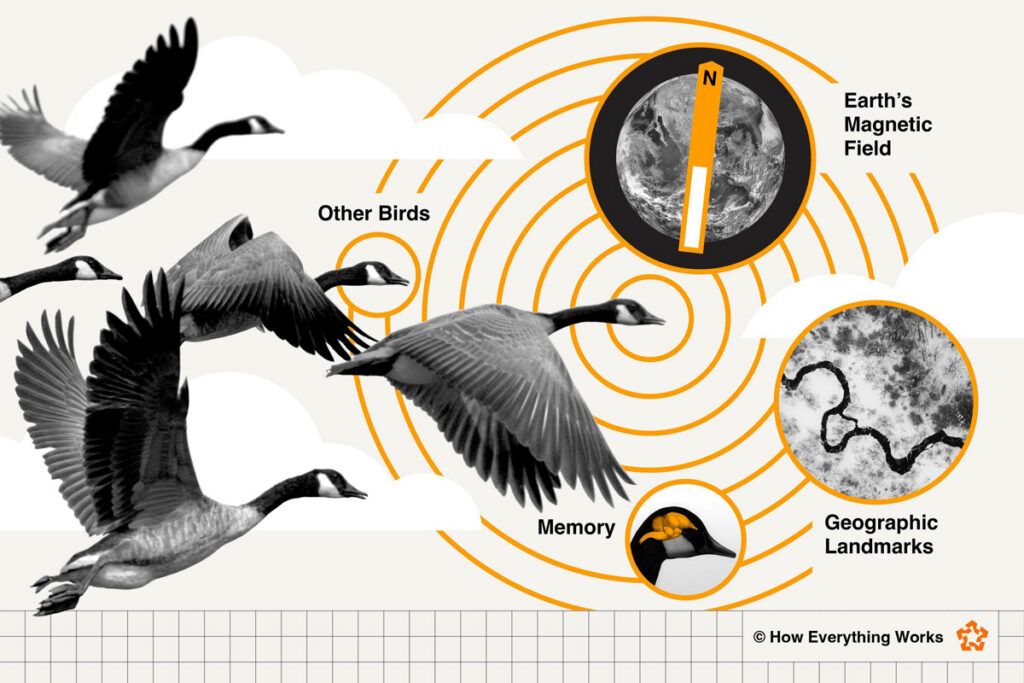
Once birds have reached familiar territory, landmarks may also help guide them. Remember a time before GPS when you’d find your in-laws by counting traffic lights and making a left at the 7-Eleven? Birds may do the same, but with rivers, coastlines, mountain ridges, and valleys, which can all serve as markers.
Smell may provide another kind of navigation tool: Seabirds can use odor to find breeding colonies on the open ocean, while other species learn how characteristic scents (from a particular field or forest, say) become stronger or weaker in different directions.
In effect, the birds seem to travel using a kind of odor-based map. It would be like you trying to find that new Italian restaurant everyone’s been talking about by rolling down your window and following the smell of lasagna.
Experience makes this whole system more effective. Adult birds can recognize when they’re off course and adjust their route accordingly, suggesting that they gradually develop a more detailed mental map. Some species also learn through social cues from their flock.
Exactly how birds combine and prioritize all these cues as they travel remains something of a mystery. Different species may favor different systems, and an individual bird may switch methods as conditions dictate. (Using the sun won’t do much good on a cloudy day.)
Rather than possessing one flawless internal GPS, migrating birds navigate by constantly comparing a suite of senses — and learning a little more with every journey.
Birds are born with some navigational instincts that they then combine with cues from the sun, stars, Earth’s magnetic field, physical landmarks, and smells. Some species also learn routes by following other birds in their flock. Scientists are still unclear on how birds mix and match all these tools, though. As birds gain experience, they develop more detailed mental maps that help them correct mistakes and refine their routes.
Short Answer