ENGINEERING
How Do Boomerangs Always Come Back?


Throw a baseball or your dog’s favorite fetch toy, and it lands wherever your arm sends it. Give it your all with a boomerang, though, and watch it sail right back into your hand, as if it changed its mind mid-flight.
Unlike its path, a boomerang’s mechanics are fairly straightforward. In fact, its design provides the same aerodynamics that keep an airplane aloft.
Return Flight

The first boomerangs didn’t boomerang back at all. Called kylies, early boomerangs were heavy, straight-flying hunting weapons built to strike prey with force. The returning version we recognize today was likely an accidental offshoot, refined over time by Australian Aboriginal peoples who found that lighter, curved variants were useful for sport, recreation, and mimicking predatory hawks to flush birds into nets.
The shape of a kylie originally intended to fly in only one direction was likely off in such a way that — to the surprise of the thrower — that the item came back. Take a close look at the arms of a modern boomerang. You’ll notice they’re shaped a lot like airplane wings: flat on one side, curved on the other. That’s not a design flourish — it’s an airfoil, and the reason a boomerang flies instead of tumbling to the ground like a poorly folded paper airplane.
As a boomerang spins through the air, its curved shape forces air to move faster over the top of each arm than underneath it. Faster-moving air means lower pressure pressing down, so the arm gets pushed upward. It’s the same basic principle that keeps a 747 aloft. That upward push is lift, and a well-thrown boomerang generates it on both arms as it spins.
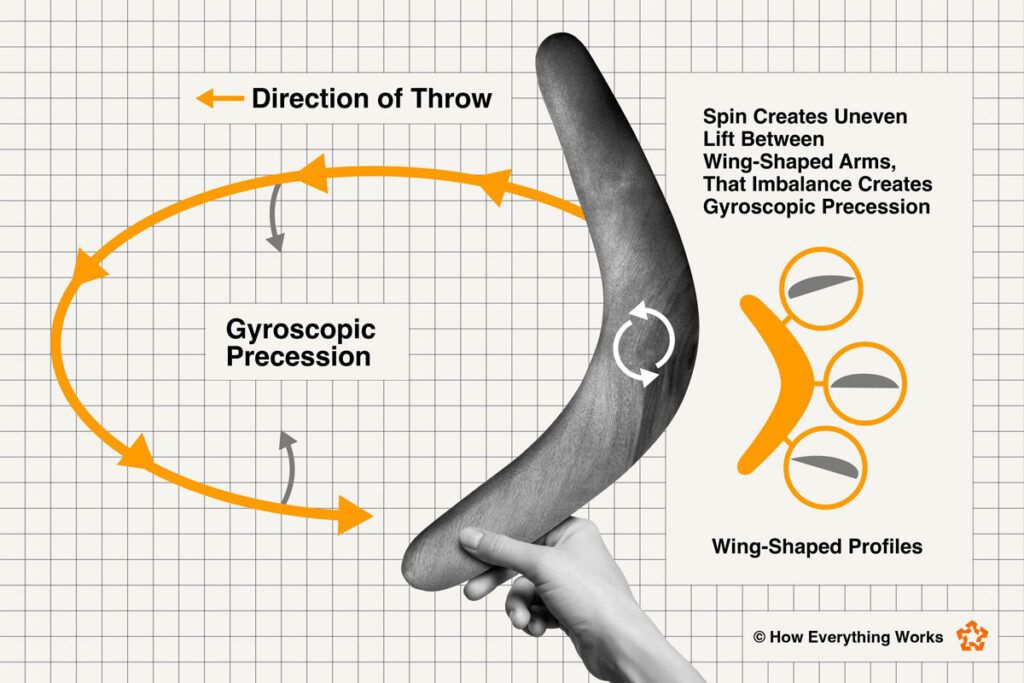
Here’s where it gets interesting: Because the boomerang is spinning rapidly while also flying forward, lift isn’t distributed evenly. One arm is swinging in the same direction as the throw, so it’s moving fast, while the other arm is swinging against the throw, so it’s moving slower. The faster arm generates more lift than the slower one.
You might expect that imbalance to tip the boomerang over. Instead, a phenomenon called gyroscopic precession redirects it into a turn, where a force applied in one direction ends up shifting the object’s motion 90 degrees away. (Just like a spinning top.) The result is a flight path that curves instead of running straight. Rather than changing direction mid-flight, the boomerang is really coming back toward you the entire time — assuming you throw it correctly, that is.
A few factors need to line up for a successful boomerang throw. First, you have to throw it vertically, not flat like a Frisbee, so the loop it traces curves back toward you. It also needs enough spin to stay stable. Without significant force, it’ll fly off in a lopsided arc instead of a clean circle.
If that were to happen, a boomerang’s path would be even more surprising — at least it would be to the unsuspecting person in the park you’ve just accidentally clobbered with it.
A boomerang comes back because it’s spinning fast while also flying forward. That spin creates uneven lift between its two wing-shaped arms, with one always moving faster through the air than the other. Instead of tipping the boomerang over, that imbalance triggers gyroscopic precession, which slowly rotates the whole spin axis and bends the flight path into a curve. Thrown at the right angle and spin speed, that curve loops all the way back around to where it started.
Short Answer