NATURE
How Do Cats Always Land on Their Feet?
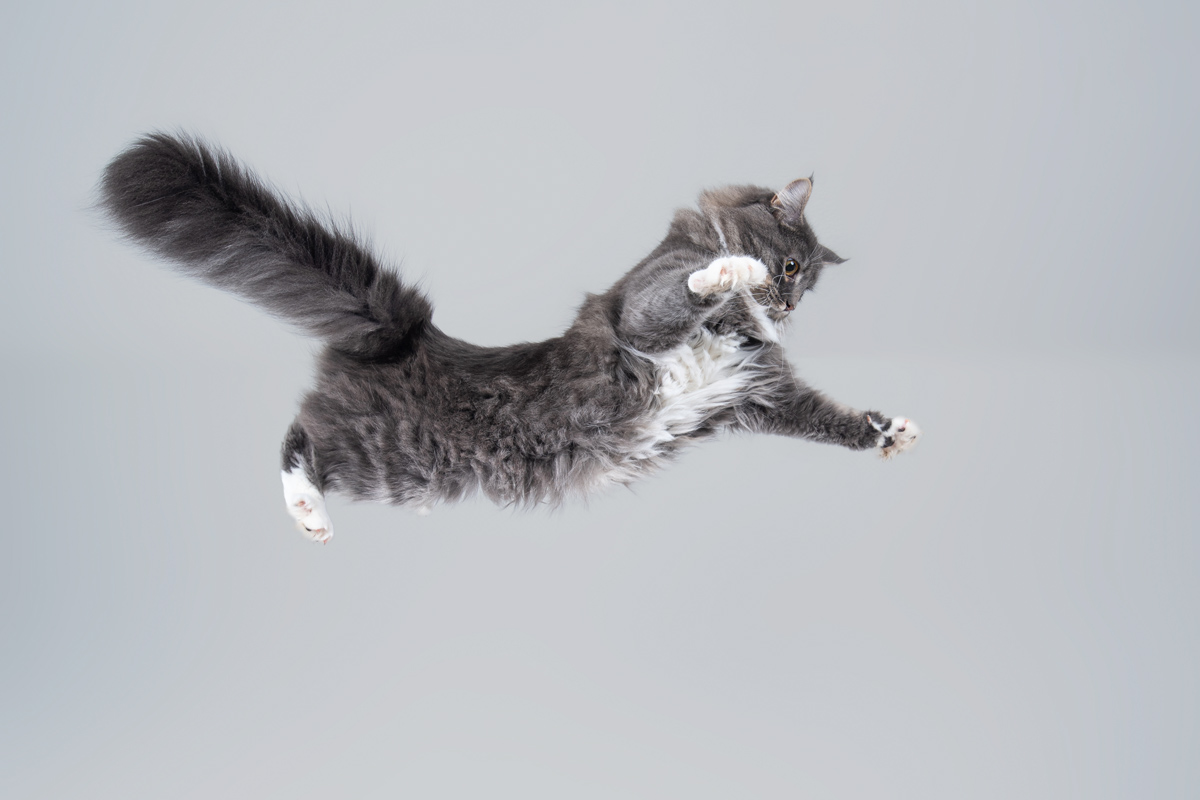

If you’ve ever lived with a cat, you know they’re little acrobats. Our feline companions are supernaturally fast, agile, and capable of jumping 8 feet vertically from a standing position. This means that nowhere in your house is off-limits, including odd places like the top of the fridge.
The downside of a cat’s passion for bird’s-eye perches is that they occasionally (okay, maybe more than occasionally) get spooked and fall. But no matter how high the drop, a cat almost always lands on its feet — even when it starts off upside down.
So how do cats always stick their landing? It’s not luck.
Raining Cats and Cats
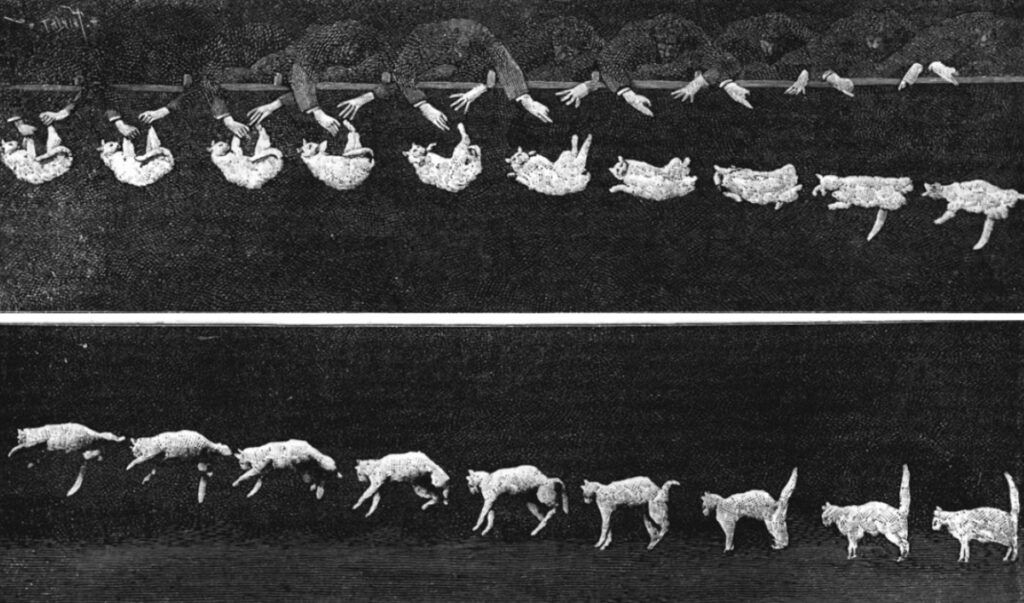
A cat’s ability to seemingly defy Newtonian physics has beguiled scientists since the 1700s. Academia’s fascination with felines hit a fever pitch in the 19th century, when physicists in universities the world over began tossing cats through windows to watch them land.
Now, we definitely do not recommend you try this with your furry friend at home. But the strange university pastime did lead to a scientific breakthrough in 1894, when physiologist Étienne-Jules Marey utilized a brand-new technology to find out how cats almost always land on their feet.
Chronophotography, a precursor to motion pictures, allowed Marey to photograph cats falling upside down at 12 frames per second. The photos showed (rightfully) angry felines contorting their bodies midair to right themselves before landing. Marey concluded that cats quickly coupled the inertia of their own body mass with a midair twisting motion to flip themselves right side up before hitting the ground.
Before Marey’s experiment, many scientists believed that cats used ledges, tree branches, or human hands as fulcrums to generate the momentum needed to land on their feet. You’ve seen similar acrobatics at play during the Olympics, where gymnasts swing around bars, flip midair, and land on their feet like it’s nothing.
But Marey’s photos disproved the fulcrum theory and showed that a falling cat is able to move its forelimbs and hind legs in opposing directions to generate a twisting motion rather than use any leverage.
Twist and Shout (er… Meow?)
More than a century later, Japanese researchers from Yamaguchi University’s Laboratory of Veterinary Physiology and Biochemistry studied the properties of feline spines and proved Marey correct. Using deceased cats, researchers subjected the upper (thoracic) and lower (lumbar) regions to mechanical tests measuring strength, flexibility, and rotational capabilities.
Simultaneously, they filmed live cats dropping from low heights onto soft cushions using high-speed cameras — a modern-day take on Marey’s chronophotography experiments. The results showed that a cat’s upper trunk is far more flexible than its lumbar region — and those regions can move independently.
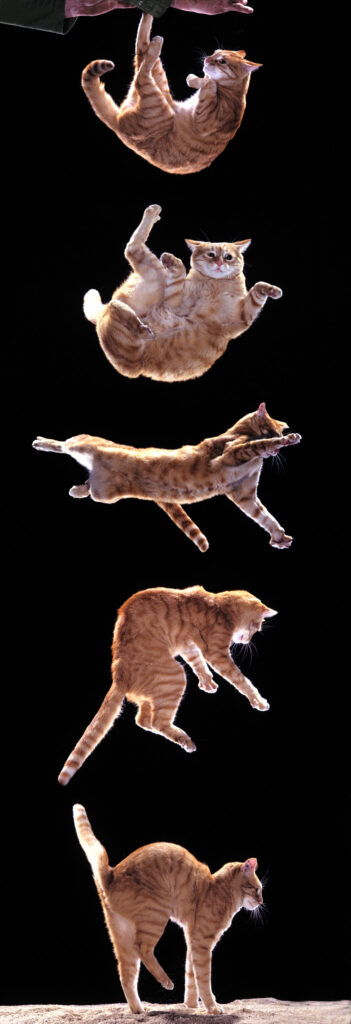
Slow-motion footage revealed that a falling feline will first reorient its head and forelimbs via its flexible upper trunk. Once the cat’s forelimbs are pointing down, the less flexible lumbar region will follow suit, righting the body. And voila, our angry tabby lands on its feet like nothing happened.
Another study found that cats falling from greater distances would, once reaching a terminal velocity of around 62 mph, relax and spread out their bodies to soften the impact. Since it takes falling about five stories to reach that speed, cats actually land more safely when falling from, say, a seven-story drop than a three-story one, since they have more time to prepare. One cat in the study even managed a 32-story drop with little more than a chipped tooth.
So if you get nervous seeing your cat perched on a tall banister or appliance, you can relax. Consider it a leap of faith in your cat’s own anatomy.
The upper and lower regions of a cat’s spine can twist in opposite directions. When a cat falls, its more flexible upper (thoracic) region twists first, positioning the forelimbs toward the ground. Then its lower (lumbar) region follows suit, allowing the cat to land purrrfectly on all fours.
Short Answer