TECHNOLOGY
How Do Noise-Canceling Headphones Block Sound?

The world is loud, and we’ve gotten very good at tuning it out. Enter the multibillion-dollar industry of noise-canceling headphones and earbuds. While they were initially used by the military and commercial pilots, active noise-canceling (ANC) headphones have become a popular choice for everyday users listening to music or podcasts.
Capable of turning chaos to calm with the tap of a button, these devices don’t just provide sound but eliminate the ambient noise around you so you can better hear what they’re playing. Ironically, ANC headphones actually do this by creating more sound.
Fighting Acoustic Fire With Acoustic Fire
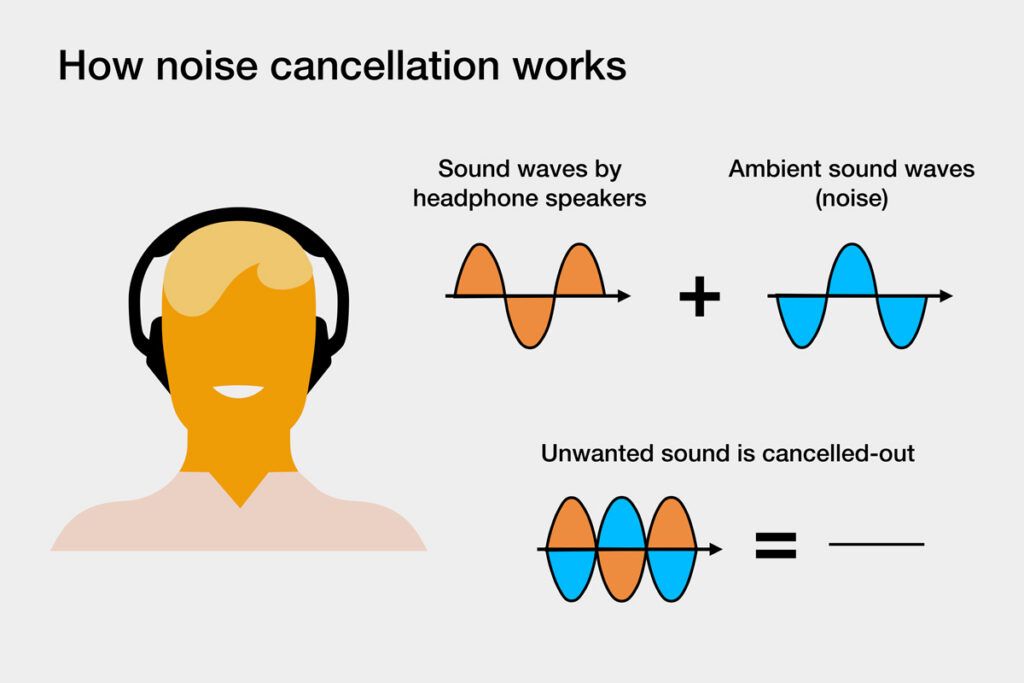
The key piece of modern active noise-canceling headphones is the “active” part. Unlike standard (aka passive noise-canceling) headphones that simply create a physical barrier between the ear and external noise, ANC headphones use battery power, signal processing, software, and miniature microphones to actively counteract unwanted sound.
They do this by essentially creating a second sound wave that is 180 degrees out of phase with the sound wave of the unwanted noise; in other words, one sound wave’s highest point matches the other’s lowest. The reverse amplitude of this produced sound wave cancels out the external sound in a process called destructive interference, leaving behind peaceful silence (or a very close approximation).

The most common method of ANC is known as “feedforward,” in which microphones on the outside of the earcup process external sound before sending the out-of-phase, noise-canceling signal to the earcup. Feedback ANC, on the other hand, uses microphones placed inside the earcups that process sound, and can then adjust to a broader range of frequencies, though this is less effective in higher ranges. Because both types have advantages and disadvantages, companies now sell “hybrid ANC” versions that offer the best of both worlds.
Of course, processing these signals takes time and it’s a big part of the reason noise-canceling headphones work best at zeroing out predictable, low-frequency sounds, such as the hum of an airplane, rather than sudden, high-frequency sounds like a baby crying. So while ANC headphones help lower the volume on the world around us, they can’t silence it completely.
Active noise-canceling (ANC) headphones eliminate background noise for the wearer by producing their own sound, an out-of-phase soundwave that is exactly the opposite of incoming audio. This cancels out that ambient sound, leaving nothing but silence or whatever you’re playing through your headphones.
Short Answer