CULTURE
The Rules of Roman Numerals
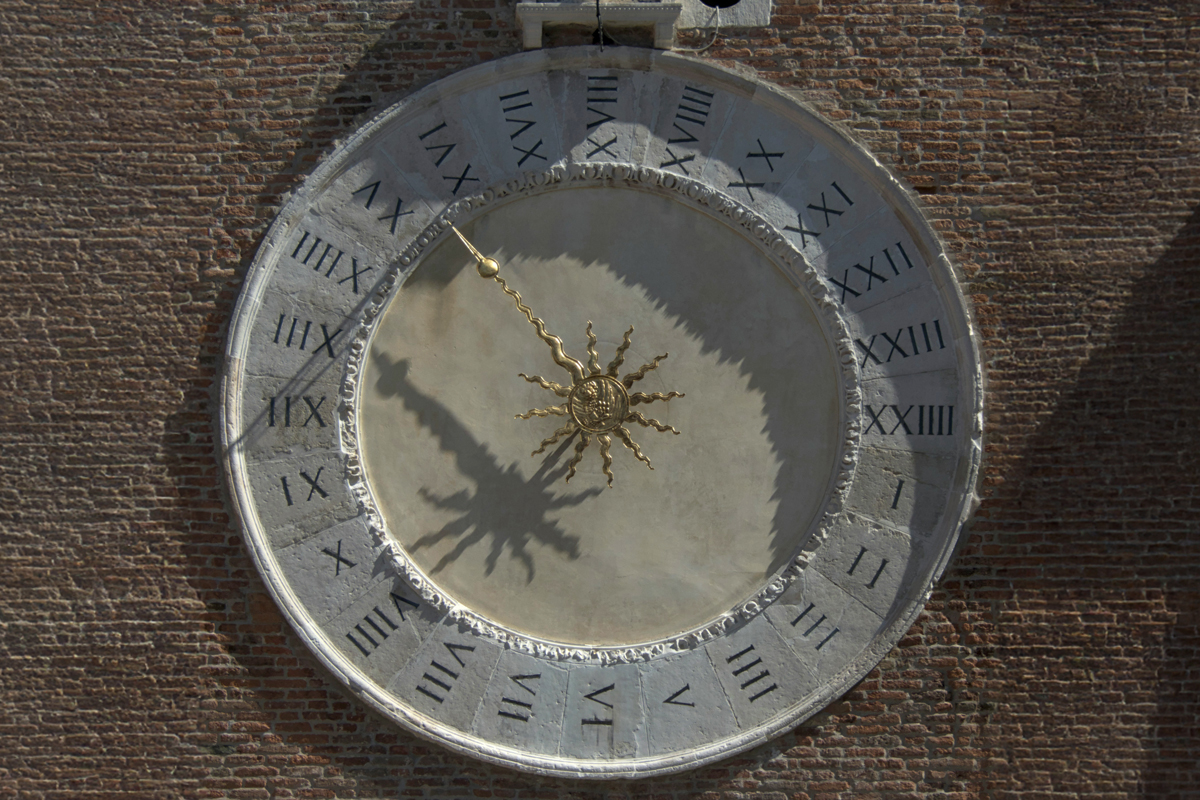

If you’ve ever watched the Super Bowl or read a movie’s copyright during the credits, you may have wondered why Roman numerals are, in fact, letters. The symbols used by ancient Rome didn’t actually start out as letters, though.
Instead, they were distinct symbols, borrowed from the numerical system used by the Etruscans, who lived in Italy before the Romans, around the fifth century BCE. Over time, these symbols changed shape to fit the letters of the Latin alphabet.
Here, we go letter by letter — in alphabetical order — to explore how every Roman numeral got its shape, and how the Romans used these numerals to count.

C
The Roman numeral C has a value of 100. It stands for centum, the Latin word for 100 and the root of words such as “century” and “percent.”
D
The numeral D has a value of 500. Romans initially used a circle with a vertical line through it to represent 1,000. It’s believed that D was used for 500 because that’s what you get when you cut that symbol in half.
I
The numeral I has a value of one. There are two theories as to why ancient Romans used the letter I to represent the number one. The first is about as simple as you can get, positing that a single I represents a person holding up one finger.
The second theory, meanwhile, involves sheep, with shepherds and farmers using tally marks to count their livestock, such as sheep. In this case, the I simply represents a single tally mark, just as it does in traditional tally systems used today.
L
The numeral L has a value of 50. It evolved from the original symbol for 50, which looked like a trident before it was simplified into an upside-down T and eventually an uppercase L.
M
The numeral M has a value of 1,000. Some sources say that the M evolved from a similar-looking symbol originally used for the value. Others, however, believe that — like C — it’s an initial of sorts, and stands for mille, the Latin word for 1,000.
V
The numeral V has a value of 5. The same two theories behind the origin of the numeral I also explain where V comes from. Hold up one finger and it resembles an I. Now hold up five fingers. With your palm facing outward, the space between the thumb and index finger resembles a V, which is much simpler than drawing an entire hand.
The V represents the number five in the farmers’ tally system because every fifth sheep counted was denoted with a half-notch branching from a full notch — not unlike the modern tally system of a line drawn through four notches to represent five.
X
The numeral X has a value of 10, which may also relate to the fingers on the hands. If holding up one finger is I and holding up one palm becomes a V, holding up two palms — 10 fingers — comes to represent 10. The X represents the criss-cross of the two thumbs when both palms are spread.
As for the tally system, an X representing the 10th sheep could be the shape formed by a second full tally mark slashing through the first.
The Rules of Roman Numerals
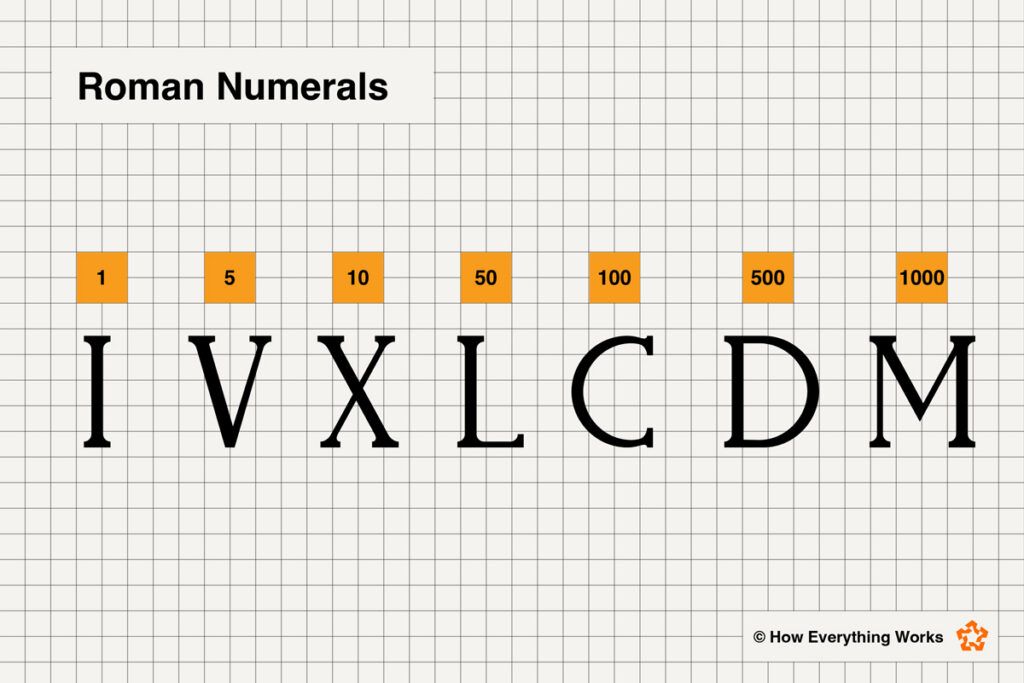
Of course, the best way to think about the values of Roman numerals probably isn’t in alphabetical order, but rather by increasing value. A mnemonic device often used for this purpose is “I Value Xylophones Like Cows Do Milk.” Nonsensical, sure, but effective. Now here are the basic rules.
Numbers are read left to right, just like the alphabet. This was a big change from the Etruscan system that the Romans had adopted, which read from right to left. If a bigger numeral is followed by a smaller numeral, you read them by adding them together. For example, VIII equals eight because you have one larger number (V, which equals five) followed by three smaller numbers (I, which adds up to three when repeated three times).
Conversely, if a smaller numeral is followed by a larger numeral, you subtract the smaller number from the larger number. For example, IV equals four because you subtract I (one) from V (five).
Numerals can only repeat sequentially up to three times, with limited exceptions. For example, III equals three, but you don’t write four using four tally marks. Instead, you write it as IV. Ancient Romans didn’t always follow this rule, though, in the same way the spelling of certain modern words would vary before dictionaries came along.
Advanced Rules and X-Ceptions
There are also rules stipulating which numerals can repeat or be used for subtraction. For one, V, L, and D can never be repeated — not even twice. If you want to write 15, it’s XV, not VVV.
Also, any numeral can be used for addition, but only I, X, and C are used for subtraction. For example, 95 isn’t written as VC, despite five subtracted from 100 equaling 95. Instead, 95 is written as XCV: 10 subtracted from 100, which is 90, plus another five. (You can see why we don’t use Roman numerals anymore.)
Finally, the numeral I can only be used to subtract from V and X, X to subtract from L or C, and C to subtract from D or M. In other words, IM is not used to represent 999, nor is VL used to represent 45.
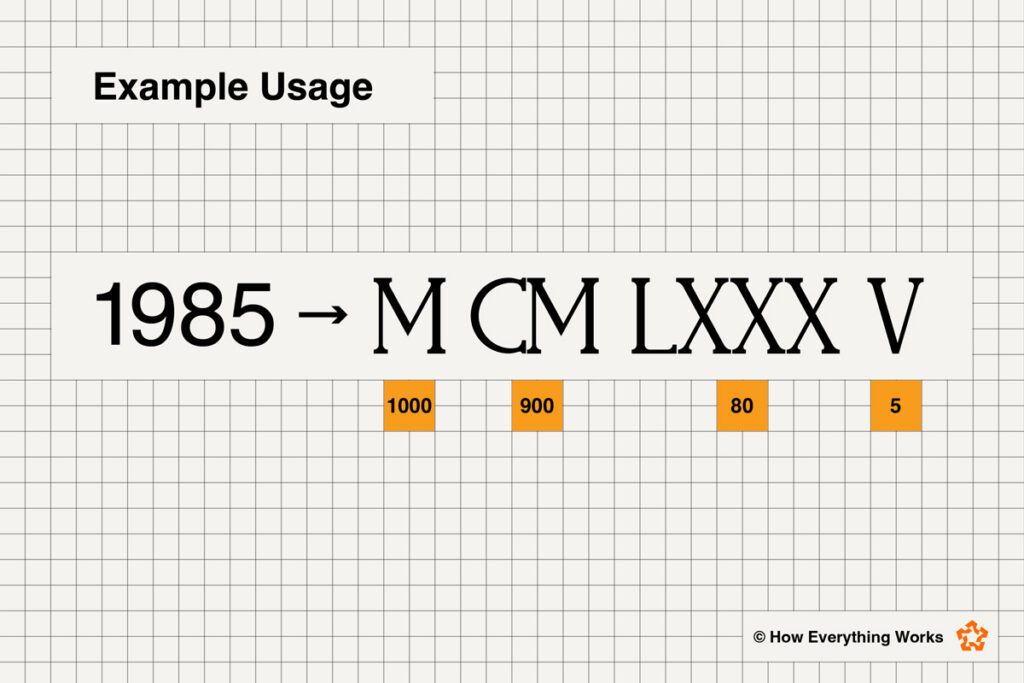
So, using these rules, if you want to write the year 1985 in Roman numerals, it’s MCMLXXXV: M (1,000) + CM (900) + L (50) + XXX (30) + V (five).
That’s already a lot more work (and space) than just writing 1985, but what if you wanted to write an even larger number? Using the standard rules, 3,999 is the highest value you can represent, but the system does allow for bigger numbers. If that number were between 4,000 and 4,999, you’d break the repetition rule and use four Ms in a row. For example, 4,325 is MMMMCCCXXV.
For any number over 4,999, you use the vinculum: a horizontal bar that, when placed over a numeral, multiplies it by 1,000. For example, placing a vinculum over V gives you 5,000.
To write 1 million, you’d place a vinculum over M (1,000 x 1,000). Even larger? To write 1 billion, you’d place a double vinculum, or two horizontal bars, over M. In other words, a double vinculum multiplies the value underneath it by 1 million. Ancient Romans were probably not counting to 1 trillion (that’s a lot of sheep), though if you really wanted to push it, you could add a third bar to multiply M by 1 billion.
There’s One Number You Can’t Write in Roman Numerals

There’s no symbol for zero. Some early civilizations, including ancient Greece, saw no need for zero as they didn’t use numerals to do math, but to participate in commerce and count items. If a Roman had none of something, they’d just say nulla, the Latin word for none.
By now, you’ve probably found multiple reasons it wouldn’t be practical to use Roman numerals today. But you do occasionally still see them in everyday life, such as on clockfaces and in titles, typically for aesthetic purposes. The Super Bowl, for instance, still commonly uses Roman numerals.
Yet, as always seems to be the case with Roman numerals, there are exceptions. Super Bowl 50 went with Arabic numerals over Super Bowl L — simply because it didn’t look right.