SCIENCE
The States of Matter, Explained


You are matter. So are your dog, your sofa, and the coffee in your mug. Unlike many concepts in physics, matter is a fairly simple one to wrap your head around — anything that takes up space and has mass is matter. That includes, well, pretty much everything aside from a few exceptions like forces (such as gravity) and energy (though energy can turn into matter).
All matter consists of atoms, which can bond together to form molecules and chemical compounds. Helium is made purely of helium atoms, but water is a molecular compound made of two hydrogen atoms bonded to one oxygen atom. Water is also the perfect example of how a molecular compound, which is matter, can change states to become different types of matter.
You likely know the big three: solid, liquid, and gas. But did you know there are actually four main naturally occurring types of matter — and possibly even a few others?
Solids
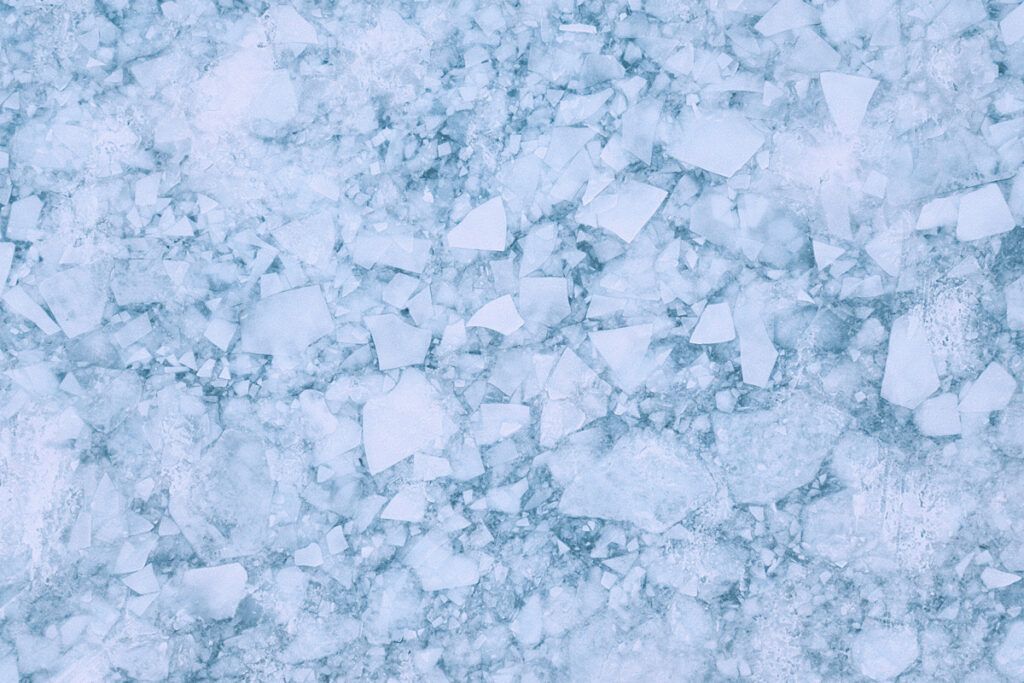
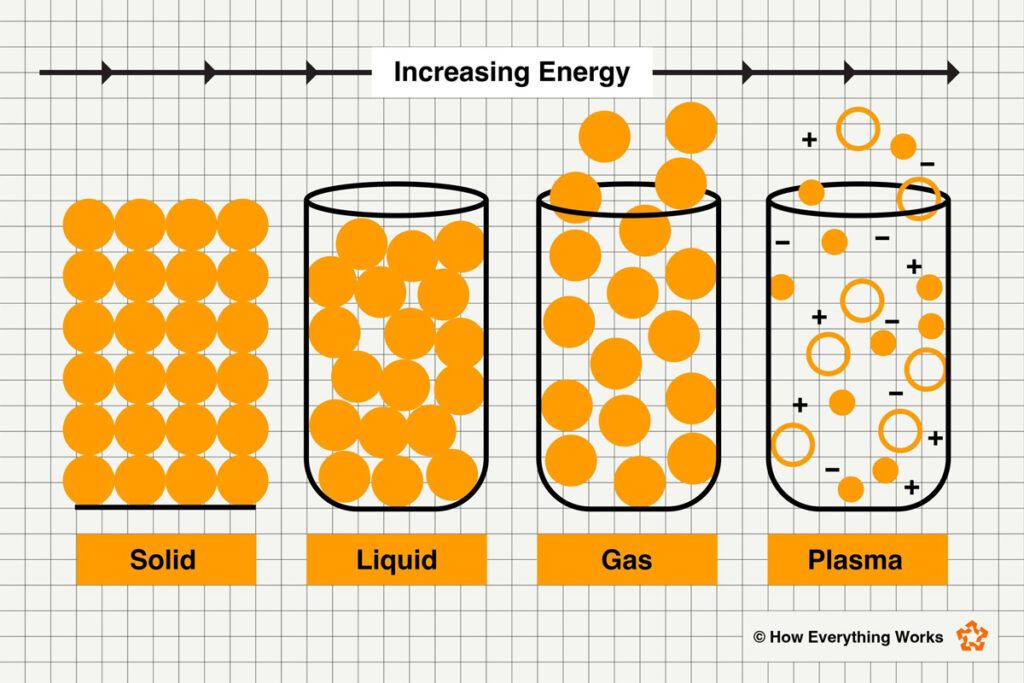
In a solid, atoms are packed tightly together and held firmly in place by their chemical bonds. They vibrate (which you can’t feel), but otherwise don’t move around. Solids have a defined shape, a fixed volume, and do not conform to containers they’re placed inside. They resist forces applied to them — for example, an intense wind won’t change the shape of a brick the way it would a cloud of smoke.
Water, typically a liquid, is a solid when it freezes to become ice. When you fill a glass with water, it takes the shape of the container, leaving no spaces under its surface. But fill a glass with ice cubes, and they’ll just sit there as is, with plenty of space between them — at least until they melt.
There are several types of solids. Crystalline atoms are arranged in a neat, repeating pattern. Metals and most minerals are crystalline. Conversely, noncrystalline or amorphous atoms are arranged with no pattern; glass, plastic, and gels are amorphous solids.
There are also quasicrystalline solids, such as aluminum-copper-cobalt and certain other metal alloys, whose atoms are arranged in patterns but do not repeat. Semicrystalline solids are a mix of both crystalline and noncrystalline compounds — they’re common in polymers and plastics, such as milk jugs or plastic bags.
Liquids

Liquid particles can flow around one another. They have a fixed volume, but no defined shape. So a glass of water will take the shape of any container you pour it into, but it’ll still be the exact same amount (unless you spill some). Water and most of the liquids you encounter on a regular basis such as oil or your morning OJ are ordinary liquids. But there are a few rarer substates.
Liquid crystal is one such type: Molecules flow freely like a liquid, but maintain an ordered orientation like a crystal. Think of how a school of fish are separate animals that still turn and swim as an orderly group, or a shaken box of toothpicks where the sticks slide past and over one another but are still neatly aligned.
Liquid crystal displays (LCDs), found in the screens of phones, TVs, and computer monitors, are the most common use of liquid crystals. A more fun example: mood rings. The liquid crystals inside change their structure, and thus the color they reflect, based on your skin’s temperature.
Other types of liquid include superfluids, which are rare liquids that flow with no friction or viscosity, meaning they can creep up a wall and through the tiniest cracks. That’s because their molecules are attracted to the container’s walls, allowing them to slowly climb up the sides somewhat like water climbing up a paper towel as it’s absorbed.
One example is liquid helium-4 when it’s been cooled to near absolute zero, which is commonly used to cool the magnets inside MRI machines. Supercritical fluids, another type of liquid, can be found in less dramatic settings — they’re commonly used for decaffeinating coffee and in other extraction processes. These types of liquids are heated and pressurized beyond their critical point, resulting in a substance with properties of both a liquid and a gas.
Gas
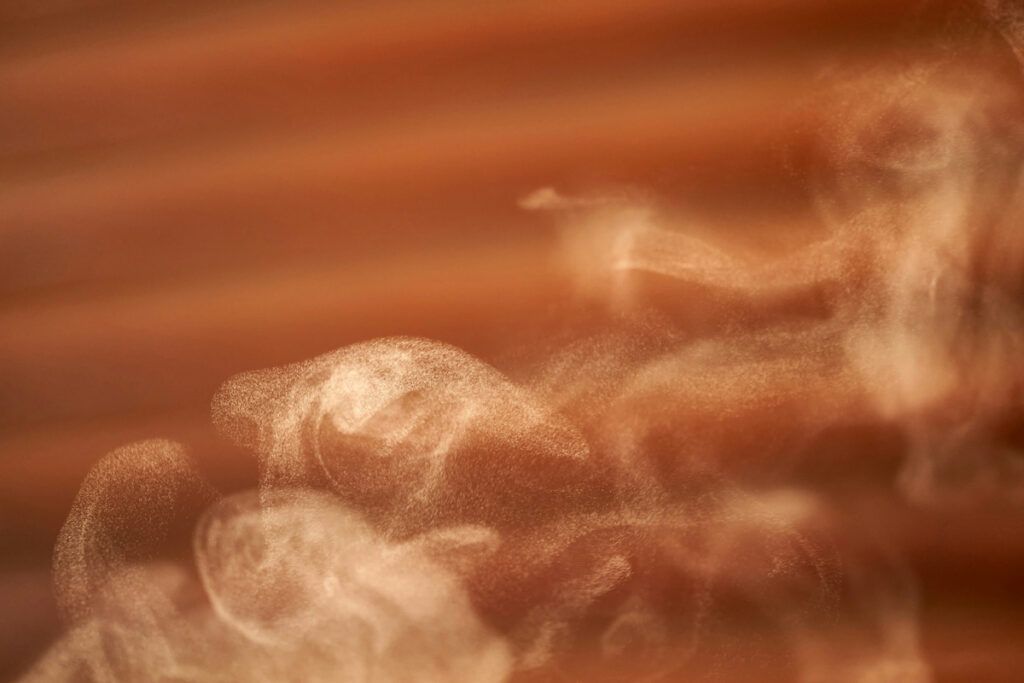
Like liquids, gases are considered fluids, due to the way they move. Yet gas particles are spread far apart and move independently of one another, so gas has no defined shape or fixed volume, and will expand to fill available space, the way air fills a room.
The air we breathe is a mixture of gases, about 78% nitrogen, 21% oxygen, and smaller amounts of argon, carbon dioxide, and others. A vapor refers to the gas phase of a substance that’s liquid at room temperature.
When liquid water evaporates or boils, it becomes water vapor, which — like many other gases — is invisible. Steam, on the other hand, is actually still a liquid, made of tiny water droplets floating in the air and reflecting light, which is why you can see it. In fact, the same goes for clouds, which are visible water droplets and not a gas.
Plasma
You may or may not have heard of plasma (not the kind that’s in your blood), but this fourth state of matter is actually very abundant in the universe, and you likely see it every single day (emphasis on “day”). Plasma isn’t a liquid, but it is a fluid — a mix of positively charged ions and free electrons that occurs when atoms are exposed to high amounts of energy, such as heat or electricity.
Like a gas, plasma will expand to fill a container. However, plasma can also conduct electricity and be influenced by magnetic fields, so it can also be contained without physical walls. Neon signs, for example, contain plasma formed by neon (or another gas) that are exposed to electricity. Most plasma isn’t human-made, though. Stars, including the sun, are made of plasma, as are lightning and the aurora borealis.
In cold or nonthermal plasma, electrons are hot, but ions and neutral atoms are cool. This is why you can still touch a neon light or plasma TV without getting burned. In hot (thermal) plasma, electrons, ions, and neutral particles are all hot, which is why you definitely wouldn’t want to touch lightning or the sun.
Bose-Einstein Condensate (BEC)
There are also states of matter that don’t fit these four categories and don’t occur in nature; instead, they’re created in a lab. Bose-Einstein Condensate (BEC) can be created by cooling gas atoms to almost absolute zero, the lowest theoretically possible temperature in the universe, where atomic motion mostly stops. (We’ve never actually been able to achieve absolute zero, hence it’s only theoretical.)
When atoms are this cold, they become indistinguishable as individual atoms and begin behaving as one “super-atom.” (Keep this in perspective the next time you’re frustrated your frozen veggies are stuck together.)
Three scientists won the 2001 Nobel Prize in Physics for successfully creating this state of matter in 1995, but it’s named for Indian physicist Satyendra Nath Bose and Albert Einstein, whose ideas led to the theory that it could exist. Bose-Einstein Condensate and its related research have led to advancements in a variety of scientific fields, including quantum computing.
Time Crystals
Perhaps the most unusual phase of matter is the time crystal. This is a pretty weird one. Essentially, it’s a state where crystals repeat patterns not through space, but over time. They do this by vibrating at very specific frequencies. In theory, a time crystal could keep repeating its pattern without ever wearing out. But this state of matter isn’t just theoretical — researchers created the first time crystal in 2016.
Though still very much in the research phase, time crystals could have applications in precise timekeeping and quantum computing, especially if they really can last forever without losing energy.
Antimatter
Antimatter both is and isn’t a state of matter. That’s because it’s nearly the same as matter in every way — except the opposite. Antimatter is made of atoms, which in turn are made of subatomic particles, but they have the opposite charge of matter.
Hydrogen is typically a positive nucleus surrounded by a negative electron, but antihydrogen (yep, that’s what it’s called) has a negative nucleus surrounded by positively charged electrons (called positrons). Nearly every type of subatomic particle, including protons, neutrons, and quarks, has an anti-twin counterpart. Antihydrogen and antihelium are, indeed, antielements. It’s the soap opera cliche of the evil twin, come to life — all that’s missing is the eyepatch.
When matter and antimatter collide, they annihilate (again, that’s the scientific term) one another, atom by atom. Variations of the big-bang theory propose that both matter and antimatter were abundant mere seconds after the big bang, but immediately began colliding with and annihilating each other, particle by particle.
The two substances cancel each other out equally, but because there was an ever-so-slightly greater amount of matter than antimatter, the leftover surviving matter is what became our universe — including all of the solids, liquids, gases, plasmas, and yes, even time crystals we have today.