SCIENCE
Why Do Wheels Sometimes Look Like They’re Spinning Backwards?
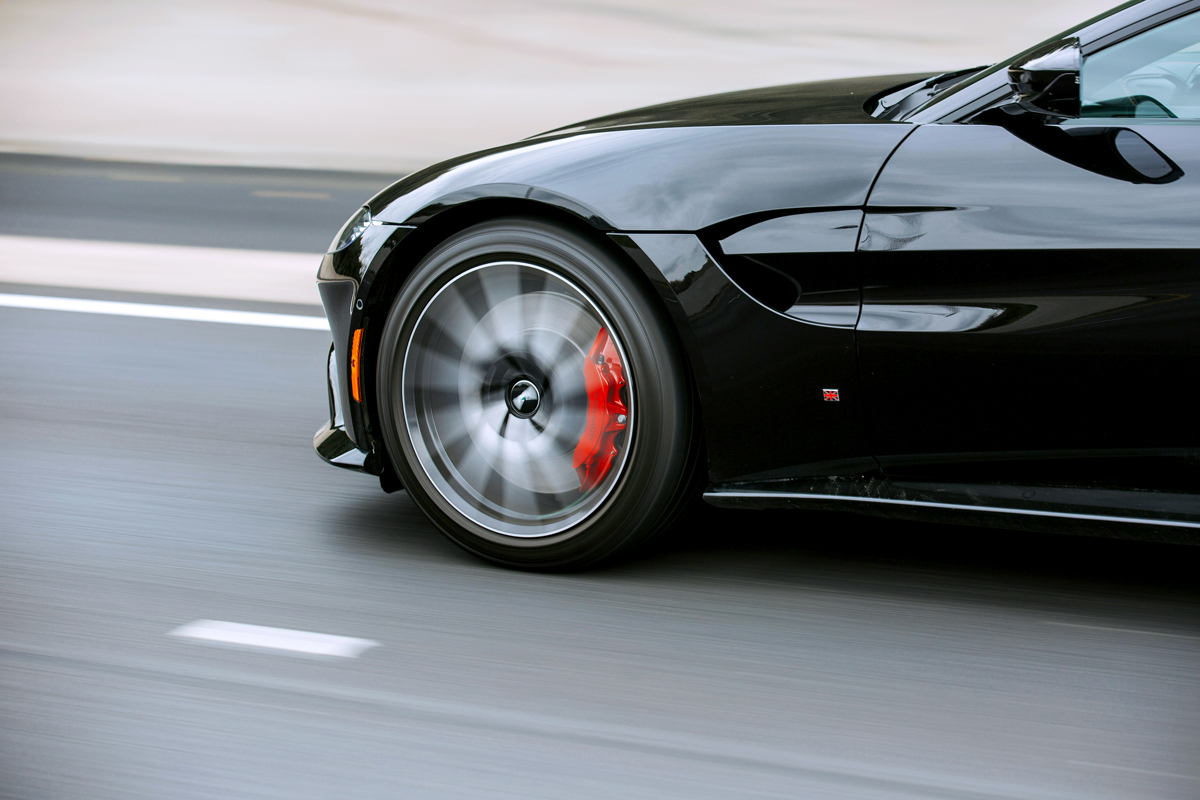

You’ve heard of the five basic senses: sight, hearing, smell, taste, and touch. But the way we perceive the world around us is more complicated than that. Every day your brain is constantly interpreting the physical inputs these senses take in. It uses that information to form a “controlled hallucination” that, in a sense, constitutes the reality we live in.
But despite the immense sophistication of the brain and its ability to dictate what is real, sometimes that hallucination breaks down. How your brain may interpret a given sense can be incorrect, feeding you misinformation. When the sense is sight, these mental miscalculations are known as optical illusions. And one of the most common of these sensory snafus often occurs when you’re driving down the highway.
Known as the “wagon-wheel effect,” the illusion makes the wheels on the vehicles speeding by appear as if they’re spinning backwards, even as the cars are clearly moving forward. Sometimes, they may just appear to rotate more slowly, or perhaps oddest of all, look as if they’re not spinning at all.
If you’re wondering how such an obviously contradictory illusion can occur, even when you stare at it and try to “correct” it, here’s a look at why your brain is getting turned around.
The Wagon-Wheel Effect in Motion

To understand why wheels sometimes appear to spin backwards, on the highway or otherwise, it’s helpful to first explore a phenomenon first noticed in films, called the wagon-wheel effect.
It may be easier to understand the phenomenon with a bicycle wheel — go ahead and picture one slowly accelerating. At first, the spokes of the wheel are easily distinguishable as the bicycle moves forward, but the faster it goes, things begin to blur until, suddenly, it appears as if the wheel is now moving backwards.
The wagon-wheel effect is a reference to early Western films where audiences would encounter this visual phenomenon during speedy horse-and-buggy chases. And coincidentally, it’s movies — and the methods with which they’re made — that can help us understand what’s happening in the human mind.
Cameras don’t record a steady stream of visual information but instead record and display motion as individual still frames, sort of like an extended flip-book. Historically, cameras film 24 frames per second, meaning the camera’s shutter opens and closes 24 times a second, creating 24 images that together make up one second of video.
The number isn’t totally random — around this rate, the human eye can’t detect these breaks in motion and interprets the “flip-book” as continuous movement. However, spinning objects such as spokes, fan blades, or engine propellers mess with this perception of motion.
If you had a wheel with 24 spokes that was moving at the same speed as the camera, it would appear not to be moving at all. That’s because every time the camera is taking an individual “picture” of the wheel (24 times per second) a new spoke has moved 1/24th of the wheel’s circumference and into the exact same position as the previous one. When you combine the still images one after another, the 24 rotating wheel spokes appear as a single, unmoving one.
If you’re not a fan of Westerns, you may also see the effect when helicopter blades are spinning in sync with the camera, seemingly floating midair with the engine turned off. That’s when the speed of the camera and the wheel line up at just the right time and rate of motion, though.
When film is moving through the camera a little slower than a wheel, the spokes won’t line up perfectly in the same spot every frame. Instead, the next spoke may be almost to where the last one was. When you see the two images side by side, it looks like the same spoke just moved a bit backwards.
String a bunch of these frames together as a wheel is quickly spinning and your brain sees the spokes going in the wrong direction, as if the wheel is spinning in reverse — even as the wagon train, bicycle, or car is moving forward.
Eyes on the Road
The wagon-wheel effect is part of a larger family of visual illusions known as the “stroboscopic effect,” referring to how strobe lights force the human eye to take in visual information through intermittent “still” images. But even in direct lighting, the naked eye can sometimes perceive the wagon-wheel effect.
A simple way to understand how the human eye works is to compare it to a movie camera, though eyes are much more complicated. Your eyes don’t perceive motion quite the same way as a camera, but your brain processes information in discrete packets at a specific frequency — somewhat similar to the individual frames a film strip strings together.
Because of this, you don’t need a camera to see the wagon-wheel effect; it can occur even with the naked eye, as fast-moving, ambiguous information can confuse the visual cortex. Temporal aliasing is rarer with human eyesight, though, since eyes are continually taking in light. Spokes of a wheel tend to look blurry instead of appearing frozen in time or moving in reverse. However, under certain conditions, even the human eye can be fooled, including when seeing fast-moving wheels on the highway.
This can be dangerous in certain situations, such as when using lathes or saws. If the sharp teeth of a saw blade are spinning in just the right way, the blade may appear not to be moving at all — just as wheel spokes might. The effect can even be exacerbated by fluorescent lighting, which is rapidly pulsating on and off, not unlike a camera shutter.
The last thing you want to do is grab a spinning saw that looks as if it’s not even powered on. Luckily, most workshops use lighting that works around this momentary lapse in our brain’s “controlled hallucination” of reality.
Seen most commonly in movies, the “wagon-wheel effect” describes how fast-moving wheels, propellers, or blades appear to freeze or travel in reverse due to a mismatch between the speed of the object and the speed of the camera. Typically filming around 24 frames per second, cameras can’t accurately capture circular movement because the rate that spokes move between frames makes it seem as if they’re in the same location or even slightly behind where they were in the previous frame. When these frames are stitched together, the movement appears frozen or even going in reverse. Like a film camera, human vision also processes motion as discrete images, so the wagon-wheel effect can be observed by the naked eye, including on the highway.
Short Answer