NATURE
What Exactly Are the Northern Lights?
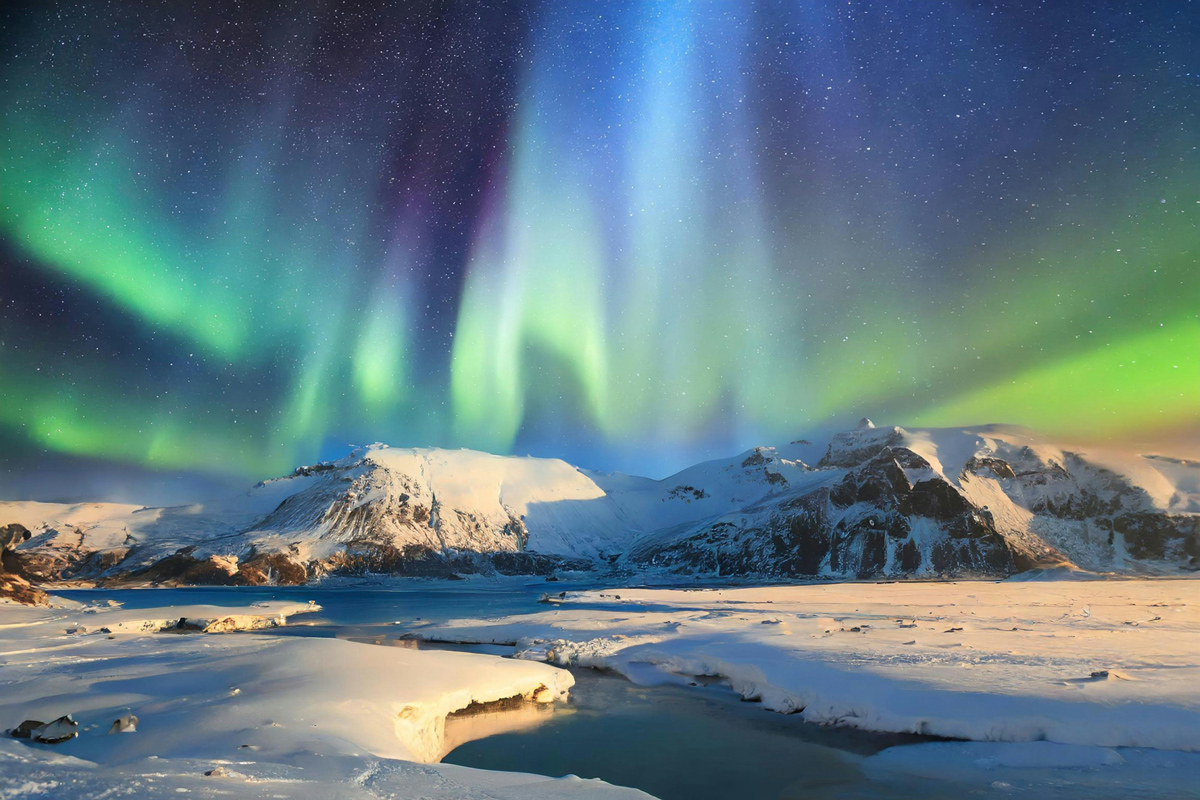

Each year, tens of thousands of tourists flock to remote parts of the far north for a very specific reason. It’s not to visit Santa’s Workshop — it’s to see the northern lights.
These colorful bands of undulating light are called auroras and are named after ancient Roman gods: Aurora is the goddess of the dawn. Aurora borealis, the lights seen in the Northern Hemisphere, are named after the god of the northern wind. Aurora australis, aka the southern lights, are named after the god of the southern wind.
The majestic names appropriately describe the cosmic light show, which seems like something out of a fantasy movie. But the northern lights (and the southern lights) are purely natural, bound by the laws of physics. The colorful phenomenon originates on the surface of the sun, nearly a hundred million miles away.
In space, the sun creates what’s known as solar storms. And the northern lights? You can think of them as a solar storm’s lightning.
The Colors of the (Solar) Wind
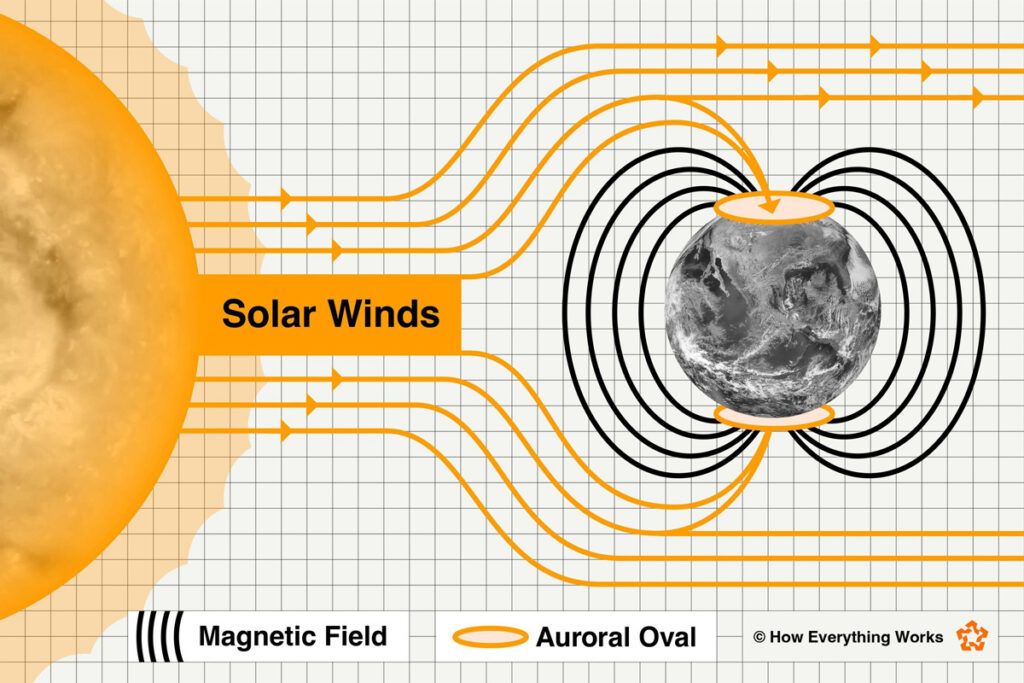
The sun is an enormous thermonuclear reactor, ceaselessly emitting radiation in all directions. These particles traveling through space are called solar wind, and are part of the universe’s cosmic weather. If you thought Florida was bad, imagine a solar storm. Solar storms occur when more particles explode from the sun than usual, through solar activity such as flares and coronal mass ejections.
Just as strong wind here on Earth can create thunderstorms, strong solar wind becomes solar storms. The energy produced by solar storms is massive — a nuclear reactor would need to operate continuously for hundreds of thousands of years to approximate the electromagnetic radiation produced by a single solar flare.
Sometimes, Earth orbits directly into the path of this radiation. This would spell doom for us earthlings, were it not for an invisible force field protecting the planet. That force field is known as the magnetosphere — which has nothing to do with Magneto from X-Men, and everything to do with Earth’s magnetic field.
When it’s not helping birds migrate, the magnetic field protects our planet by guiding harmful solar radiation around Earth. Like water going around a rock in a stream, solar wind flows around the planet.
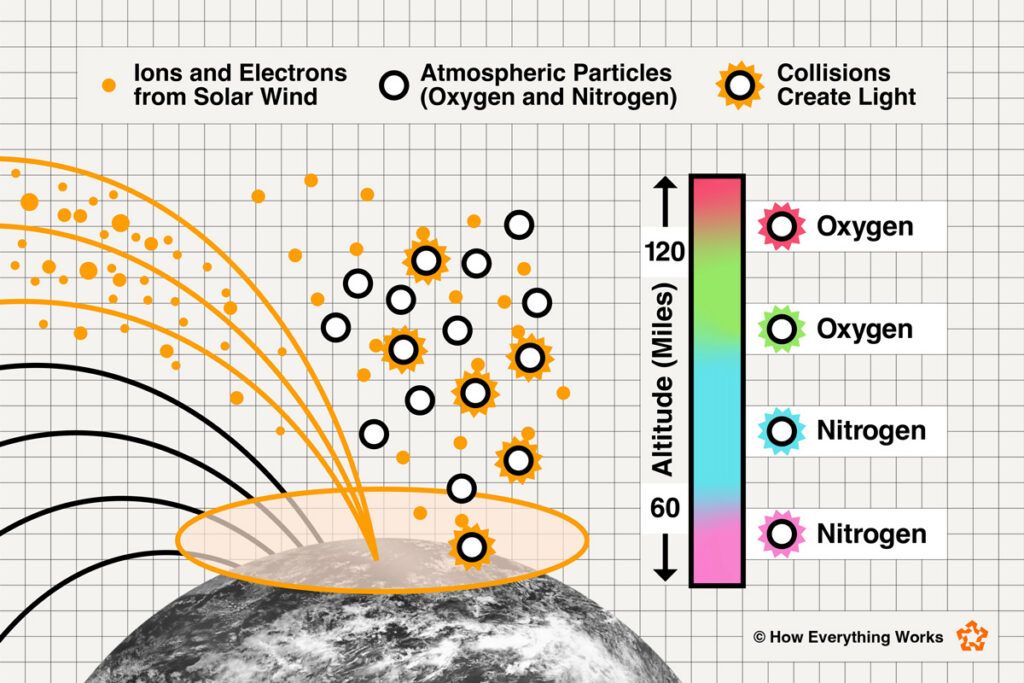
But particularly strong “gusts” of solar wind accelerate particles fast enough to penetrate the magnetosphere and enter Earth’s upper atmosphere. Electrons from the sun collide with oxygen and nitrogen in the air, causing each atom to emit a flash of light. Some atoms become electrically charged, or ionized, in the process as well, which also creates light.
Different gases emit different colors, depending on the altitude. Oxygen interacting with solar wind at an altitude of 120 miles or more produces red, while at lower altitudes it produces green — the most common aurora color. Nitrogen, on the other hand, produces blue and pink.
Replicate the process billions of times and you’ve got quite the (northern) light show! The colors form tall curtain-like bands because they’re actually shaped by normally-invisible lines in Earth’s magnetic field.
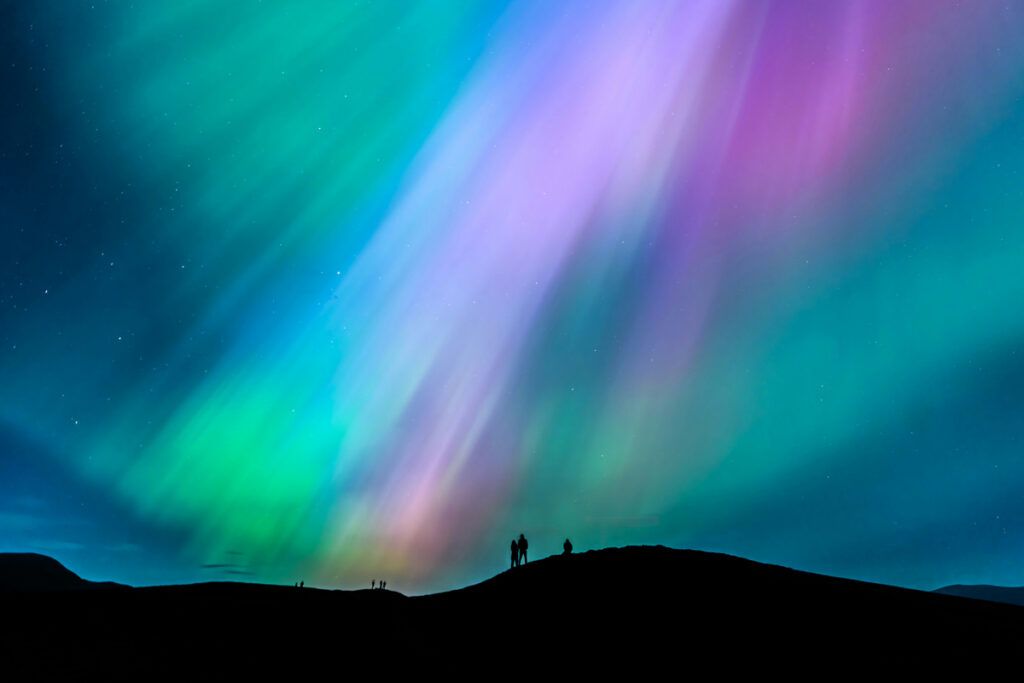
Unfortunately, most of us don’t see auroras in the wild because they tend to only occur in the northernmost and southernmost reaches of the globe. This is because Earth’s magnetic field funnels solar particles to the poles, just as it guides migrating birds north and south. However, when a solar storm is strong enough, the magnetic field is overwhelmed and particles can reach the atmosphere at lower latitudes.
Often, the stronger the storm, the further south the northern lights can appear. They’ll also be more colorful as particles reach lower altitudes than usual. In 2026, the largest solar storm in two decades created aurora that could even be seen over Southern California — at that point, calling them northern lights is borderline confusing!
Solar storms that powerful are rare, though, and auroras are typically confined to the Arctic and Antarctic. If you don’t have plans to spend a night under Arctic skies anytime soon, don’t sweat — er, freeze — it, though. Just head to Vegas, because neon lights are made using the same process that generates the northern lights in our atmosphere. The science is just more… down to earth.
The northern lights occur when particles from the sun collide with gases in our atmosphere. Solar electrons excite oxygen and nitrogen atoms, which emit light in different colors depending on the altitude.
Short Answer