CULTURE
Why Do You Get Deja Vu? Why Do You Get Deja Vu?


Imagine walking through a new city, only to get the feeling that you’ve stood on this very street corner before, even though you’ve never once been anywhere near it. This is deja vu — a new experience that you feel has happened before.
Even a mundane conversation can become unsettling when you suddenly have the sense that you’ve previously lived this moment. While it can be used idiomatically to refer to something overly familiar, it’s not technically deja vu if you actually are thinking of a previous experience.
Instead, deja vu is a neurological glitch with a few potential causes, all of which involve the way we form memories in the first place.
Mistaken Memories

Deja vu, which means “already seen” in French, is surprisingly common — two-thirds of people have experienced deja vu at least once in their life. Despite its ubiquity, most researchers have historically avoided studying deja vu because of its unpredictability — and because it was perceived as a little woo-woo for mainstream science.
That changed in 2003, when psychologist Alan S. Brown published a paper in Psychological Bulletin that connected deja vu to neuroscience, opening the door for other researchers. One of those researchers, Anne Cleary, a cognitive psychology researcher at Colorado State University, devised a way to trigger deja vu by moving subjects through an immersive video game landscape.
Subjects reported experiencing deja vu when the geography of a given scene was similar to previous ones, leading Cleary to posit that deja vu may occur when the physical layout of a new space is similar to another, more familiar one.
Cleary’s research suggests you experience deja vu on that strange new street corner because it triggers a hazy memory in your subconscious of a different but similar corner you’ve already been to. This, in turn, causes that uncanny “I’ve been here before” feeling, even though you haven’t. Cleary’s work seems to support the popular theory that deja vu is an error in memory processing.
Deja Vu All Over Again

But this is just one of many theories on how deja vu is generated in the brain. Some researchers believe the phenomenon has less to do with misplaced memory and more to do with an interruption in the brain’s processing.
For example, you pass a new store and get a text in transit. You stop to answer said text, then look up to see this sparkling new shop that’s oddly familiar. “I’ve been here before,” you think, swimming in deja vu. Yeah, you were there before, alright — 10 seconds ago. Your brain clocked it, but your conscious mind didn’t, because it was interrupted by the text. Deja vu? More like distract-a-vu.
Whether caused by lapses in memory, interrupted processing, or some combination thereof, neuroscientists agree that deja vu signals a glitch in the brain’s internal communication. It likely happens when two parts of the brain responsible for creating memories, the temporal lobe and hippocampus, miscommunicate with one another.
This makes sense if you think about it. Long-term memory and short-term memory don’t just describe how long ago something happened — they’re two distinct types of memory that are processed and stored differently by the brain. It stands to reason that something will feel slightly off if your brain tells you a short-term memory is actually a long-term one. Ever put a shoe on the wrong foot? They’re both shoes, they’re both your size — but it doesn’t quite fit.
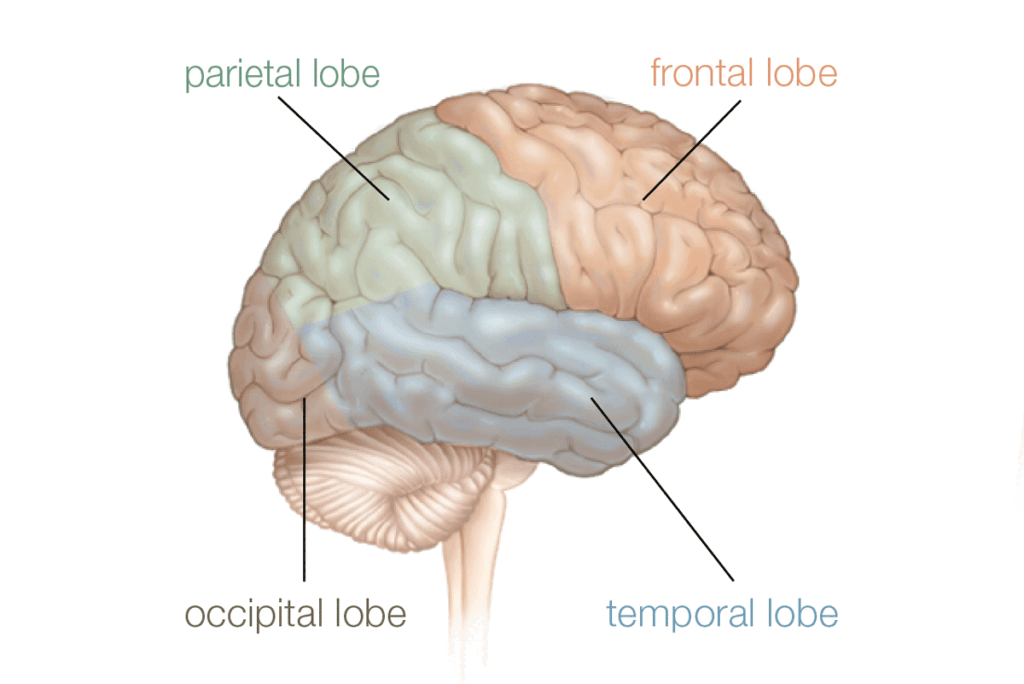
Whatever the glitch is, researchers are reasonably sure it’s happening entirely within the brain. Epileptics, who suffer from neural misfiring, often experience frequent deja vu.Teenagers, whose brains are undergoing rapid transformation, also experience more deja vu than the rest of us.
Disorienting as it may be, deja vu is usually not a cause for concern. Akira O’Connor, a psychology professor at Scotland’s the University of St. Andrews believes that the phenomenon is actually a good thing for most people, as it indicates a healthy brain fact-checking its own memories.
As unsettling as the feeling may be, take solace in the fact that deja vu means your memory’s actually pretty good, because you’re flagging things that likely never happened. It would be a lot more concerning if you actually had visited another city before and completely forgotten about it.
Deja vu is caused by misfiring between the region of your brain responsible for long-term memory (the temporal lobe) and the core processing center (the hippocampus), which creates a false sense of familiarity in novel situations. There isn’t a consensus on what causes it — it may be remembering something similar or having your memory formation interrupted, or something else altogether. But it’s common and perfectly natural, and may even be a sign of a healthy memory.
Short Answer