CULTURE
What Is a Cousin ‘Once Removed’?


If you come from a large extended family with lots of cousins, family reunions can become huge — and confusing — affairs. You may not even be sure how some of your family members are actually related to you. Are they your second cousin? Third cousin? Or are they your first cousin once removed? Once removed from what?
The larger a family tree grows, the harder it can be to follow. There are some easy ways to think about how more distant cousins relate to you, though, and a lot of it has to do with the generations you’re from.
What’s a Cousin Anyway?

Often, the term “cousin” is used interchangeably with “first cousin,” which refers to the child of your aunt or uncle. A second cousin, meanwhile, is the child of a parent’s first cousin. Another way to look at it: Your child would be second cousins with the child of your first cousin. A third cousin is the child of a second cousin, a fourth cousin is the child of a third cousin, and so on.
The easiest way to figure out what “level” of cousins two people are is to look at their ancestry. First cousins share the same set of grandparents, while second cousins share a set of great-grandparents, since their parents are first cousins. Third cousins share a set of great-great-grandparents, and down the line it goes.
This means that you and your cousin must be in the same generation to use terms such as “first,” “second,” or “third” cousins. (In terms of genealogy, that is — two first cousins may differ in ages widely enough that one is a baby boomer and the other is Gen X, for example.)
When a new generation is born is where “once removed” comes in.
Generational Differences
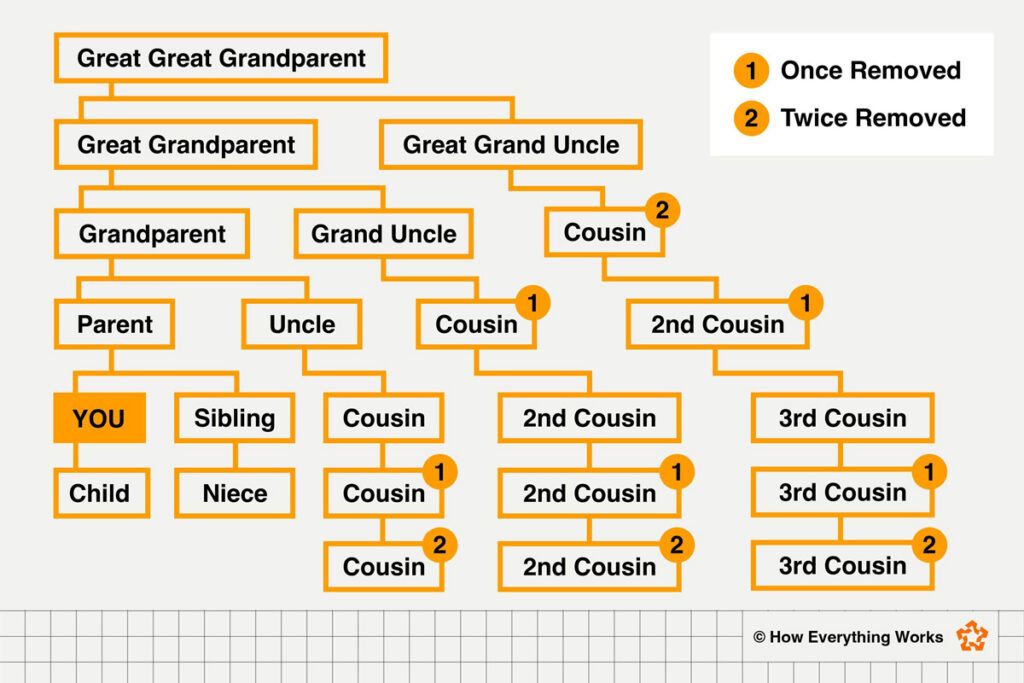
Your first cousin once removed is either the first cousin of your parent or your first cousin’s child. They’re removed from your generation by one level, either older or younger. Because you’re a generation off, you’ll never share the same set of grandparents or great-grandparents, but you still share a relative.
For example, your first cousin’s daughter would be your first cousin once removed. Your grandfather — who is also said first cousin’s grandfather, is her great-grandfather. The shared ancestor is two generations back for you, and three generations for her. So, she is your first cousin once removed — i.e., removed by one generation.
If you and a cousin are two generations apart, you’d be twice removed — your grandfather’s first cousin, for example, is your first cousin twice removed. Your great-great-grandfather would be their grandfather.
If you think that’s confusing, consider there are relatives such as third cousins twice removed and all kinds of other combinations. In this case, third cousin refers to the branch of the family tree you’re connected to — unlike standard third cousins, you’re not in the same generation. You can’t be, because you’re twice removed. So a third cousin twice removed would be the grandchild of your third cousin or the third cousin of your grandparent — either way, you’re two generations off from being third cousins. Good luck with those Christmas cards.
Because heritage is so important to royalty, the family trees of monarchs are usually spelled out more clearly than your own. Here’s a real-life example from Britain’s royal family: King Charles III and Princess Anne are brother and sister. King Charles is father to Prince William and Prince Harry. Princess Anne is mother to Zara Tindall and Peter Phillips.
William and Harry are first cousins to Zara and Peter. Prince William has three children, including Prince George. Zara is George’s first cousin once removed, because their shared ancestor, Queen Elizabeth II, was Zara’s grandmother but George’s great-grandmother. Meanwhile, Zara’s daughter Mia is second cousins with George — her mom and his dad are first cousins.
While second cousins may sound simpler, first cousins once removed are actually more closely related to you. You share about 6.25% of DNA with a first cousin once removed. With second cousins, it’s about 3.125%. Second cousins may feel closer to you, though, because being in the same generation means there’s a decent chance you’re around the same age and may have grown up together. During the holidays, you may have sat with your second cousins at the kids’ table — before the next generation (your cousins once removed) succeeded you.
A cousin once removed means the two of you share the same ancestor but are separated by one generation, either up or down the family tree. Your first cousin once removed may be your parent’s first cousin or the child of your first cousin. Your grandfather would be their great-grandfather, or vice versa. Twice removed is two generations apart, and so on. Second cousins, on the other hand, are in the same generation of the family as you; they have the same set of great-grandparents. Third cousins share a set of great-great-grandparents — they’re less closely related to one another, but still part of the same generation.
Short Answer