ENGINEERING
Which Type of Bridge Is Strongest?
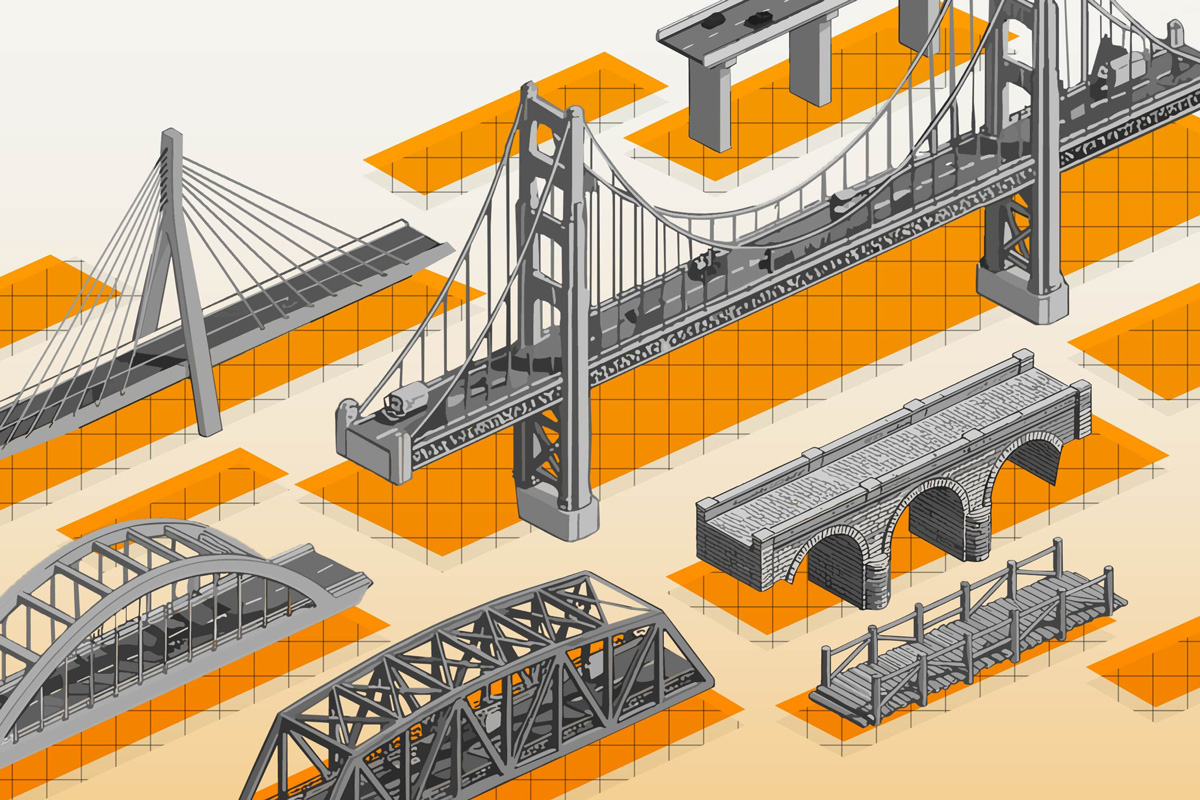

How many bridges have you seen in your life? A hundred? More? Yet almost every bridge you’ve ever driven, walked, or ridden over is a version of one of just seven designs. Some of those designs are very old — one dates all the way back to the ancient Romans. The most recently developed style, meanwhile, has only been around since the 1950s. In fact, no fundamentally new design has come along since then — a testament to how well these seven do the job.
So which type of bridge is strongest? Well, that depends on geography, distance, budget, load, and the ground underneath the structure.
The weight of what’s crossing a bridge pushes down on it, which creates tension and compression. Think of pressing the palm of your hand straight down on a ball of Silly Putty. Compression is the vertical force pushing down on the putty, squeezing it between your hand and the table. Tension is the horizontal force that stretches it outward across the table.
Silly Putty is soft, but something hard, such as wood or stone, will crack and break when these forces are too strong. The main difference between each type of bridge is how it manages these forces. Here’s a look at all seven.
Beam Bridges
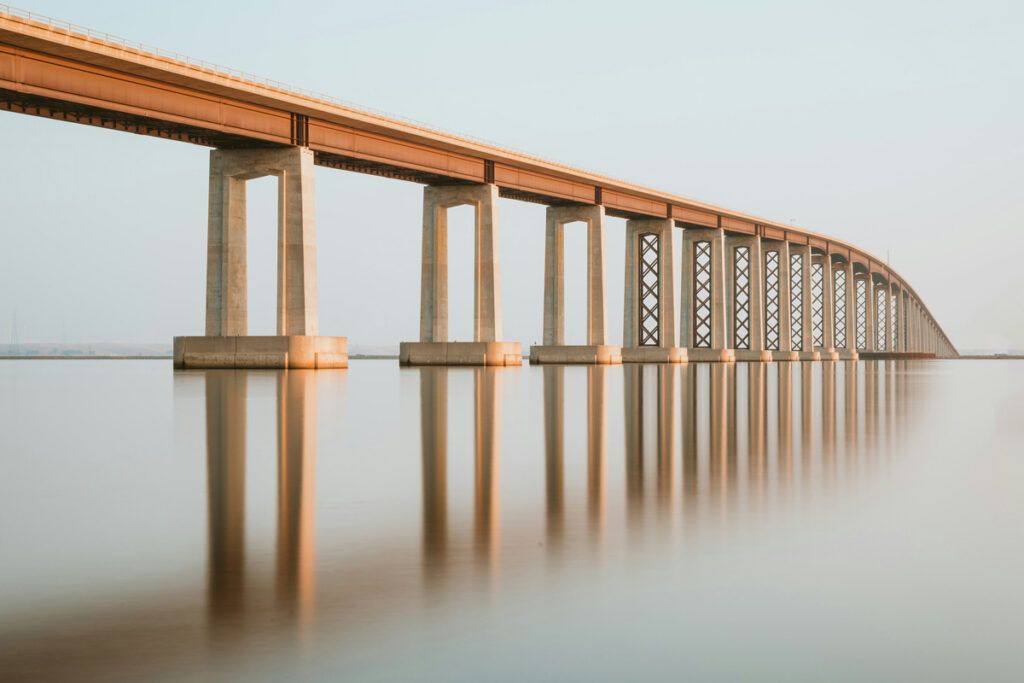
This is the simplest of the bunch — any log crossing a stream technically fits the bill. A beam bridge is a flat deck resting on supports at each end, sometimes with piers in between. Most highway overpasses are beam bridges.
The physics are simple: The weight presses down on the deck, squeezing its top edge and stretching its bottom. It’s easier to picture how a beam handles stress by picturing the bridge as a big loaf of soft bread. Unlike the Silly Putty example, there’s no table under a bridge because it’s crossing over empty space. Since it can’t flatten outward across a surface like the putty, it sags in the middle instead.
Beam bridges are cheap and fast to build due to their simplicity, but also the weakest of the group. Push a single span (a section between two supports) past about 250 feet and it begins to sag under its own weight, but there’s an easy workaround to extend it: support columns. Consider the country’s longest beam bridge, Louisiana’s Lake Pontchartrain Causeway, which is nearly 24 miles long and basically thousands of shorter beam spans in a row.
Truss Bridges
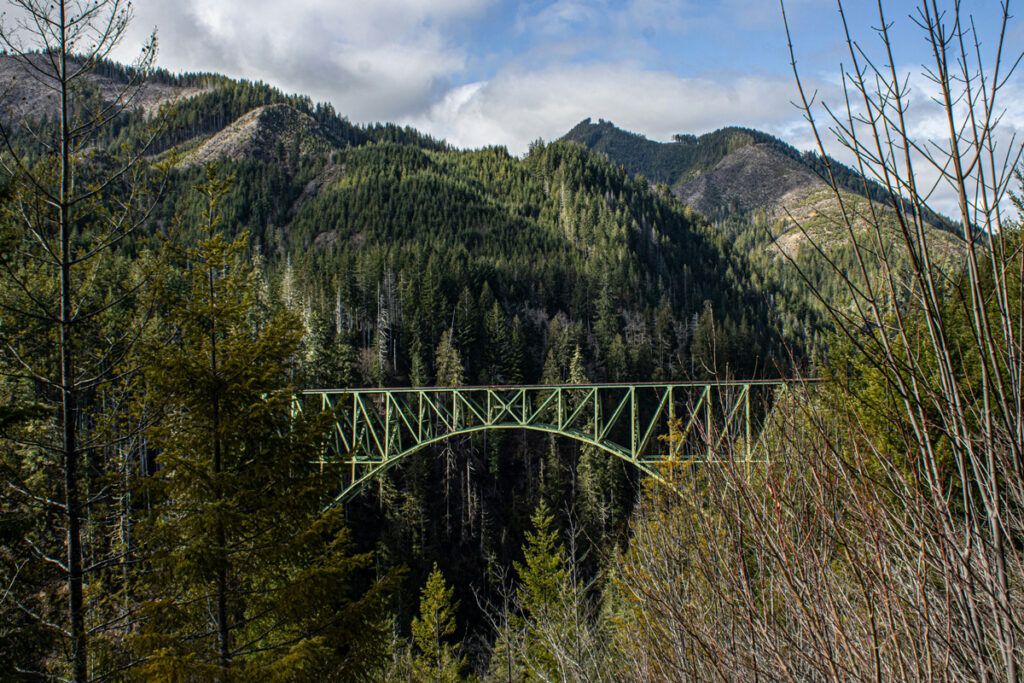
You already know what a truss looks like, even if you don’t know the name: It’s the web of triangles, usually made of metal or wood, that you see in a lot of structures, such as a construction crane or the Eiffel Tower. Triangles are shapes that are very difficult to be deformed by stress, and a truss bridge is basically a road on top of a series of trusses, able to bear more weight than a standard beam bridge.
Each bar in the truss lattice handles pure tension or compression, spreading the load efficiently across the whole structure. The result is a remarkable strength-to-weight ratio: Trusses carry a lot using relatively little material, which is why they’re often called the strongest design pound for pound. The trade-off is all those joints and members connecting each bar, meaning more to inspect and maintain over time.
Arch Bridges
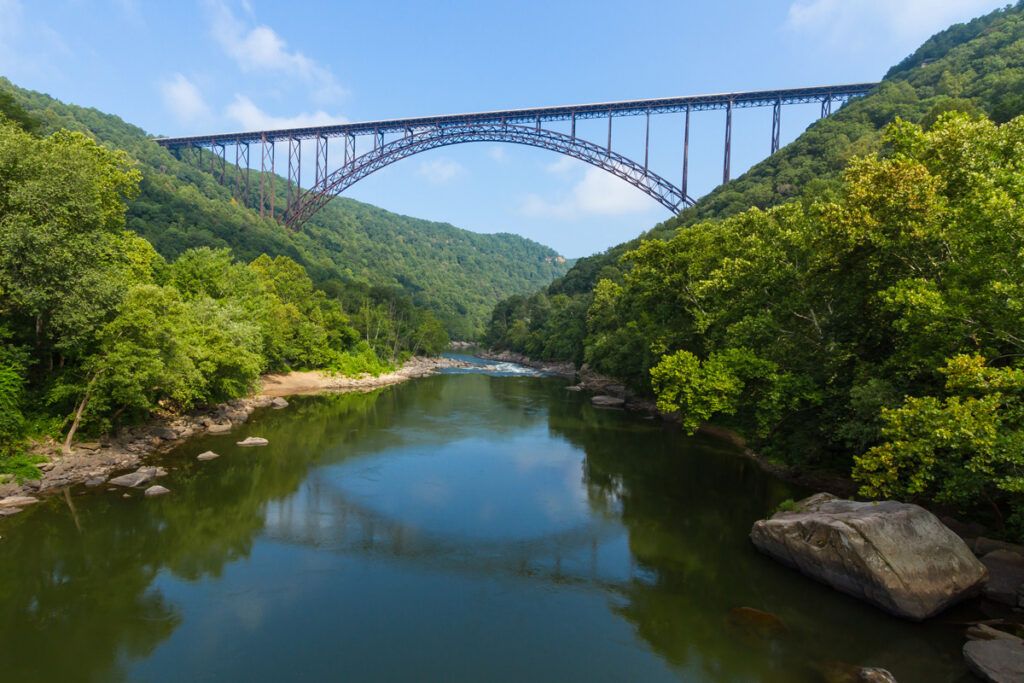
The arch is one of the oldest designs still in use, and its endurance is hard-earned. Roman arch bridges and aqueducts such as the Pont du Gard have stood for roughly 2,000 years; the steel New River Gorge Bridge in West Virginia, which has a 1,700-foot arch length, is a modern descendant.
The arch is one of the strongest shapes in engineering, which is why it’s also used in tunnels and vertical structures (such as the Colosseum). It works by channeling the weight above it outward and down along the curved arch it sits upon and into solid ground at each end. Stone, brick, and concrete are enormously strong under compression, but an arch just needs firm rock or soil footing at both ends to push against.
Tied-Arch Bridges

Think of a tied-arch bridge as the reverse of a standard arch bridge. In a tied-arch bridge, the deck (the surface upon which you travel) hangs from the arch rather than sitting on top of it.
While a standard arch needs firm footing at both ends to absorb its outward push, a tied-arch bridge gets around that requirement entirely. The arch rises above the deck, and the deck itself acts as a “tie” — a horizontal structure holding the arch’s two ends together, like the string on a bow (which is why these are also called bowstring bridges).
The Fremont Bridge in Portland, Oregon works this way, as does the Chaotianmen Bridge in China, which claims the world’s longest steel arch span at about 1,800 feet. Because the tie absorbs the outward thrust that a normal arch shoves into the ground, a tied-arch can sit on soft soil or tall piers where a standard arch couldn’t stand at all. The catch: That tie is doing essential work — if it fails, the arch has nothing holding it in.
Cantilever Bridges
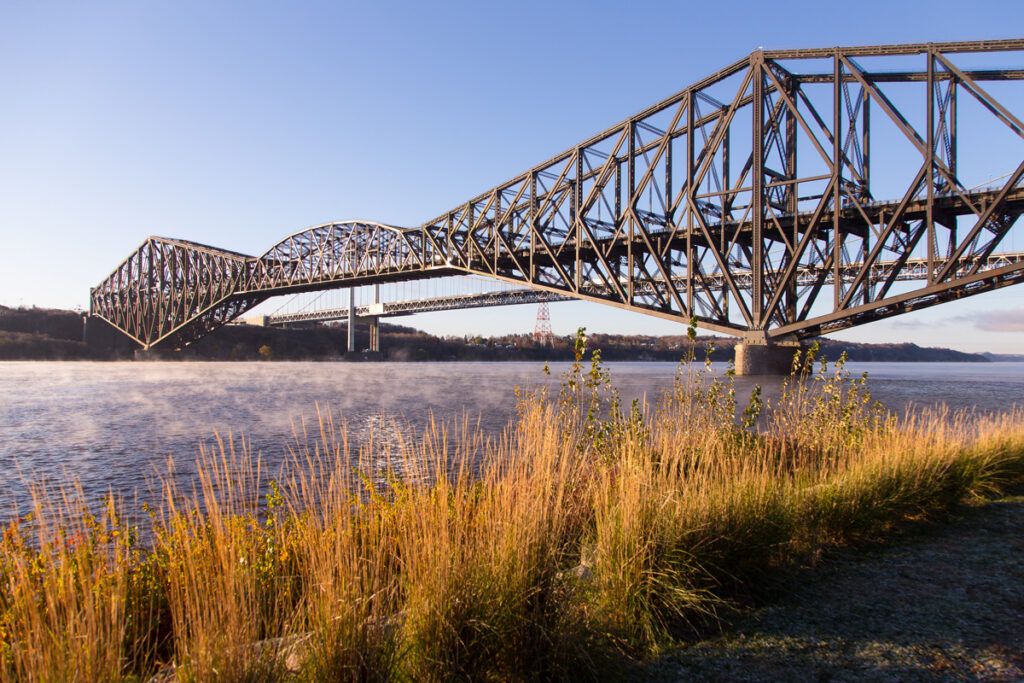
A cantilever is a beam anchored solidly at one end and left to project into open space (kind of like a diving board). In a cantilever bridge, two such arms reach toward each other from opposite piers, often meeting a short “suspended” span in the middle. Canada’s Quebec Bridge holds the record for the longest cantilever bridge span in the world at 1,801 feet.
The advantage of a cantilever bridge is that each arm can be built outward from its pier without temporary supports underneath — useful over deep water or busy shipping lanes. The downside is weight and complexity, and getting the balance wrong is unforgiving; the Quebec Bridge collapsed twice during construction before it finally held.
Suspension Bridges

Many of the most iconic bridges in the world, including San Francisco’s Golden Gate Bridge and New York City’s Brooklyn Bridge, are suspension bridges. You know the look: Two massive main cables are draped in parallel between two stoic towers; the roadway (deck) hangs from vertical cables that drop from those main cables, with everything anchored firmly in the ground at each end.
You can picture the load being distributed through the cables like electricity. Through the cables, tension forces move from the road to the sturdy anchorages. No other design spans anywhere near as far. The current record-holder, Turkey’s 1915 Çanakkale Bridge (which, despite the name, opened in 2022) literally spans continents. It stretches about 1.3 miles between its towers to connect Europe and Asia.
But reach comes at a price. Suspension bridges are relatively flexible and can sway in high wind. The original Tacoma Narrows Bridge in Washington state collapsed in a windstorm in 1940, just four months after opening. Suspension bridges may go the farthest — and look the most elegant — but they aren’t the strongest pound for pound, trading rigidity for span.
Cable-Stayed Bridges
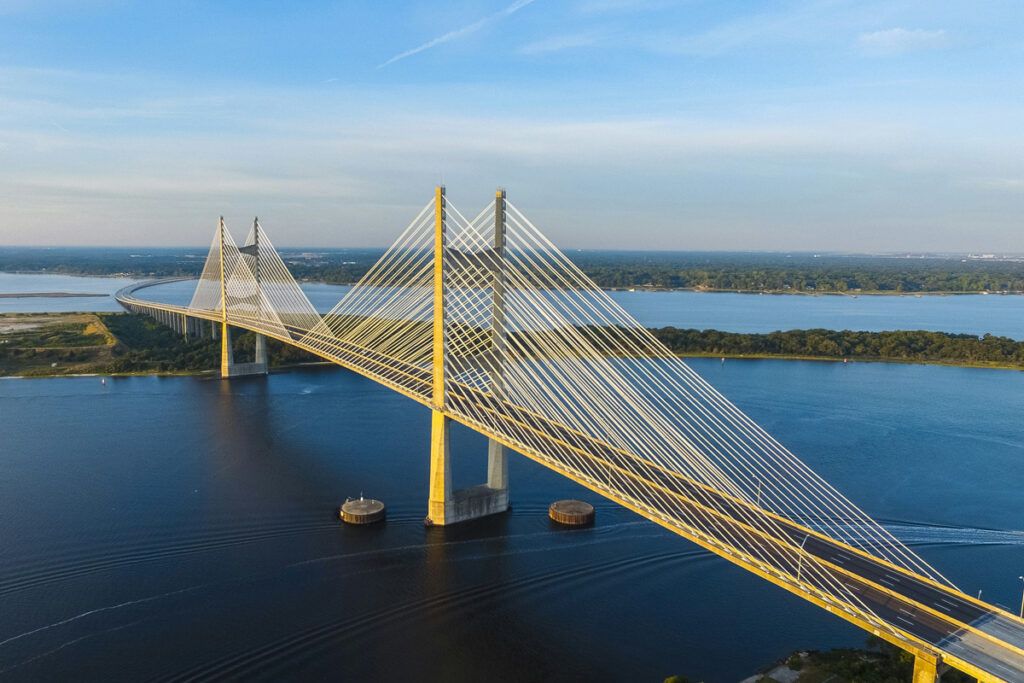
The cable-stayed bridge is the newcomer, and it’s often mistaken for a suspension bridge. But there’s an easy way to tell the difference: In a cable-stayed bridge, the cables run diagonally from the deck up to one or more towers, often fanning out like harp strings. France’s Millau Viaduct is a famous example.
Each cable carries a slice of the deck’s weight straight up to the tower in tension, and the tower passes it down to the ground in compression — an efficient setup that uses far less cable than a suspension bridge. That makes cable-stayed bridges strong, relatively quick to build, and ideal for medium-to-long spans — China’s Changtai Yangtze River Bridge currently holds the record for longest cable-stayed bridge, with a span of about three-quarters of a mile. The modern form dates to Sweden’s Strömsund Bridge in 1956, making this the youngest of the fundamental bridge styles.
And the Winner Is…
So which bridge is strongest? For sheer weight carried per pound of material, the arch and the truss take the cake; for crossing a canyon or a strait, nothing beats a suspension bridge. Consider this yet another example of why the correct question to ask isn’t what’s best but what’s best for a certain case — good advice for life in general, not just bridges.