CULTURE
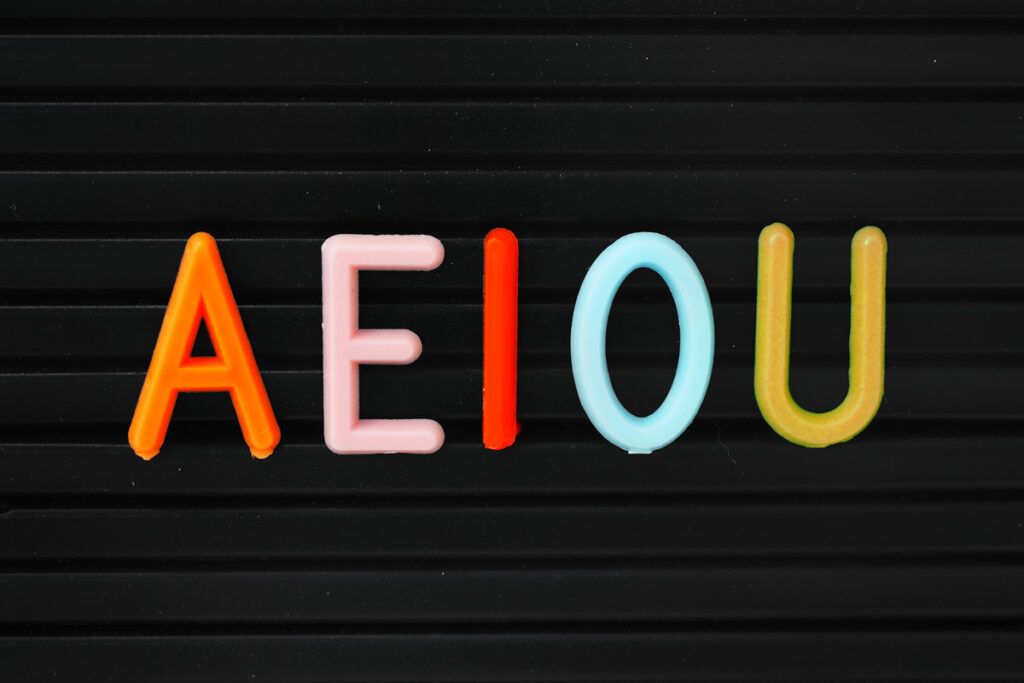
Why Are There Only 5 Vowels?


Any Wheel of Fortune fan can tell you that vowels are the most valuable letters in the game. Despite there being just five vowels compared to 21 consonants, nearly every word has at least one of them. So, if you want to solve the puzzle, you may want to fork over the dough to buy an “e” or an “a.”
But what exactly differentiates these precious vowels from the rest of the alphabet, and why are there only five? What makes one letter a vowel and not a consonant? And why can “y” sometimes be both?
Sound Off

Vowels and consonants don’t represent specific ideas or objects. They represent sounds: the distinctive pop of a “p,” the harsh hiss of an “s,” the pleasant resonance of an “o.” You make all of these sounds using your mouth, tongue, and lips in various configurations to manipulate airflow through your vocal cords.
Vowels are open sounds, with no obstruction to airflow. You use your lips and tongue to shape vowels and differentiate between them — “eee,” “ahh,” “ooh,” and so on — but your breath flows freely out of your mouth.
Consonants are made by partially or completely obstructing airflow. For example, “m” and “n” require you to cut off the airflow and redirect it to your nose. A “b,” “p,” “t,” or “k” requires you to halt and then release the air, giving those letters a harder sound.
A “j” or “ch” sound requires stopping, then squeezing the air. An “s,” “v,” or “f” sound requires you to constrict the airflow to a narrow space, either between your tongue and the roof of your mouth or between your lips and teeth.
You can hear the difference for yourself by making a protracted “z” sound — it should sound like a low buzz as you keep the “z” going through your mostly closed mouth. But watch (hear) what happens when you open your mouth wide as you continue making the sound. The airflow is no longer restricted, and it becomes a vowel-like “ahh.”
Sometimes “Y” and… “W”?

Some consonants — “y,” “w,” “r,” and “l” — require less constriction than others, and linguists refer to these as approximants. Some approximants are known as semivowels (or glides), with the most famous being “y” — it even gets included when you list the English vowels… sometimes. In words such as “cry,” “try,” or “rhythm,” the “y” is serving as the vowel — no airflow is constricted when you pronounce it in each word.
Another semivowel is “w” — when you pronounce it in words such as “new,” “low,” and “saw,” airflow is barely constricted in the way it would be when pronouncing the “w” as a consonant in words such as “watch” and “away.” Unlike “y,” though, a “w” is always paired with another vowel when it isn’t serving as a consonant.
Why Do Words Need Vowels?
Together, vowels and consonants shape every syllable of every word we speak. Vowels are the louder sounds that typically form the middle, or nucleus, of a word, while consonants form the syllable’s onset (beginning) and coda (end). Take the word “cat,” a simple word with just one syllable. In “cat,” the “c” is the onset; “a” is the nucleus; “t” is the coda.
Every syllable has a nucleus, but some may lack an onset, coda, or both. Sometimes a vowel forms a syllable by itself — both the “i” and “a” in “idea,” for example — and sometimes a consonant can form its own syllable, such as the “m” in “rhythm.” Consonants that do this are known as syllabic consonants.
In English, vowels are found in nearly every single word (though that’s not the case with all languages). That’s because they’re easier to say (and also typically louder) since you don’t constrict air with your mouth to pronounce them. This also makes vowels — and words that use them — easier to understand, which is kind of the entire point when it comes to spoken language.
Why Are There Only Five Vowels?

Given how important vowels are, you’d think there’d be more of them than just five (and sometimes “y”). And, truth be told, while there are only five vowel letters, there are more than five vowel sounds, because each vowel letter can make several different sounds.
Every vowel letter has a long and a short sound. Take the letter “i.” When pronounced in a word such as “mine,” it’s a long “i,” pronounced “eye.” But in a word such as “inbox” or “sit,” “i” is pronounced more like “ih.”
Vowels can also be combined with other letters to make even more sounds. For example, “boot” and “book” contain completely different “o” sounds from the long and short “o” sounds found in a word like “robot.” The word “caught” combines “a” and “u” to make more of an “aw” sound.
All told, there are about 20 different sounds English vowels can make, depending on dialect and accent. Consonants account for about 24 sounds including combinations such as “th,” “sh,” and “ch.”
The English alphabet is derived from Latin, whose alphabet also has just five vowel letters, though they only made about 10 vowel sounds. Many other languages adopted this alphabet.
Some added new letters or diacritics (accent marks) to denote specific sounds, but many, like English, began using combinations of existing letters. After all, it would be harder to learn your ABCs if every individual sound had its own character.