ENGINEERING
Why Do Golf Balls Have Dimples?


Imagine getting so overzealous with your golf swing that you ricochet your ball off the windmill and into a turtle pond. (Yes, we’re talking about a mini golf birthday party, not the PGA championship.) As you emerge from the pond to the tune of giggling kindergarteners, you rub the wayward ball with your sleeve to dry it, taking note of its grooved surface.
Those dimples are a defining feature of a golf ball — without them, it wouldn’t seem like a golf ball at all. And while they don’t really do anything when you’re simply putting them around a miniature golf course, on a regular fairway, where hundreds of yards separate the tee from the cup, dimples are no mere cosmetic choice but rather an essential design feature. They are the wings that make a golf ball fly.
How Golf Balls Got Their Groove

Back in 15th-century Scotland, early golf balls were intentionally smooth. The material gradually evolved from wood to feather-stuffed leather over the centuries, but it wasn’t until the introduction of the Guttie ball in the 1800s that things changed significantly. These new balls, made of natural rubber, were cheaper to make and much more durable. However, they had an obvious drawback — they were prone to denting on impact with the golf club.
This downside quickly became an upside, though. Golfers noticed that the more dents a ball had, the farther it would fly. Why? It all comes down to two competing forces in aerodynamics: lift and drag.
Ever stick your hand out the open window of a moving car? If you hold your palm perpendicular to the ground, the airflow will force your arm back. This resistance is called drag. When you slightly cup your palm and face it toward the road, you’ll feel the air push your hand upward. That’s lift. The physics of lift and drag are at play when any object, regardless of size, is in flight, such as birds, bees, bats, and yes, even golf balls.
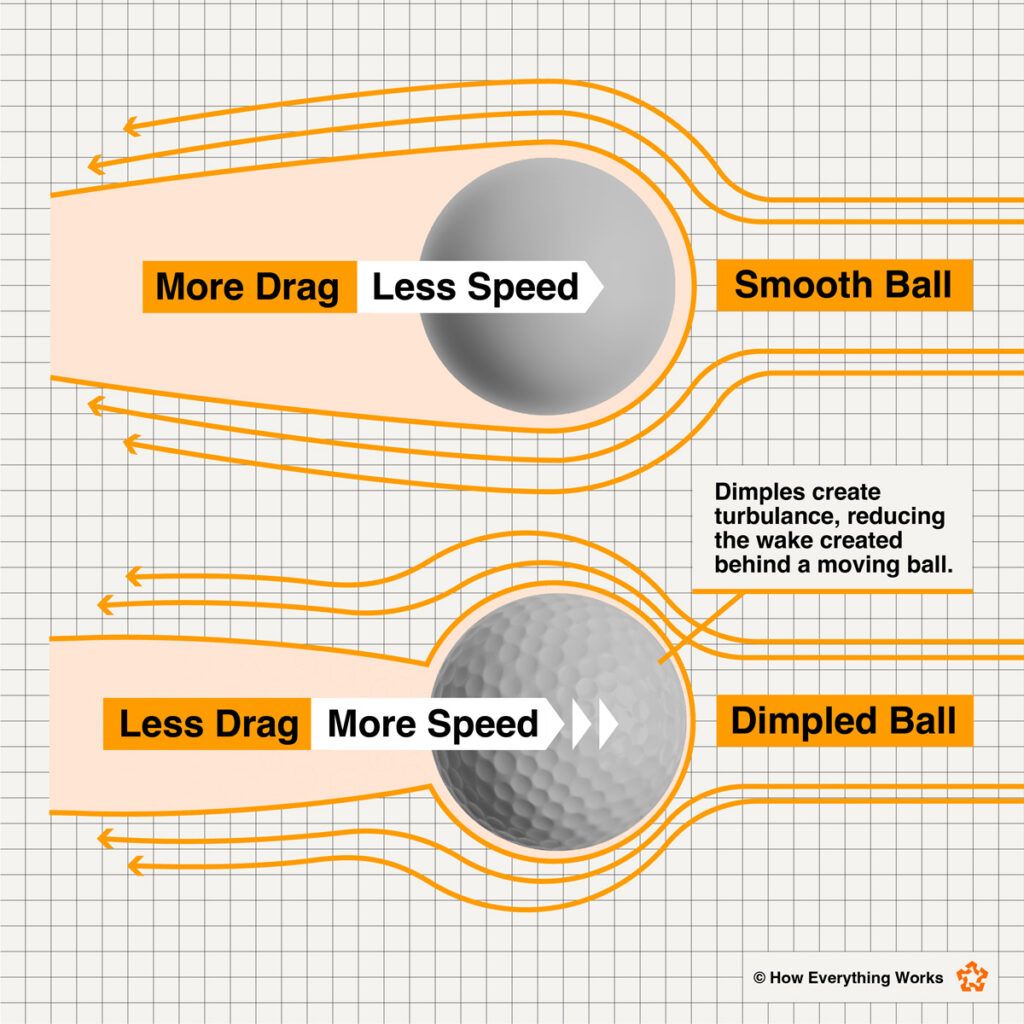
Picture our dented Guttie golf ball as it arcs over some windswept 19th-century Scottish green. Those imperfections become turbulators, which create a thin layer of turbulent air around the surface of the golf ball. Air flows to the rear of the ball, which decreases the size of its wake and reduces drag by as much as half. This allows our dented ball to fly twice the distance of a smoother one. By hacking the rubber surface of their balls, golfers discovered a new, well, hack, that greatly improved their shots and changed the game forever.
Generations of golfers experimented with various patterns and styles, until English engineer and manufacturer William Taylor secured the first patent for the dimpled ball we all know. Today, most golf balls have between 300 and 500 uniform circular dimples.
The grooves on a golf ball also help mitigate backspin, keeping the ball’s trajectory flatter and adding distance to a shot. Backspin is the rotational motion of the ball around its horizontal axis (like a car tire), with the bottom of the ball spinning back toward the golfer as it flies forward through the air. If you’re teeing off, you can reduce your spin by keeping the club head low during takeaway, and you’ll achieve a longer drive. Going for an approach shot? Increase your spin to keep the ball from rolling off the green.
Why spend money on golf lessons when you can use science to improve your handicap?
A golf ball’s dimples create turbulent airflow around its surface, reducing wind resistance (drag) and allowing it to travel a greater distance. Dimpled balls can travel twice the distance of smooth ones.
Short Answer