ENGINEERING

How Does a Gas Pump Know When To Stop?

A car at a gas station at night lit up by neon lights
Credit: Jake Heidecker/Unsplash
Erik Gregersen
Author
Erik Gregersen is a senior editor at Encyclopaedia Britannica, specializing in the physical sciences and technology. Before joining Britannica in 2007, he worked at the University of Chicago Press on the Astrophysical Journal. Prior to that, he worked at McMaster University on the ODIN radio astronomy satellite project.

You’re filling up your gas tank. You have the catch set on the pump so that you don’t have to stand there holding it. You cringe a little as you watch the dollar sign go up, up, and up. And then at some point, the tank is full, and fueling stops automatically. But how does the pump “know” your car is full?

There isn’t some tiny computer inside the pump figuring out how empty your car is and how long it will take to fill it up. There isn’t even an electrical sensor in your tank that shuts off fueling when it’s full. Electricity isn’t involved at all. It’s just fluid mechanics, the movement of air and gasoline.

Credit: Marek Studzinski/Unsplash

Air In, Gas Out

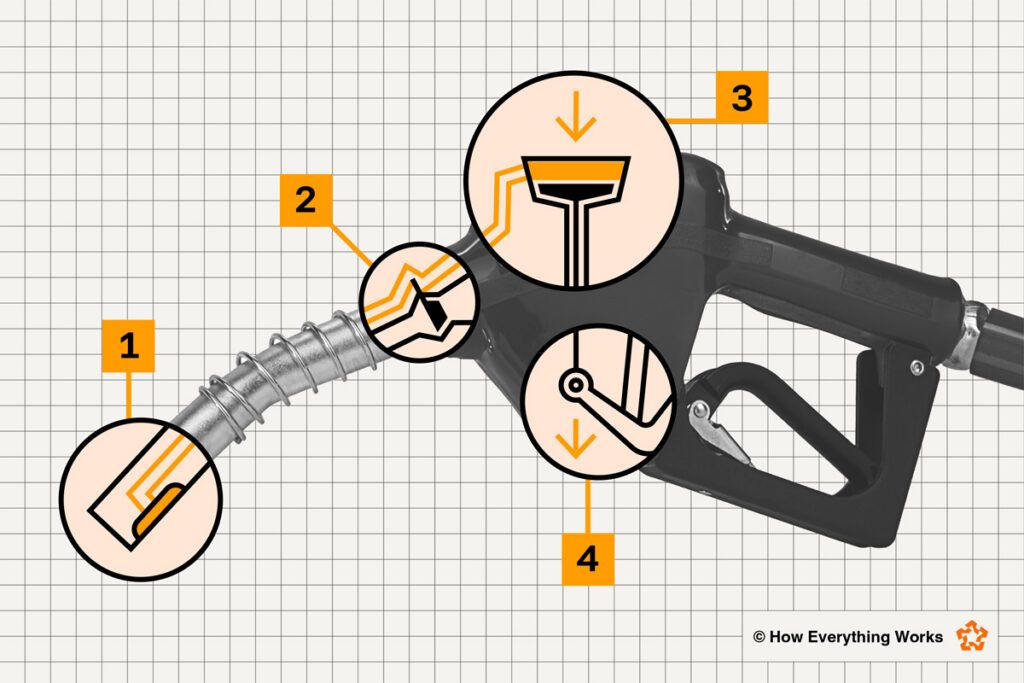
At the end of the metal gas nozzle you will see a little hole (#1 in the diagram below). That hole is connected to a tube that travels up the pump. When you are pumping gas, air flows through the hole and up this tube. The tube connects to a diaphragm inside the gas pump that’s filled with air (#2). When the diaphragm is filled with air, it pushes down a small cone (#3). That cone pushes against three ball bearings that hold a piston in place. The other end of the piston is connected to a lever that in turn is connected to a valve allowing the flow of gasoline (#4).

Credit: How Everything Works

In simplest terms, when the diaphragm inside the gas pump is full of air, it pushes open the valve allowing the flow of gasoline. 

When the gas tank becomes full, the sensing port at the end of the nozzle (#1 in the diagram above) is covered by gasoline. Now instead of the tube pulling air up, it’s pulling the heavier gasoline into the Venturi chamber (#2). But this creates negative pressure, which pulls the diaphragm (#3) up and sets off a chain reaction. The diaphragm pulls up the cone, the cone releases the ball bearings, and the shut-off piston (#4) falls down, pushing a lever to close the valve. All this happens quickly, producing a satisfying thunk as the flow of gasoline stops. 

The sound of cash leaving your wallet? A little less satisfying. 

Short Answer

It isn’t a computer that shuts off the gas pump when your tank is full. It’s just the movement of air and gasoline. As the gas tank fills, it cuts off a flow of air to a diaphragm that sets off a chain reaction that closes the valve between the gas supply and the hose. 

TECHNOLOGY

5 Things In Your House That Are Smarter Than You Think

Credit: Gabrielle Maurer/Unsplash+
Darren Orf
Author
Darren Orf is a writer and editor living in Portland, Oregon, who covers science and the natural world for places like Popular Mechanics, National Geographic, and Smithsonian Magazine, among others.

Human engineering has produced marvelously complicated wonders — from space telescopes that can peer back nearly to the beginning of the universe to microchips packed with billions of transistors, all squeezed into the device in your pocket. However, these impressive feats of ingenuity aren’t just found in advanced laboratories — they’re all around you. Inside your home, the objects you use every day, often without a second thought, are quietly doing their own complex work. Here are a few objects you use every day that were once considered scientific miracles.

Credit: Pablo Merchán Montes/Unsplash+

Refrigerator

Today’s refrigerators feature nonsensical technology and advanced “smart” features (you can even watch TV on them), but their basic design is devilishly inventive on its own. The concept of a fridge hinges on the idea that coldness doesn’t actually exist — but the absence of heat does. First, refrigerators are well insulated to not let heat inside, but the real magic happens with the refrigeration cycle. This cycle uses refrigerant that easily changes from a liquid to gas and back again. The fridge’s compressor squeezes the liquid, increasing its temperature, and passes it through the condenser releasing heat. When the liquid refrigerant moves through an expansion valve, it comes out the other side as a cold gas, which then moves through the interior of your fridge, absorbing heat inside. This gas then heads to the compressor, where the process begins again, continually keeping your favorite treats nice and cool.

Credit: Lost_in_the_Midwest/Adobe Stock

Electrical Outlet

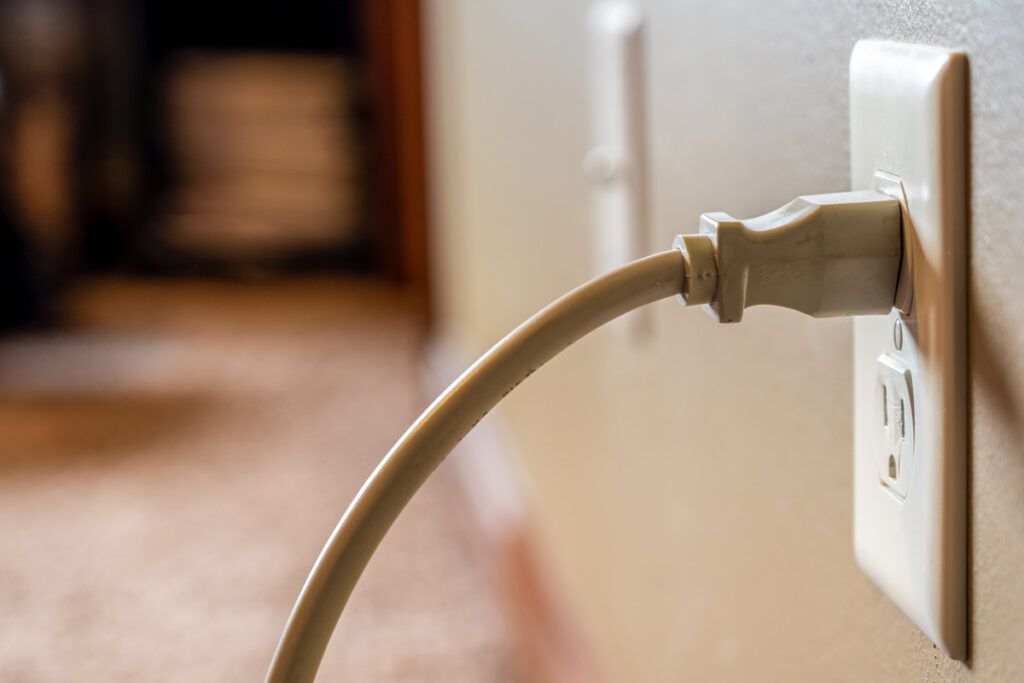
Electrical outlets transformed our homes from 19th-century dwellings to fully-electrified domiciles, and it all happened thanks to two types of wires: hot and neutral. When you plug a device into an outlet, you complete a circuit, allowing electricity to flow through the hot terminal, into the device, and back out through the neutral terminal to the breaker box, which monitors for overloads or faults (i.e. tripping the breaker). However, one of the more amazing aspects of outlets is that they’re the final destination for a flow of electrons that have traveled over hundreds of miles of wires, winding through generators, step-up transformers, high-transmission lines, step-down transformers, utility poles, and finally your home’s circuit breaker. This means the electrons powering your lamp were generated from natural gas turbines, solar panels, or nuclear power miles away before being used to generate light, heat, or motion inside your home.

Credit: Imani/Unsplash

Water Pressure

Delivering clean water to a growing population found a solution in a simple engineering truth: water flows from high pressure to low pressure. While that was the basic building blocks for Roman aqueducts, today’s cities use a variety of methods to funnel clean water through the pipes. Most cities in the U.S. rely on water pumps and water towers to reliably deliver water when the height of the local water source, such as a reservoir, doesn’t provide enough natural pressure to get the job done — as the weight of water at higher elevations applies this pressure via gravity. In New York, for example, buildings shorter than six stories don’t require pumps or water towers due to the natural location of reservoirs upstate, which provide enough natural pressure to get the water flowing. For buildings taller than six stories, water pumps store water in tanks during periods of low demand, typically overnight or in the middle of the day. Whether a giant tower in a small town of Manhattan, Kansas, or a small tower on an apartment building in Manhattan, New York, natural pressure from these mini-reservoirs safely supply water to all residents without fear of running out.

Credit: Travis/Unsplash

Coffee Maker

Coffee is a daily necessity for many, so coffee makers need to be both effective and affordable. Standard coffee makers have a large water reservoir in the back that eventually (when heated) makes your coffee while also containing a heating element in the base to keep the coffee hot when brewed. But how exactly does water get from the heating element at the bottom to the top of the machine to pour over the grounds? Instead of installing two heating elements — one at the top and one at the base — engineers devised an ingenious solution by using a one-way valve and heat-resistant tubing. This set-up creates a bubble pump, and it starts with the one-way valve at the base of the reservoir that uses a small ball that allows water to flow from the reservoir to the heating element but crucially doesn’t allow water to reverse flow back into the reservoir. As the water heats up, the boiling water creates bubbles of water vapor that in turn increases pressure inside the tube and these trapped bubbles eventually push water the only direction it can go — up the tube and out of the sprayer. The water then wets the grounds, creating a perfect pot of drip coffee in just a minute or two.

Credit: Giorgio Trovato/Unsplash

Ballpoint Pen

Although a big improvement over quill pens, fountain pens were well-known for leaking ink and constant smudging — in fact, an entire fashion accessory, the pocket protector, was designed to protect unwanted ink stains from damaging clothing. Then, on October 29, 1945, Gimbels department store in New York City began selling a new kind of writing tool — the ballpoint pen, the first ever sold in the U.S. Today, most ballpoint pens use a tiny ball bearing made of tungsten carbide to pull off two important jobs: To form a seal against the reservoir to prevent the ink from drying out and also control the ink’s flow rate via capillary action, which allows liquid to flow through narrow spaces without the need (or even opposition to) gravity. This capillary action allows the liquid to flow between the ballpoint and the paper to provide a consistent flow of ink. Unfortunately, the engineering of these pens became so good that they became a disposable commodity with billions of them finding their way to landfills. In recent years, companies like Bic have created eco-friendly versions of their pens that are made mostly of recycled plastic.

HEALTH

Why Do You Cry When You’re Sad?

A close up moody image of a man crying
Credit: Getty Images/Unsplash+
Bess Lovejoy
Author
Bess Lovejoy is a writer and editor who lives in Seattle. She is the author of the book Rest in Pieces: The Curious Fates of Famous Corpses, and her writing has also appeared in The New York Times, The Boston Globe, The Wall Street Journal, Time, Lapham’s Quarterly, The Public Domain Review, Atlas Obscura, and elsewhere. She was formerly an editor at Mental Floss and SmithsonianMag.com, and currently teaches classes on research.

Tears are one of the most universal human responses. Emphasis on the “human.” Though animals may shed tears for various biological reasons, humans are the only creatures on Earth that cry for emotional reasons, like sadness or frustration. But for something so universal, tears are still surprisingly mysterious.

Scientists still don’t fully understand why strong emotions — especially sadness — make our eyes well up. What they do know is that crying isn’t just a simple overflow of feeling. It’s a complex biological and social behavior that likely evolved to help us humans survive.

Credit: Hans/Unsplash+

The Science Behind the Sniffles

At its core, crying seems to be a signal. Long before humans shed visible tears, our ancestors — like other animals — used distress calls to alert the group when they needed help. Human crying builds on that system, adding tears as a powerful visual cue. Tears are quiet but unmistakable, broadcasting vulnerability and (hopefully) prompting empathy from others. Researchers think emotional tears may have evolved in humans because of our long childhoods: Humans rely on the support of others for years, and crying helps strengthen the bond between child and caregiver.

But crying isn’t just about communication — it also physically affects the body. There are actually three kinds of tears: basal tears that keep our eyes moist, reflex tears that flush out irritants (like the fumes from chopped onion), and emotional tears triggered by strong feelings. When we cry from sadness, the nervous system kicks in, stimulating the tear glands and setting off a cascade of physical changes. Heart rate and breathing shift, and over time, crying can activate the parasympathetic nervous system — the body’s “rest and recover” mode — helping to ease stress and tension.

That’s why crying can sometimes feel like a release. Some researchers note that emotional tears may even contain stress-related chemicals or natural painkillers like endorphins, potentially helping us regulate overwhelming feelings. Still, the evidence is mixed: Crying doesn’t always make people feel better, and its effects depend a lot on context — especially how others respond.

In the end, crying sits at the intersection of biology and connection. It’s part signal, part stress response, part emotional outlet. We cry when we’re sad not just because we feel deeply, but because we’re wired to let others see it.

Short Answer

Scientists still don’t fully understand why we weep, but it seems likely that emotional crying evolved as a distress signal — a way to get help from other humans. Crying can also help us manage emotional overwhelm by activating our parasympathetic nervous system, known as the body’s “rest and recover” mode.