TECHNOLOGY

How Do Record Players Make Music?

A close-up image of half of a vinyl record with the needle of a record player placed across it
Credit: Anthony Jacobson/Unsplash
Kellie Stewart
Author
Kellie is a writer and editorial strategist covering topics in travel, trivia, and more. When she's not writing you can find her drinking Diet Coke.

“It’s better on vinyl.”  You’ve probably heard an audiophile extol the virtues of a vinyl record. Whether the quality really improves or not, the music produced via a record player is certainly different compared to streaming an album online, playing a CD, or listening to the radio in your car. Classic vinyl records have been making a comeback over the last two decades, officially surpassing CD sales in 2022 to clinch over $1.4 billion in revenue. And while the ribbed discs and boxy players might be familiar, putting the two together to create the music we love is still a mind-blowing experience.  

You’ve probably guessed that the record player’s needle moving around the grooves of a record creates music, but what does that really mean? 

Music has the power to move us emotionally. But at its most basic level, it’s really just a pattern of vibrations called sound waves. These waves travel through the air to our ears, where they register as notes, lyrics, or sometimes just dissonant noise (hey, you do you).

Credit: Connect Images/stock.adobe.com

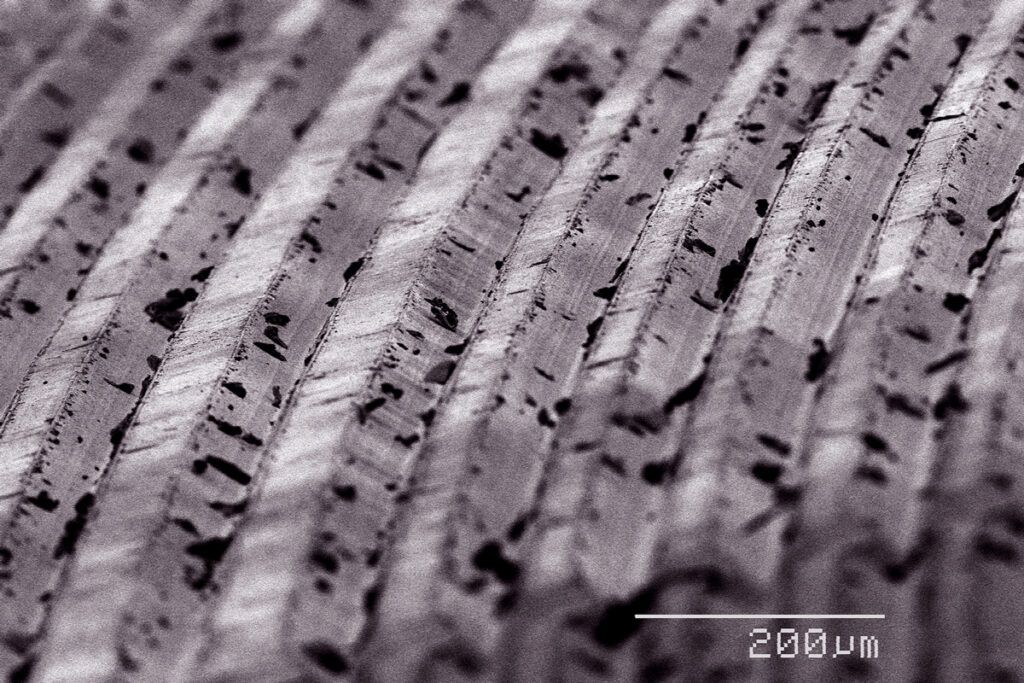
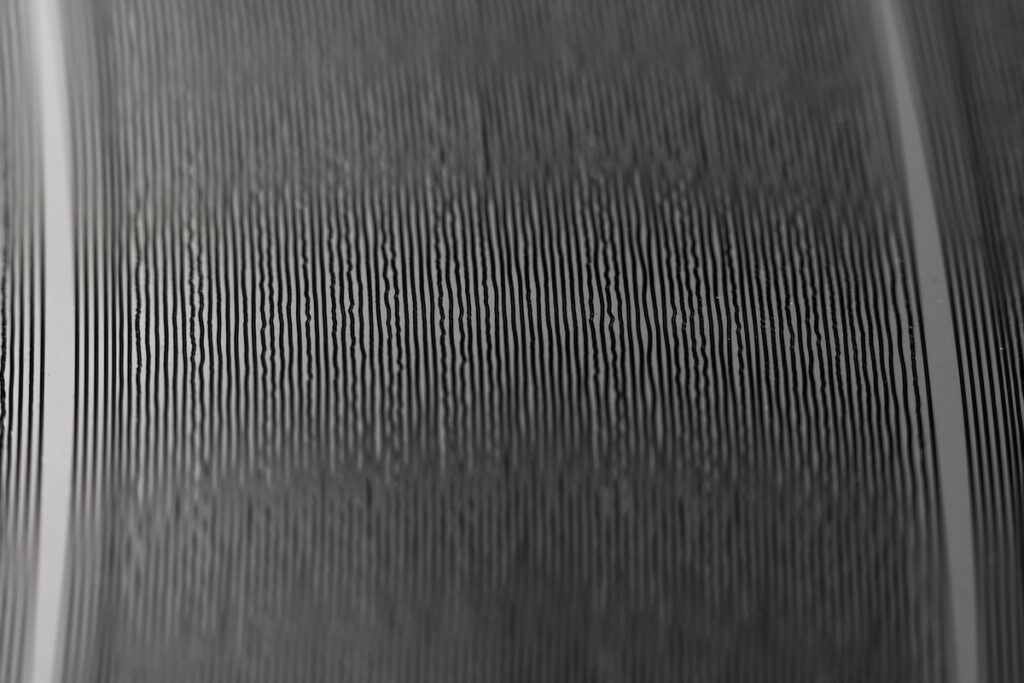
Records are an analog, or physical manifestation of those sound waves etched onto the surface of plastic — well, a polyvinyl chloride plastic, but you get the idea. Picture a sound wave moving up and down to create a continuous V-shape in the air. Record grooves are a physical version of that shape. In fact, if you look under a microscope, you’ll be able to see those V-shaped ridges traversing the record’s surface like a series of mountains and valleys. 

The Science of Good Vibrations

Once an album is recorded, it’s played into a machine called a record cutting lathe. The vibrations from the sound waves move the lathe’s needle up and down over the surface of a lacquer disc, cutting notches in the shape of those sound waves. The width and depth of these indentations affect volume and frequency. So that bass line on your vinyl record of Queen’s “Another One Bites the Dust” might have deeper grooves with more distance between them than Mariah Carey’s impressive high notes, which would be tighter and shallower. 

That lacquer disc is then placed in a stamper, a machine that applies immense pressure to, as its name suggests, stamp the grooves of the record onto the polyvinyl chloride, creating the final version of the record.

Credit: Kittyman/stock.adobe.com

Turning that stamped record into something you can hear is a little more complicated. The needle (also called a stylus) on your turntable traverses the grooves as the record spins. As the needle moves back and forth, it activates a coil and magnet inside the record player (specifically, in a piece called the cartridge, where the needle is also housed). The vibrating magnet and the coil create an electric current that travels to a speaker. From there, the record player works like most audio players — the electric current vibrates the speaker, reproducing what some might consider a superior sound. 

So, does vinyl really sound better than digital? That comes down to preference. While some listeners like having the physical interaction with their records, and others might love the nostalgia, true audiophiles believe a vinyl record represents a more pure version of the music. Digital music compresses music, potentially affecting the sound, while vinyl records come from the “master” copy, sometimes viewed as the true representation of the music as intended. We’ll leave the final judgement between you and whatever music stirs your soul — and your dancing feet.

Short Answer

Sound waves are etched into record grooves. When the needle (stylus) of a record player moves across these grooves, it vibrates in response to the shape of the grooves. These vibrations are transformed into an electromagnetic current that travels to a speaker that recreates the sound waves in the air. Then voilà — music!

HEALTH

Why Can’t You Tickle Yourself?

An image of two parents tickling a giggling toddler.
Credit: Getty Images/Unsplash.com
Bess Lovejoy
Author
Bess Lovejoy is a writer and editor who lives in Seattle. She is the author of the book Rest in Pieces: The Curious Fates of Famous Corpses, and her writing has also appeared in The New York Times, The Boston Globe, The Wall Street Journal, Time, Lapham’s Quarterly, The Public Domain Review, Atlas Obscura, and elsewhere. She was formerly an editor at Mental Floss and SmithsonianMag.com, and currently teaches classes on research.

Try it right now. Go ahead — wiggle your fingers into your own armpit or poke yourself in the ribs. Chances are, you won’t burst into helpless laughter, although you might feel a little annoyed at yourself. But give the job to another person, and suddenly your body reacts as though it’s under attack, revealing a strange thing about tickling. It’s not just about touch — it’s also about surprise, and the way our brains process unpredictability.

Credit: Getty Images/Unsplash.com

Why Surprise Matters

Your brain has a lot on its plate, so it constantly uses patterns and predictions to run your body more effectively and efficiently. Every time you walk down the street, scratch your face, or pick up a coffee mug, part of your brain is already anticipating what those actions will feel like before they happen. That prediction process helps the brain filter out sensations caused by your own body, so you don’t spend all day distracted by your shirt brushing against your skin or your arms swinging as you walk.

When you try to tickle yourself, your brain knows what’s coming. A region of the brain called the cerebellum that’s constantly monitoring your movements predicts the sensation your fingers are about to create and sends a signal to another part of the brain that processes touch. That signal turns the volume down on the sensation before you even have a chance to feel it.

But your brain has a much harder time predicting the actions of another person. That uncertainty matters because the most intense kind of tickling — the kind that makes people squirm, laugh, and beg for mercy — depends heavily on unpredictability. 

Researchers have seen this play out inside the brain. In one famous study, scientists used sophisticated brain imaging to compare self-tickling with tickling from another person. When subjects were tickled by someone else, brain regions involved in processing touch became active. Self-generated tickling, meanwhile, produced a much weaker response, thanks to the cerebellum reducing the intensity of the feeling ahead of time.

The same scientists later tried to fool the brain with a specially designed tickling machine. (Yes, really.) Participants tickled themselves by moving a stick that tugged a piece of foam lightly over their hand. Researchers also added a tiny delay — less than a second — between the action and the resulting touch. That small gap was enough to make the sensation feel noticeably more ticklish. The greater the delay, the more ticklish the foam felt. Once the brain had lost its ability to anticipate the movement, touch transformed to tickle.

The brain’s amazing ability to predict the future helps us avoid a constant deluge of sensory overload every day, but it does have at least one drawback: You can never become your own tickle monster.

Short Answer

You can’t tickle yourself because your brain predicts the sensations caused by your own movements. Since it knows what’s coming, it reduces the intensity of the feeling, which is why you’re not helplessly recoiling with giddy laughter. Tickling depends heavily on surprise and unpredictability, which is why another person’s touch — something your brain can’t as easily anticipate — feels much more ticklish than your own.

NATURE

Why Is the Sky Blue?

A picture of white, puffy clouds in a bright blue sky with the sun peeking through.
Credit: Sam Schooler/Unsplash
John Rafferty
Author
John is a science communicator who has spent more than 18 years as a Britannica editor, where he writes about Earth processes (including weather and climate, geology and geomorphology, and oceanography), terrestrial and aquatic ecology, zoology, and conservation. He also handles Britannica's articles on natural disasters.

Asking why the sky is blue seems like something we should outgrow. After all, a blue sky is as ubiquitous as wet water, a hot sun, and spotty Wi-Fi. But sometimes it’s the most obvious questions that have the least obvious answers. If you still get stumped by this age-old puzzle, remember you only need three simple ingredients to make a blue sky: sunlight, Earth’s atmosphere, and your own two eyes.

High Noon, Peak Blue

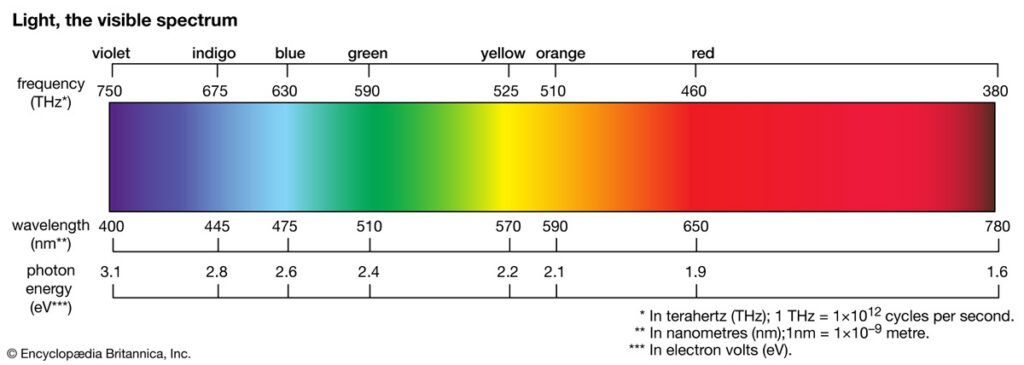
Sunlight appears white to our eyes, but this light is actually made up of all the colors of the visible spectrum, ranging from red through violet. On its path through the atmosphere, sunlight is scattered, and much of the visible wavelengths is absorbed or reflected by particles and gas molecules in the atmosphere at different times of the day.

Credit: Encyclopædia Britannica, Inc.

When the Sun is directly overhead at midday, incoming rays strike the atmosphere at nearly vertical angles. At this time, the shorter wavelengths that we perceive as violet and blue light are more easily separated. The net effect is that blue and violet are scattered throughout the sky away from the horizon. The midday sky, however, does not appear as a mix of blue and violet, because our eyes are more sensitive to blue light than to violet light. The remaining visible light made up of longer wavelengths (that is, from red, orange, and yellow bands in the spectrum) is still there, and the mix of these wavelengths create a whitish cast to the sky near the horizon. 

Credit: Diego PH/Unsplash

We also know that the sky doesn’t stay blue throughout the day. At sunrise and sunset, the Sun is closer to the horizon, and we are more likely to see a sky filled with reds, yellows, and oranges. During these times of the day, sunlight connects with the atmosphere at more-oblique (slanted) angles. Since sunlight needs to travel a greater distance through the atmosphere than it would at midday, longer wavelengths of light are more likely to strike and bounce off of oxygen molecules and other particles than they would at noon, whereas the blues and violets are mostly blocked by them and filtered out. 

As the influence of shorter visible wavelengths diminish, the color of the sky changes, giving us those romantic sunsets to backdrop a long walk on the beach.

Short Answer

The sky’s color is the result of how incoming light from the sun interacts with the atmosphere. At midday, the shorter wavelengths of light we perceive as blues and violets are scattered throughout the atmosphere, while longer-wavelength reds, yellows, and oranges pass through, still appearing white. At sunrise and sunset, the blues and violets are mostly filtered out, while the reds, yellows, and oranges are scattered throughout the atmosphere.

ENGINEERING

How Do Cruise Ships Stay Afloat?

Credit: Robert Noreiko/Unsplash.com
Melissa Petruzzello
Author
Melissa Petruzzello (she/her) is an Assistant Managing Editor at Encyclopaedia Britannica and covers a range of content including plants, algae, and fungi; insects and spiders; and renewable energy and environmental engineering. She also handles certain topics in Christianity, notably Protestant history and churches.

Cruise ships don’t look like they should float. Some of the largest vessels on the sea are closer to cities than boats and come stacked with restaurants, pools, theaters, and thousands of passengers. At a glance, they seem far too heavy to stay above water. And yet, they do, smoothly and reliably, like floating resorts that forgot they’re made of steel. So what’s keeping them from sinking to the ocean floor?

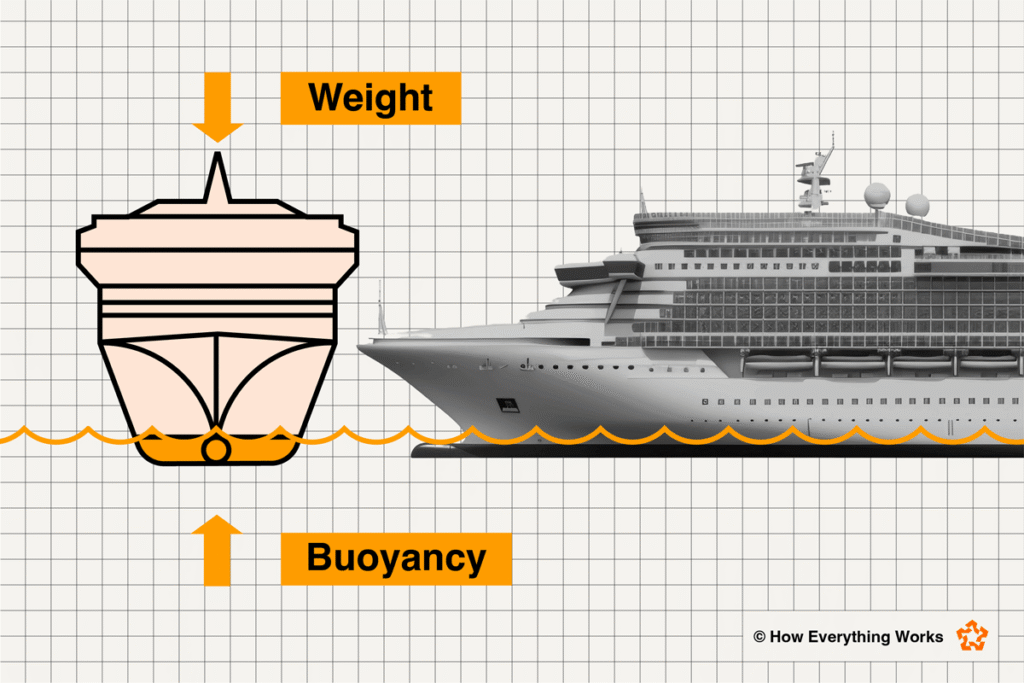
The answer comes down to a simple principle first described more than 2,000 years ago: buoyancy. According to Greek mathematician Archimedes’ principle, an object placed in water will float if it displaces a volume of water equal to its own weight. In other words, it’s not about how heavy the boat is — it’s about how much water it pushes aside. 

Credit: Custom Media/stock.adobe.com; Illustration How Everything Works

Making Waves

Cruise ships may be massive, but they’re also mostly hollow. Their hulls — the watertight outer shells — enclose large volumes of air, from passenger decks to cavernous interior spaces. This lowers the ship’s overall density, making it less dense than the water around it. As long as that remains true, the ship floats.

Shape matters, too. The wide, softly rounded hull of a cruise ship is carefully engineered to displace as much water as possible, creating a strong upward buoyant force. In effect, the shape helps spread the ship’s weight over a large area of water, keeping it from sinking too deeply. Interestingly, unlike traditional sailing ships, the bottom of most cruise ships is relatively flat, which helps increase stability, even in choppy seas. 

When a ship is launched, it sinks into the ocean until the weight of the water it displaces equals its own. As it’s loaded with mountains of food, booze, passengers, water slides, BINGO chips, and fuel, it settles deeper, displacing more water with every added ton. That weight is carefully distributed — not just front to back and side to side, but from bottom to top. Heavy engines and fuel are kept low in the vessel, while lighter spaces like restaurants and entertainment decks sit higher up. This lowers the ship’s center of gravity and helps prevent tipping. Modern ships also rely on ballast tanks — compartments that can be filled with water or air — to fine-tune balance and stability depending on conditions at sea.

Credit: Eric Prouzet/Unsplash.com

So while a cruise ship may look improbably large, its ability to float isn’t all that mysterious. It’s an engineering marvel, a careful balancing act between weight, volume, and design. Physics and good design can turn a seemingly impossible object into something that glides across the ocean — and offers three different all-you-can-eat buffets.

Short Answer

Cruise ships float thanks to buoyancy: They displace a volume of water equal to their weight, allowing them to stay afloat despite their size. Their large, hollow hulls reduce overall density, while careful design and weight distribution keep them stable.

CULTURE

How Is Mail Sorted?

A close-up shot of the back tire and bumper of a U.S. mail truck
Credit: Sean Boyd/Unsplash
Alicja Zelazko
Author
Alicja Zelazko is the editor of arts and humanities at Encyclopædia Britannica, covering topics in the visual arts, architecture, design, fashion, and performance. Before joining Britannica in 2017, she worked at the Art Institute of Chicago and taught courses in art appreciation.

Every hour in the U.S., more than 15 million pieces of mail are sorted and sent on their way. But the most interesting part isn’t the volume — it’s how little the system has changed since Benjamin Franklin oversaw it in 1775. The core idea is the same today as it was back then. What’s different is the speed. While Postmaster General Franklin ran the system by hand, today, technology has transformed mail sorting into a highly automated process.

Credit: Robyn Beck—AFP/Getty Images

From Collection to Carrier

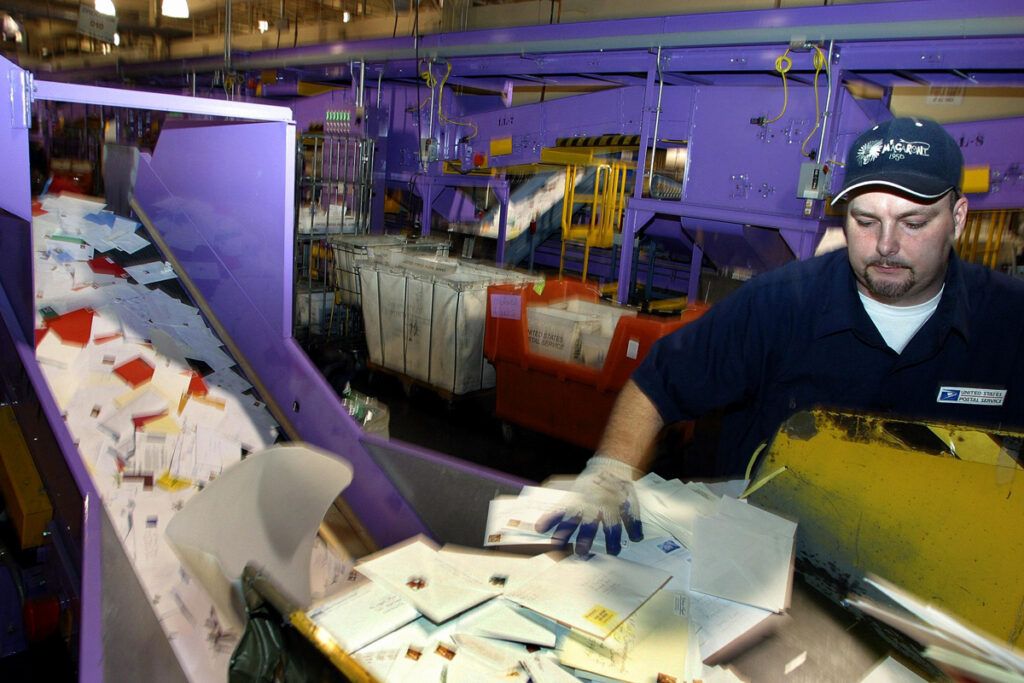
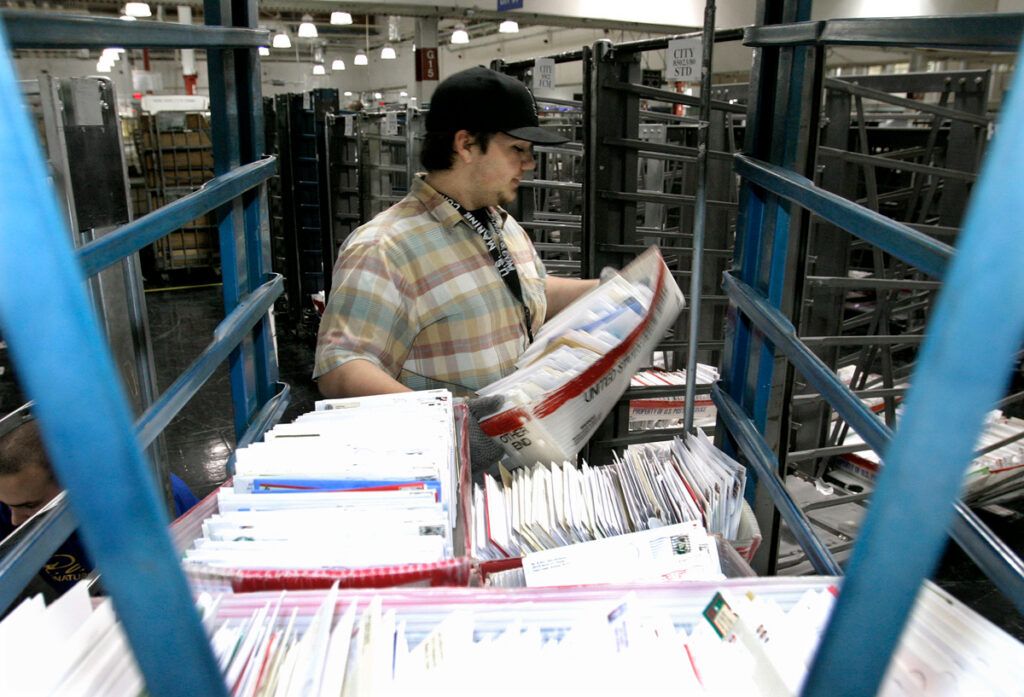
Mail sorting begins the moment your letter to grandma hits the mailbox. That envelope travels to a USPS sorting facility where high-tech equipment has replaced hands to separate items by size and shape, a step called culling. Then, rather than a human orienting each piece of mail so the address is upright (called facing) and canceling the stamp to prevent reuse, systems such as the Advanced Facer Canceller System (AFCS) complete the task.

But the mail is nowhere near ready to ship. Next is the address recognition step. What early postal workers did manually — reading each address then using their knowledge of cities, routes, and post offices to organize letters into labeled pigeonholes — is now done with high-speed scanners, advanced software, and automated sorting machines. Scanners first capture images of each piece of mail, software then identifies the destination ZIP code. The mail receives a new barcode containing routing information, which is read by an automated machine that then sorts the mail into bins organized by destination. As the item moves closer to its final destination, it is typically processed through several facilities, with each stage reading the barcode and sorting the piece into increasingly specific groups — think state, city, neighborhood, street, house — following the same basic logic that guided mail sorting in Franklin’s time, but executed with far greater speed and precision.

Credit: Jeff Topping/Getty Images

At the final processing center, you guessed it, more machines perform the final round of sorting, often arranging mail in the exact order it will be delivered along a carrier’s route. So when the mail is sent to local post offices, carriers no longer need to hand-sort the mail according to their route. They simply pick it up and complete delivery — and the long wait for your package or postcard is over.

Short Answer

Modern technology has made sorting mail far faster and more efficient, with USPS machines handling millions of items per hour. Mail is collected, organized, scanned, and assigned a barcode, then repeatedly sorted by automated systems as it moves closer to its destination. By the final stage, it is arranged in delivery order and sent out to carriers for delivery. 

NATURE

How Do Animals Survive Hibernation?

A close-up image of a brown bear in a cave with two cubs
Credit: byrdyak/stock.adobe.com
Kellie Stewart
Author
Kellie is a writer and editorial strategist covering topics in travel, trivia, and more. When she's not writing you can find her drinking Diet Coke.

Hibernation sounds like a dream: Eat a ton, take a long nap, wake up when the sun is shining. Except animals that hibernate aren’t really sleeping — and calling it a nap wildly undersells what’s actually happening. In fact, if humans hibernated the way animals do, we’d be considered clinically dead. So how do animals survive it?

During hibernation, animals enter a state called torpor, in which metabolism slows to a fraction of its normal rate. Heart rate and breathing drop dramatically. Waste production stops. Brain activity nearly flatlines. Body temperature can even dip below freezing. Sleep, by comparison, is busy: You’re still breathing steadily, dreaming, and running essential systems. Torpor is far more extreme. 

Credit: Stan/stock.adobe.com

More Than a Long Winter’s Nap

Hibernation is fundamentally about energy conservation. Endothermic animals—often called “warm-blooded” — can regulate their own body temperature, a process that burns a lot of fuel, aka food and water. When resources are scarce, like during a snowy winter, these creatures enter hibernation to conserve energy. But it’s not just animals in cold climates that hibernate — in fact, some tropical animals hibernate during hotter months when water is hard to come by.

Most animals will engage in a period of extreme eating (hyperphagia) before entering hibernation in order to store enough fuel to power their limited bodily functions through the long rest. 

Animals don’t spend their entire hibernation period in torpor. They cycle in and out of it periodically, though why exactly these periods of “interbout arousal” occur is a mystery. They do explain, however, how some mammals like female polar bears can give birth and lactate during hibernation. So when spring arrives, and mama bear leaves her den with a pair of frolicking cubs, that’s a pretty productive winter.

Credit: Getty Images/Unsplash+

SHORT ANSWER

During hibernation, animals enter a state of torpor during which their metabolism decreases to a fraction of its normal rate. Heart rate, breathing, and other physical activities like breathing and eating, slow or stop altogether to help conserve energy during a time of resource scarcity. While commonly associated with cold-weather animals, hibernation occurs in creatures across climate zones and species.

SCIENCE

Why Does Stirring Stop a Boiling Pot From Spilling Over?

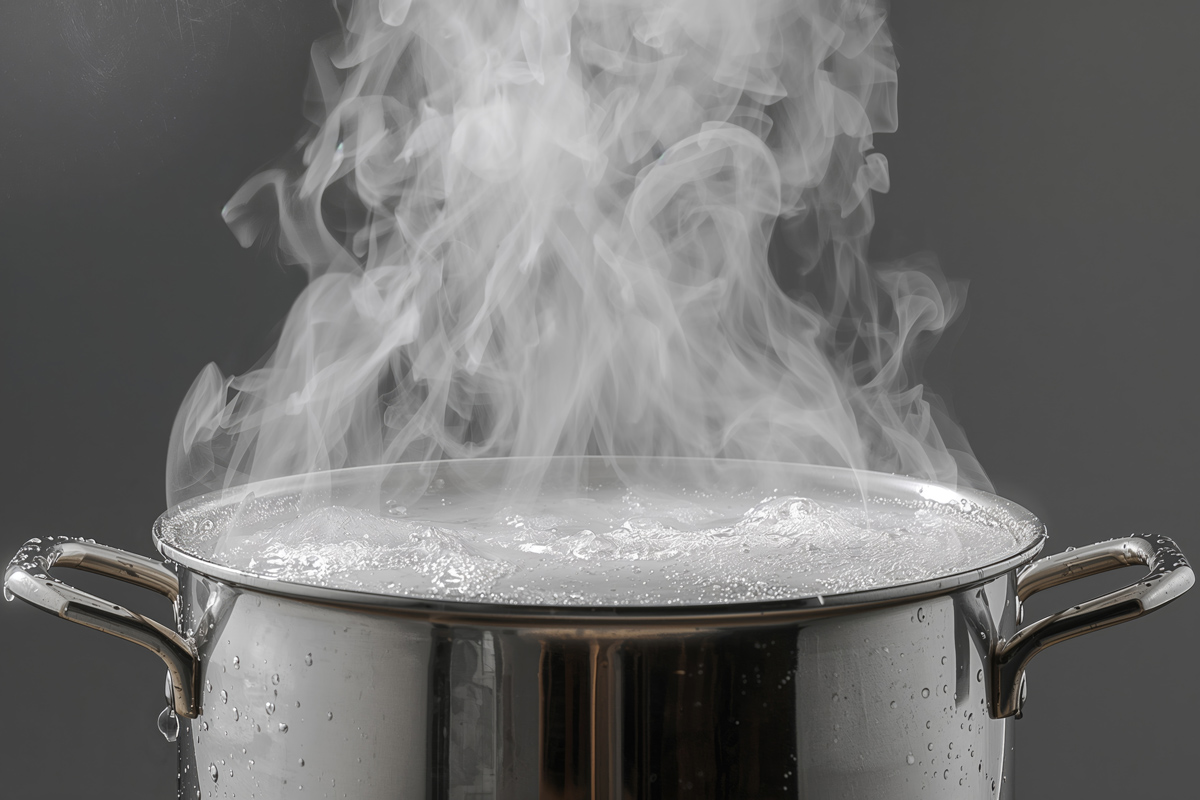
A black and white image of steam rising from a boiling pot of water.
Credit: Emin/stock.adobe.com
Bess Lovejoy
Author
Bess Lovejoy is a writer and editor who lives in Seattle. She is the author of the book Rest in Pieces: The Curious Fates of Famous Corpses, and her writing has also appeared in The New York Times, The Boston Globe, The Wall Street Journal, Time, Lapham’s Quarterly, The Public Domain Review, Atlas Obscura, and elsewhere. She was formerly an editor at Mental Floss and SmithsonianMag.com, and currently teaches classes on research.

They say a watched pot never boils, but once you take your eyes off the stove, that’s usually when things start really heating up — and spilling over the edges in a foamy froth. If you don’t want a big mess on your hands, you’ll probably grab a spoon to stir things up, bringing your pasta back to a nice rolling boil. But just what’s happening when you stir a pot to bring down the foam?

For such a simple gesture, there are a variety of mechanisms at work, but it really comes down to two primary factors: temperature redistribution and popping the bubbles.

Credit: Javier Esteban/Unsplash.com

Let’s Stir Things Up

Picture your boiling pot. The water at the bottom of the pot, closest to the heat source, is hotter than the water near the surface. Stirring the pot swirls some of that cooler water down, redistributing the heat and bringing the overall temperature beneath the boiling point. (The thing you’re stirring with — like a wooden spoon — will also temporarily absorb some of the heat.) 

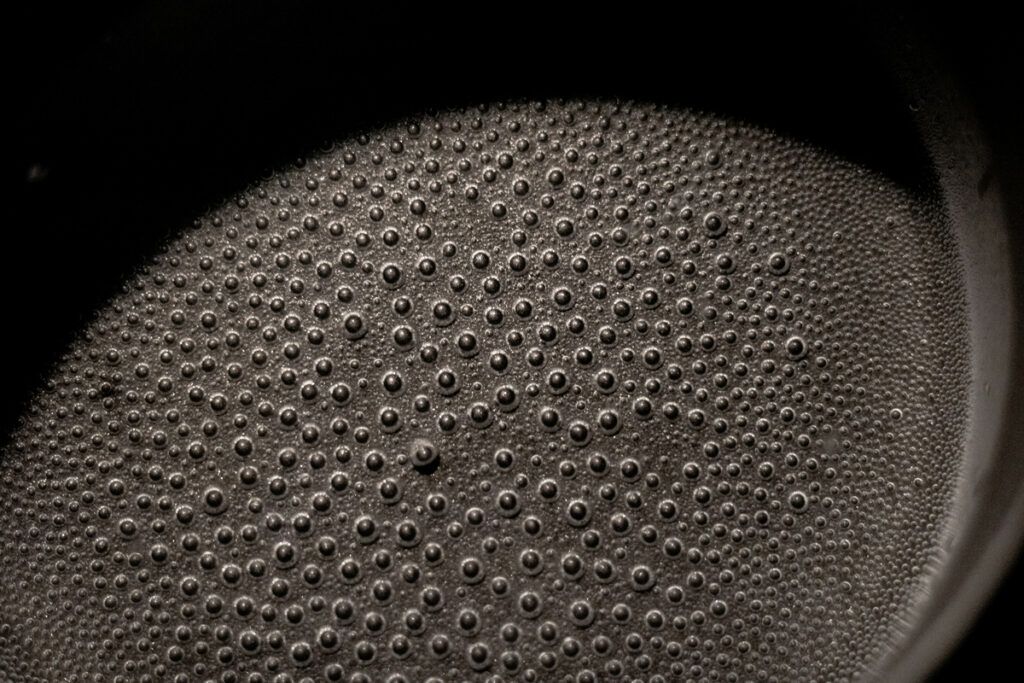
Additionally, those bubbles are fairly fragile, whatever mess they’re threatening. Stirring the bubbles causes them to tear or stretch and then — pop! Once some bubbles burst, other bubbles connected to them will also burst, bringing the foamy surface down to a more manageable layer.

If you’re boiling something like pasta, rice, or milk, the starches and proteins involved create sticky films, which trap steam and air and create an insulating layer of foam. That can cause overheating and make the pot more likely to boil over. Stirring that thick film releases steam, keeping it from trapping the heat and being even more likely to cause a big mess.

So don’t be afraid to stir the pot — in this case, it’s a good thing.

Credit: dals stock/stock.adobe.com

Short Answer

Stirring a pot redistributes the water temperature, bringing cooler water from the surface to the hot water below and lowering the temperature. It also breaks up the bubbles, stretching and tearing them until they pop, and releasing steam.

NATURE

Why Are Flamingos Pink?

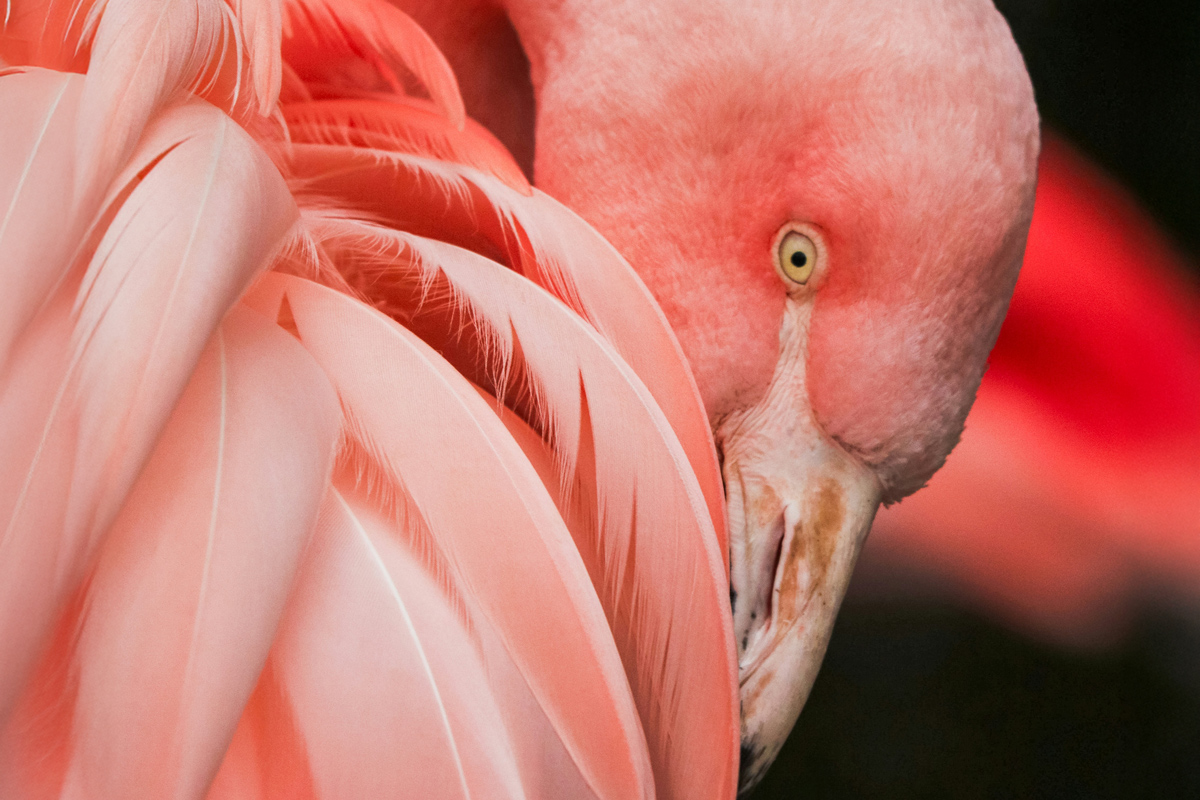
A close up of the wing and eye of a bright pink flamingo
Credit: Gwen Weustink/Unsplash
Bess Lovejoy
Author
Bess Lovejoy is a writer and editor who lives in Seattle. She is the author of the book Rest in Pieces: The Curious Fates of Famous Corpses, and her writing has also appeared in The New York Times, The Boston Globe, The Wall Street Journal, Time, Lapham’s Quarterly, The Public Domain Review, Atlas Obscura, and elsewhere. She was formerly an editor at Mental Floss and SmithsonianMag.com, and currently teaches classes on research.

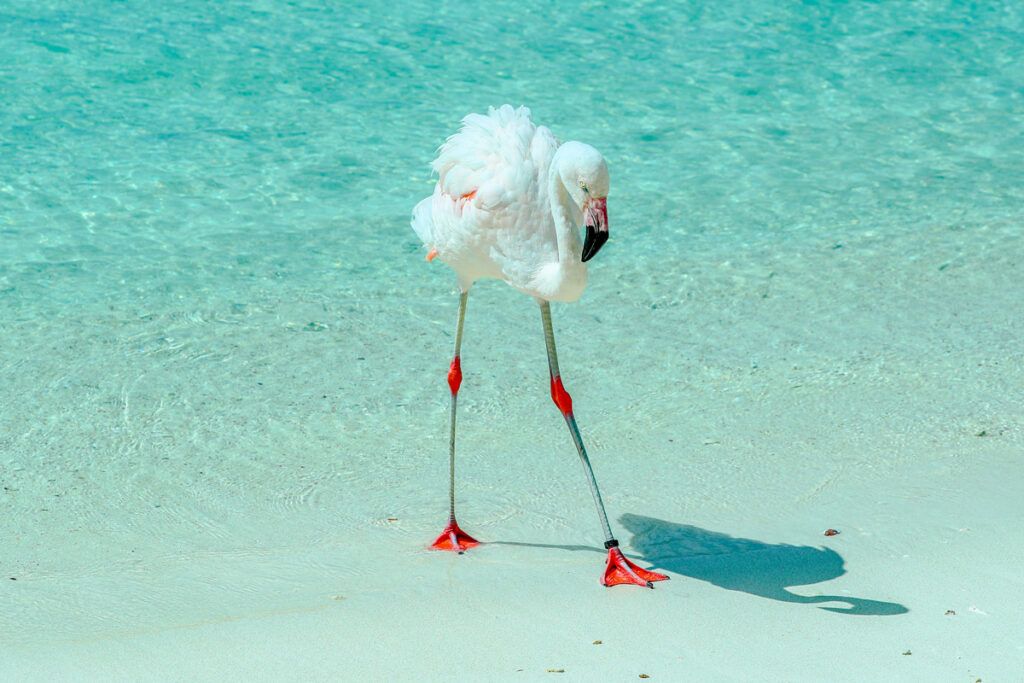
In the animal kingdom, flamingos don’t exactly blend in. A full-grown flamingo is unmistakable — cotton-candy pink, with neon flashes under its wings. Whether it’s standing on one leg in a pond or perched on a plastic lawn ornament, you know it when you see it.

But flamingos aren’t born that way. When newborn flamingo chicks hatch, they’re actually a dull gray or snow white. Their famous color develops over time, and it’s all thanks to their special diet.

Credit: Lex Melony/Unsplash

You Are What You Eat

Flamingos spend much of their lives wading through shallow lakes and wetlands, munching on blue-green algae, tiny crustaceans such as brine shrimp, and other microscopic snacks. These organisms are rich in a class of pigments called carotenoids — the same family of compounds that make carrots orange and ripe tomatoes red.

But eating those pigments isn’t enough to turn them cotton-candy pink on its own. Inside a flamingo’s body, those carotenoids are metabolized into byproduct pigments that are transported through the bloodstream and deposited into growing feathers, as well as the skin of the legs and the beak. The result: The bird gradually turns a pretty pink. 

The intensity of the color depends on their diet, and flamingos that consume more pigment-rich food can become deep pink, scarlet, or even bright orange. Birds that consume less, such as those that live in drought-plagued areas, may appear pastel.

Credit: Dattatreya Patra/Unsplash

Look closely, though, and you’ll see that flamingos aren’t entirely sunset-colored. Their flight feathers — the long feathers used for flying (yes, flamingos fly) — are tipped in black. That darker color isn’t just for looks: it comes from a different pigment called melanin, which helps strengthen the feathers for long flights.

So a flamingo’s color isn’t just for show, and they depend on a clean, healthy diet to stay glowing. In a very real sense, flamingos are what they eat.

Short Answer

Flamingos are pink because of pigments called carotenoids in their diet. When they eat algae and small crustaceans, their bodies convert these compounds into red pigments, which are carried through the bloodstream and deposited in feathers, skin, and beaks. Over time, this process turns them pink.

CULTURE

How Do Optical Illusions Trick Your Brain?

An optical illusion involving a white 3D triangle that appears to connect to itself
Credit: 愚木混株 Yumu/Unsplash
Bess Lovejoy
Author
Bess Lovejoy is a writer and editor who lives in Seattle. She is the author of the book Rest in Pieces: The Curious Fates of Famous Corpses, and her writing has also appeared in The New York Times, The Boston Globe, The Wall Street Journal, Time, Lapham’s Quarterly, The Public Domain Review, Atlas Obscura, and elsewhere. She was formerly an editor at Mental Floss and SmithsonianMag.com, and currently teaches classes on research.

Look at a classic optical illusion, and you might see a vase — or two faces. A grid might sprout ghostly gray dots that vanish when you stare straight at them. Two identically colored squares might somehow look like completely different shades. Your eyes aren’t broken. In fact, optical illusions have less to do with your eyes and more to do with your brain. 

We like to think of vision as a straightforward process: Light hits your eyes, and you see what’s there. In reality, your brain is doing something much more ambitious. It’s not just receiving information — it’s interpreting it, filling in gaps, and making its best guess about what you’re looking at. Most of the time, that guess is spot-on. But optical illusions reveal the cracks in the system.

Credit: martinjanecek/stock.adobe.com

It’s All an Illusion

The problem — or feature, if you love optical illusions — is one of speed. Your brain evolved to make split-second decisions based on incomplete information. (That’s useful for survival; events actually happen some milliseconds before we can perceive them.) Instead of carefully analyzing every pixel, the brain uses shortcuts: expectations about light, shadow, shapes, and more based on past experience with how the world usually works.

That’s why you’re able to do things like catch a fast-moving baseball or duck for cover when a bird flies your way. Your brain has interpreted the situation and made a quick, split-second decision on how to react. 

But it’s also why a shadow can trick your brain into thinking one square is lighter than another, even when they’re identical. Or why a flat drawing can suddenly flip into a 3D object. Your brain isn’t seeing the world as it is — it’s seeing the world as it expects it to be.

Sometimes, those expectations collide with reality.

Credit: Library of Congress, Washington, D.C. (LC-USZ62-99206)

Take the famous “which one do you see?” images, for example, where perception flips between two possibilities. That’s your brain choosing between competing interpretations — and refusing to hold both at the same time. It has to pick a story, even if more than one fits the evidence.

Not all illusions work the same way, of course — and scientists still don’t fully understand why some of them work at all. Plus, perception isn’t universal. Cultural background can shape how you interpret visual cues, and even age can influence what you see first in an ambiguous image. (In the famous “My Wife and My Mother-in-Law” image, for example, younger people are more likely to see the wife first, while older viewers see the mother-in-law first.)

The result is a reminder that perception isn’t passive. It’s a construction.

Which means optical illusions aren’t just party tricks. They’re glimpses into how your brain works — fast, efficient, and occasionally, a little too confidently.

Short Answer

Optical illusions trick your brain because vision relies on your brain’s interpretation. Your gray matter constantly fills in gaps, makes predictions, and relies on past experience to figure out what you’re seeing. Most of the time, those shortcuts help you understand the world quickly. But when an image is carefully designed to exploit them, your brain’s best guess turns out to be wrong — and that’s when you see something that isn’t really there.

HEALTH

What Does Your Appendix Actually Do?

A close-up photo of the midsection of a woman's exposed belly button
Credit: Hrant Khachatryan/Unsplash+
Melissa Petruzzello
Author
Melissa Petruzzello (she/her) is an Assistant Managing Editor at Encyclopaedia Britannica and covers a range of content including plants, algae, and fungi; insects and spiders; and renewable energy and environmental engineering. She also handles certain topics in Christianity, notably Protestant history and churches.

The appendix has a reputation as a useless troublemaker — the odd organ out, so to speak. Small, expendable, and quick to be removed, it’s long been the textbook example of a vestigial organ, a biological leftover from an earlier stage of human evolution. But as scientists have taken a closer look at this small structure, that assumption has begun to unravel.

The appendix is a narrow, finger-shaped tube attached to the beginning of the large intestine. For decades, it was thought to have no clear purpose in modern humans. It has also had a bad boy reputation: appendicitis is infamous for triggering emergency surgery (just ask Madeline who lives in a house in Paris covered in vines).  

Since removing the appendix is the standard response to appendicitis, we know that this appendage is not essential to our day-to-day functioning  But research suggests it may still play a modest but useful role in the body.

Credit: Encyclopædia Britannica, Inc.; Illustration How Everything Works

So What Does It Do?

One clue to the appendix’s usefulness lies in its evolutionary history. The structure appears to have evolved independently multiple times in mammals rather than being inherited from a single common ancestor — an unusual pattern that suggests it offers some recurring advantage. Even so, scientists agree that the appendix is gradually disappearing from the human species, meaning its benefits today may be subtler than they once were.

A key feature of the appendix is its concentration of lymphoid tissue. In practical terms, it appears to help the body recognize and respond to pathogens, contributing to immune development. Indeed, white blood cells in the appendix are exposed to a steady flow of foreign material from the gastrointestinal tract. Think of the appendix then as a sort of training ground where these immune cells learn to manage microbes and other would-be invaders.

The appendix also seems to play a role in human development. The organ begins to develop around 6-8 weeks of gestation, and begins producing endocrine cells that help maintain the body’s chemical balance, or homeostasis. It isn’t until about 10 weeks later that the organ starts acquiring its immune-boosting lymphoid tissues. 

The appendix is also thought to serve as a reservoir for beneficial gut bacteria. The human digestive tract depends on a complex community of microbes to aid digestion and maintain overall health. When illness — such as severe diarrhea — or antibiotic use disrupts this community, the appendix may help restore balance by sheltering helpful bacteria and reintroducing them to the gut. 

You can live without your appendix — that hasn’t changed. In fact, surgeons once routinely removed it just in case, but that practice has largely stopped.  Today, it’s recognized as a useful backup, one that can even be repurposed to help repair other parts of the body. So it’s less of a useless leftover and more of a handy spare part, ready and waiting if you ever need it. 

Short Answer

The appendix is neither useless nor indispensable. Instead, it appears to function as a quiet supporting player — contributing to immune development and possibly helping maintain the stability of the gut’s microbial ecosystem.