HEALTH
5 Ways Your Eyes Lie To You Every Day

Every day is full of visual illusions. That doesn’t mean you’re walking around a giant hallucination, with everything resembling one of those “Magic Eye” posters. Instead, these illusions are usually just subtle signals from your eyes that your brain misinterprets.
These visual distortions stem from how vision works — your eyes “see” something by receiving light, before interpreting that light and sending it to your brain via nerve signals. Your brain then creates your perception based on these signals.
Sometimes your brain fills in missing information, predicts patterns, or even imagines things that aren’t even there as it “builds” the final images you see. You encounter some of the most frequent visual illusions without realizing it. Here are five of them.
The Moon Illusion

We have at least 12 full moons every year. Imagine one of those moons as it slowly rises. It looks much bigger on the horizon than it does high in the night sky. Sometimes it looks absolutely massive. But the size of the moon never changes, and it doesn’t move closer to the planet in any way that accounts for such a larger look.
Scientists are still unsure what exactly causes this discrepancy, but it may be an illusion caused by our brain’s depth perception system. When the moon is on the horizon, it’s often surrounded by trees, buildings, and the distant landscape, so our brain, which compares it to those adjacent objects, misjudges both how close and big it really is.
When the moon is high in the sky and we have no depth cues, it looks smaller. This is the same logic behind the Ponzo illusion, which is how a railroad track looks smaller in the distance, even though it’s exactly the same width. Our brain uses context to interpret size and sometimes we get fooled.
Color Constancy

Remember the viral image of the dress that divided the internet over whether it was white and gold or blue and black? (It was white and gold, by the way). [Editor’s note: Actually, it was blue and black.] That’s an optical illusion known as color constancy. It’s how your brain keeps colors looking consistent even when lighting changes.
Here’s another example: Imagine a bowl of bananas. The bananas look yellow whether the bowl is sitting in sunlight, shade, or your kitchen. That’s because when the light hits your eyes, your brain keeps the colors consistent. The lighting changes, which objectively affects the coloring, but your brain automatically adjusts the hues for you. (The reason the viral dress looks different to different people is because, unlike with a banana, our brain isn’t primed to expect any specific color.)
We use color constancy all the time — a stop sign doesn’t look grayer on a cloudy day, for instance. Without color constancy, everything would constantly appear to change color.
Forced Perspective
Your brain uses visual clues to measure distance and typically assumes that things higher — or farther away — in the frame are smaller than they appear. When you see a building in the distance and block it with your finger, you know it’s not actually smaller than your thumb. But sometimes the brain “forgets” this difference in size, especially when it’s not something we’ve come to expect, such as a distant skyline.
Because of this, you can use forced perspective to rearrange your size and depth cues, which is an illusion often used in photography and filmmaking. You can try this anytime with a few friends and make objects look bigger, smaller, closer, or farther than they are by arranging how they appear in a photo. It’s a popular trick to do at tourist attractions like the Leaning Tower of Pisa and the Eiffel Tower, making it appear as if you’re holding a landmark in your hand.
Movies also use this trick — in The Lord of the Rings, Gandalf appeared much taller than the hobbits because he sat closer to the camera, with props such as candles and teacups made smaller to further exaggerate his size.
Wagon-Wheel Effect
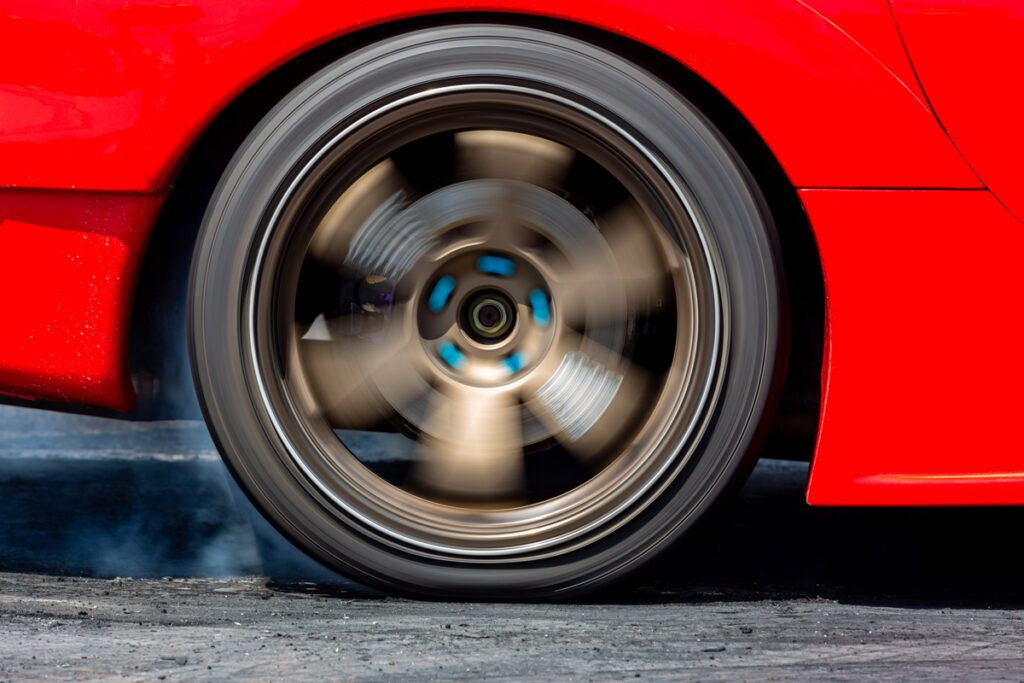
Have you ever seen a car drive by that looked as if its wheels were spinning backward, or perhaps not at all? This same illusion can also be recreated if you turn on a ceiling fan and record it with your phone’s camera. As the blades begin to rotate, they look like they’re spinning in one direction, but as the fan reaches full speed, it appears to change directions.
Both are examples of the wagon-wheel effect, which occurs because your brain (or your camera) perceives the world in separate snapshots, not as one smooth motion. Fan blades or spokes of a wheel mess with this perception when their rate of motion is out of sync with the rate your brain takes its “snapshots.”
If every snapshot sees a spoke in the same spot as before, it thinks the wheel isn’t moving. If the spokes appear slightly behind where they were with each snapshot, the wheel appears to be moving backward.
Delboeuf Illusion

Size matters, at least when it comes to your plate and how much you eat. Because your brain compares food to the plate it’s served on, when you put a small amount of food on a big dish, it looks like you don’t have enough. Put the same amount of food on a small plate, and it suddenly looks like more.
This is known as the Delboeuf illusion, and it’s possible because your brain gauges the size of something by comparing what’s around it. The Delboeuf illusion is a visual trick that makes a circle look bigger when it’s surrounded by a slightly larger ring, but smaller when surrounded by a much larger ring.
Studies show we like to fill up our plates, no matter the size, to feel satisfied from a meal. That means you can use optical illusions to cut down on calories, using smaller dishes to feel full. Just as your brain tricks you sometimes, you can trick your stomach.