HEALTH

Why Do You Yawn When Someone Else Does?

A person yawning
Credit: Antonioguillem/stock.adobe.com
Sarah Gleim
Author
Sarah Gleim is an Atlanta-based freelancer with more than 25 years of experience writing and producing explainers and features about history, science, food, and health for media outlets such as AARP, WebMD, The Conversation, History.com, HowStuffWorks, CNN, and others. She's also the editor of several cookbooks for Southern Living and Cooking Light.

Your body performs many functions that could be considered, well, unusual. Take yawning, for instance. It’s a mostly involuntary reflex brought on by various situations, such as being tired, bored, or even stressed. 

Though the mechanism isn’t fully understood, researchers believe yawning may help wake up your brain by increasing your heart rate, stretching your facial muscles, and reducing your brain’s temperature.

What’s even stranger, though, is that when you see someone yawn, it can trigger you to yawn, too. Even thinking about a yawn can cause one — you may have just yawned while reading this, in fact. Does that mean yawning is contagious? Colds are contagious, but you can’t catch one by reading about it. 

So what exactly makes a yawn — or even the thought of one — cause another yawn?

Copycat Brain Cells

A person yawning during a business meeting
Credit: Kay A/peopleimages.com/stock.adobe.com

Scientists have been trying to figure out why yawning is “contagious” for decades. One leading theory has to do with mirror neurons. These are specialized brain cells that were first discovered in the 1990s, which can fire when you perform an action as well as when you see someone else do the same thing. 

These neurons tell your brain to “mirror” the actions and emotions of others, and may help us learn from others. There’s still debate about the role mirror neurons play in yawning, but at least one functional magnetic resonance imaging (fMRI) study has shown that when you see someone yawn, the areas of the brain that control social cognition and imitation are activated. 

That means your brain subconsciously mimics the physical action of the yawn you just witnessed. It’s an automatic imitation response known as the “chameleon effect.” Mirror neurons may even be activated simply by reading or thinking about a yawn.

You can see an evolutionary advantage to the phenomenon. If you’re in a hot environment with someone and see them yawn to cool their brain temperature, you probably should be doing the same.

Humans Are Social Creatures

A lion yawning
Credit: Getty Images/Unsplash.com

Other scientists, though, think contagious yawning has more to do with socialization and empathy. Social species, including lions, chimpanzees, and domestic dogs, might yawn together to help the group stay alert or shift from resting to waking states. 

Because of this highly social function, whether you mimic a yawn could be influenced by how close you are to the person doing the yawning. A landmark study found that you’re more likely to yawn when you see a relative or friend yawn than an acquaintance or stranger.

According to one 2010 study published by The Royal Society, contagious yawning also doesn’t begin at birth. In the study, it wasn’t observed in children until they were around age 4 or 5, when traits such as empathy — experiencing the emotions of others — become more developed. Not everyone is susceptible to contagious yawning. In studies where people were shown others yawning on video, between 30% and 60% responded by yawning back.

So why are some people less likely to catch yawns than others? Personality traits, empathy levels, intelligence, and genetics could all play a role. One small study found that people with high levels of psychopathic personality traits — including reduced empathy, mimicry, and group cohesion — are less susceptible to yawning contagiously. 

Even after decades of research, why we yawn when someone else does remains a challenge to answer with certainty. While empathy, social bonding, and copycat brain cells are all possible factors, maybe this strange phenomenon is just proof of how deeply connected we are as humans.

Short Answer

While the reason for contagious yawning is still being studied, one leading theory is that it’s triggered by brain cells called mirror neurons that mimic the actions of others (or even actions you’re just thinking about). Studies also suggest it’s closely linked to empathy and social bonding, which is why people are more likely to “catch” a yawn from friends or family than from strangers.

NATURE

What Exactly Are the Northern Lights?

Northern Lights over Iceland
Credit: Mark Balkens-Knurre/Unsplash.com
Mike Diaz
Author
Mike Diaz is a Los Angeles-based television writer and producer who got his start making docuseries for National Geographic. Most recently, he wrote for Magnum P.I. and NCIS: Hawai'i on CBS.

Each year, tens of thousands of tourists flock to remote parts of the far north for a very specific reason. It’s not to visit Santa’s Workshop — it’s to see the northern lights. 

These colorful bands of undulating light are called auroras and are named after ancient Roman gods: Aurora is the goddess of the dawn. Aurora borealis, the lights seen in the Northern Hemisphere, are named after the god of the northern wind. Aurora australis, aka the southern lights, are named after the god of the southern wind.

The majestic names appropriately describe the cosmic light show, which seems like something out of a fantasy movie. But the northern lights (and the southern lights) are purely natural, bound by the laws of physics. The colorful phenomenon originates on the surface of the sun, nearly a hundred million miles away. 

In space, the sun creates what’s known as solar storms. And the northern lights? You can think of them as a solar storm’s lightning.

The Colors of the (Solar) Wind

Diagram showing how the northern lights work
Credit: How Everything Works

The sun is an enormous thermonuclear reactor, ceaselessly emitting radiation in all directions. These particles traveling through space are called solar wind, and are part of the universe’s cosmic weather. If you thought Florida was bad, imagine a solar storm. Solar storms occur when more particles explode from the sun than usual, through solar activity such as flares and coronal mass ejections.

Just as strong wind here on Earth can create thunderstorms, strong solar wind becomes solar storms. The energy produced by solar storms is massive — a nuclear reactor would need to operate continuously for hundreds of thousands of years to approximate the electromagnetic radiation produced by a single solar flare. 

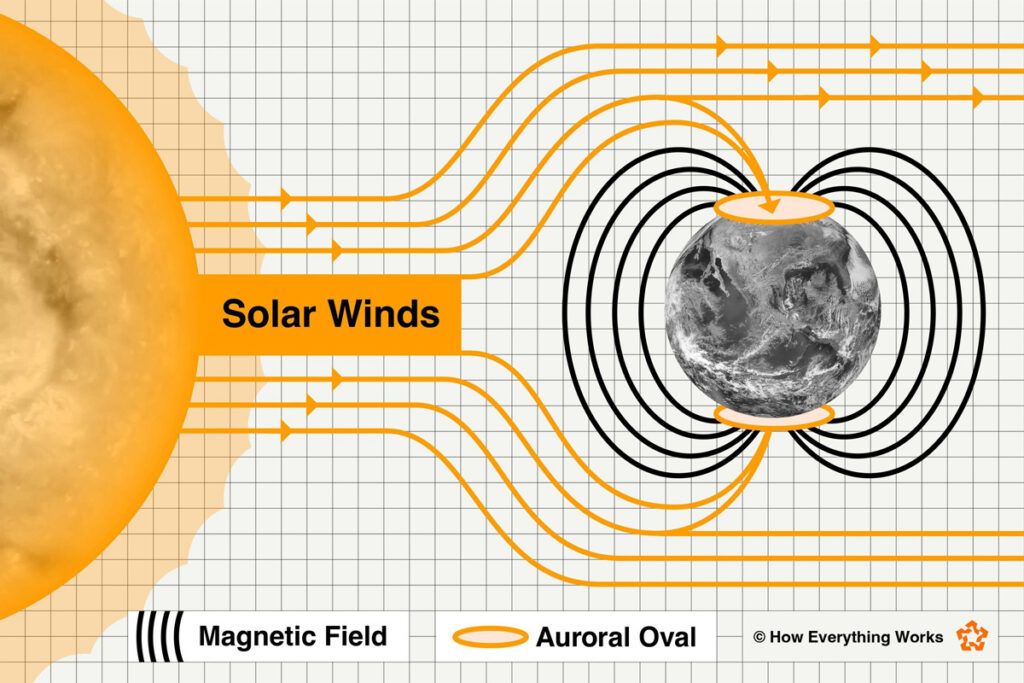
Sometimes, Earth orbits directly into the path of this radiation. This would spell doom for us earthlings, were it not for an invisible force field protecting the planet. That force field is known as the magnetosphere — which has nothing to do with Magneto from X-Men, and everything to do with Earth’s magnetic field. 

When it’s not helping birds migrate, the magnetic field protects our planet by guiding harmful solar radiation around Earth. Like water going around a rock in a stream, solar wind flows around the planet.

Diagram showing how various colors appear in the northern lights
Credit: How Everything Works

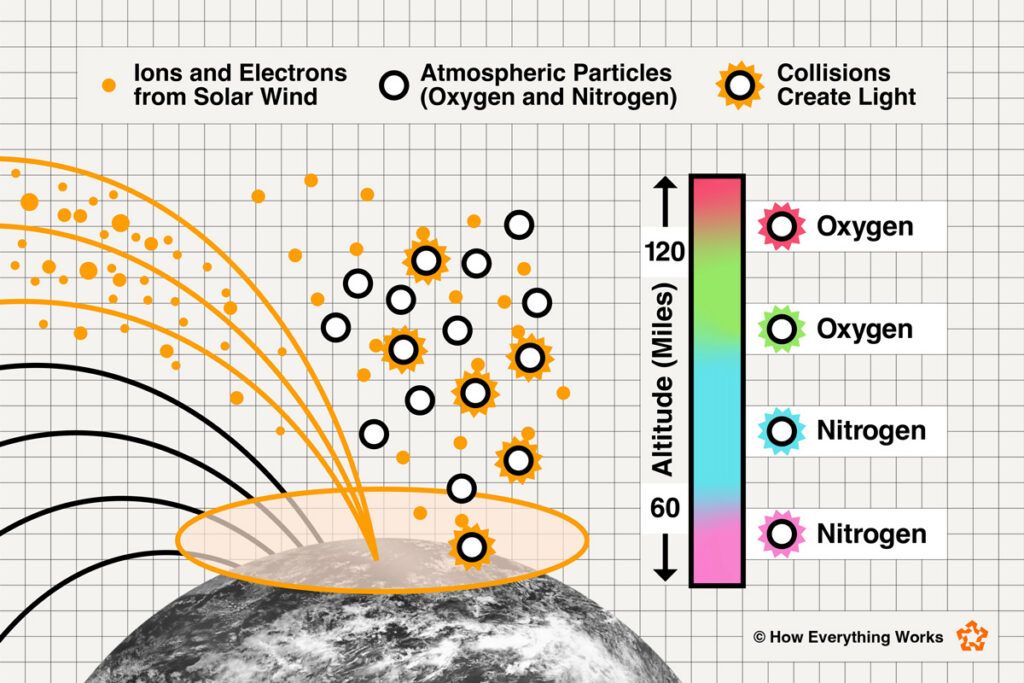
But particularly strong “gusts” of solar wind accelerate particles fast enough to penetrate the magnetosphere and enter Earth’s upper atmosphere.  Electrons from the sun collide with oxygen and nitrogen in the air, causing each atom to emit a flash of light. Some atoms become electrically charged, or ionized, in the process as well, which also creates light.

Different gases emit different colors, depending on the altitude. Oxygen interacting with solar wind at an altitude of 120 miles or more produces red, while at lower altitudes it produces green — the most common aurora color. Nitrogen, on the other hand, produces blue and pink. 

Replicate the process billions of times and you’ve got quite the (northern) light show! The colors form tall curtain-like bands because they’re actually shaped by normally-invisible lines in Earth’s magnetic field.

Aurora
Credit: Jonny Gios/Unsplash.com

Unfortunately, most of us don’t see auroras in the wild because they tend to only occur in the northernmost and southernmost reaches of the globe. This is because Earth’s magnetic field funnels solar particles to the poles, just as it guides migrating birds north and south. However, when a solar storm is strong enough, the magnetic field is overwhelmed and particles can reach the atmosphere at lower latitudes.

Often, the stronger the storm, the further south the northern lights can appear. They’ll also be more colorful as particles reach lower altitudes than usual. In 2026, the largest solar storm in two decades created aurora that could even be seen over Southern California — at that point, calling them northern lights is borderline confusing!

Solar storms that powerful are rare, though, and auroras are typically confined to the Arctic and Antarctic. If you don’t have plans to spend a night under Arctic skies anytime soon, don’t sweat — er, freeze — it, though. Just head to Vegas, because neon lights are made using the same process that generates the northern lights in our atmosphere. The science is just more… down to earth.

Short Answer

The northern lights occur when particles from the sun collide with gases in our atmosphere. Solar electrons excite oxygen and nitrogen atoms, which emit light in different colors depending on the altitude.

ENGINEERING

Why Are Objects in Car Mirrors Closer Than They Appear?

Passenger-side mirror
Credit: Alec baker/Unsplash.com
Sarah Gleim
Author
Sarah Gleim is an Atlanta-based freelancer with more than 25 years of experience writing and producing explainers and features about history, science, food, and health for media outlets such as AARP, WebMD, The Conversation, History.com, HowStuffWorks, CNN, and others. She's also the editor of several cookbooks for Southern Living and Cooking Light.

Modern cars come equipped with cutting-edge safety systems, including airbags, automatic emergency braking, and blind spot monitoring. But there’s also a very low-tech safety feature automakers attach to every passenger car at no extra cost: the side-view mirror.

A passenger-side mirror is designed in such a way that it minimizes a driver’s blind spots. However, this design also comes with an unavoidable side effect that, ironically, can make it more dangerous to drive, turning blind spots into optical illusions.

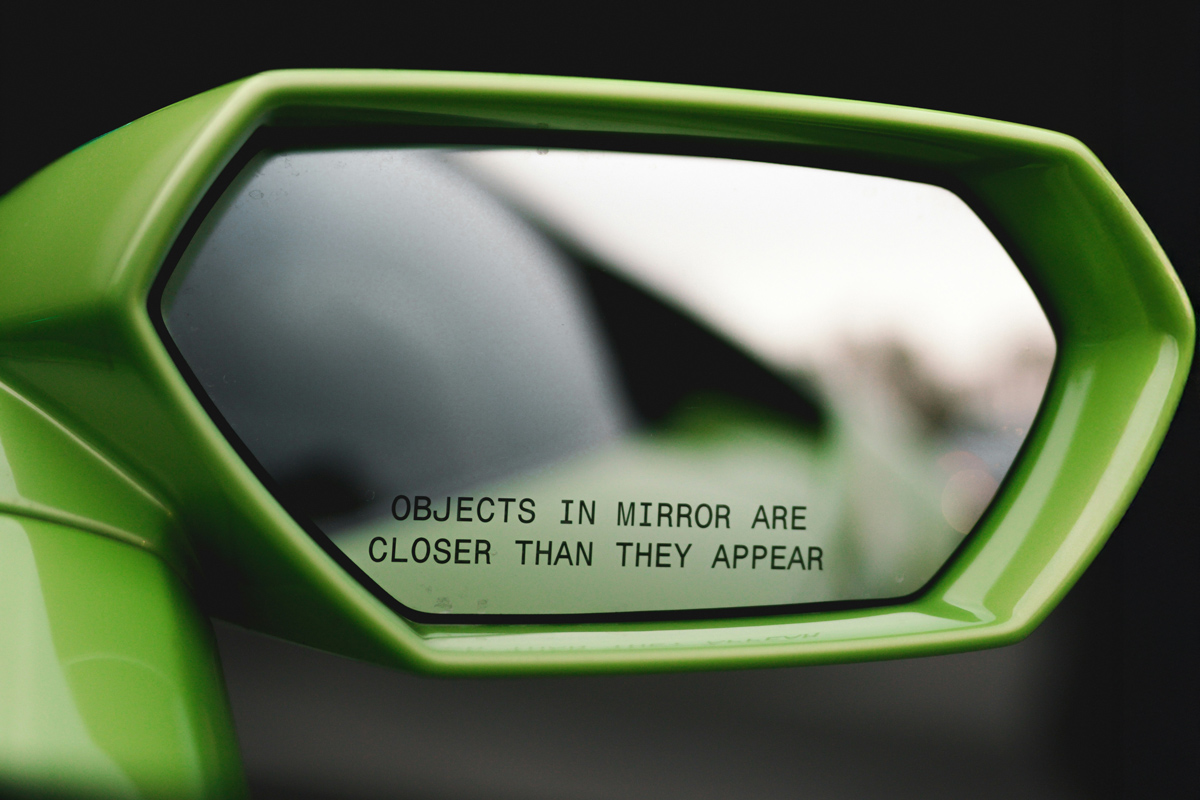
This side effect is significant enough that it’s required to include a warning etched right onto the glass: “Objects in mirror are closer than they appear.” It sounds like a legal disclaimer, but what does it even mean, and why does something intended to make driving safer come with such a trade-off? 

Perhaps more importantly, why doesn’t this mirror show objects as they appear?

The Two Side Mirrors Aren’t the Same

Passenger-side mirror reflecting a desert road
Credit: Alyssa Jane/Unsplash.com

Let’s start with the shape of the mirror. The mirror on the driver’s side is flat, just like the one in your bathroom. It doesn’t distort size or shape, so what you see is a true reflection of what’s on the road.

But the passenger-side mirror is different. It’s convex-shaped, which means it’s slightly curved and rounded. When light reflects off objects on the road and hits the curved mirror, it spreads out before it reaches your eyes, distorting the image.

The distortion isn’t random. Light rays always travel straight, and there’s a lot of complicated geometry that can calculate the exact angles of light every curve of a convex mirror will reflect compared to a flat mirror.

The way a convex mirror reflects light gives it a much wider field of view, which is why it’s attached to your car. The wider view helps reduce blind spots, allowing you to see more of the lane beside and behind your car. If the passenger-side mirror was flat, you’d only be able to see a small part of the road.

Your Brain’s False Assumptions

Sunset reflected in a passenger-side mirror
Credit: kvdkz/stock.adobe.com

Just like the wide-angle lens of a camera, the more information you try to cram into a space, the smaller everything appears. That’s the trade-off. 

Your eyes trace reflected light in straight lines, looking for their source — your brain doesn’t realize you’re looking at a mirror, so it traces the imaginary paths of light backward behind the glass. That’s why objects in a mirror look like they’re actually on the other side of the glass rather than on a flat surface.

When light is spread out from a convex mirror, these imaginary lines intersect at a smaller distance, which compresses the image and makes it look smaller than it really is. This, in turn, makes these “smaller” objects seem farther away than they are. But why?

Once again, it’s because of false assumptions made by your brain. It instinctively falls back on the basic principle of depth perception and relative size. The further away something is, the smaller it seems. That’s why the sun and moon look about the same size in the sky, even though the sun — which is much, much further away — is much, much bigger.

Conversely, when something is smaller in a convex mirror, it looks further away — especially when you already have an idea of how large something like a car is supposed to be.

Because cars reflected in the passenger-side mirror are reduced in size, your brain thinks they are farther away than they really are. That can be a dangerous misperception, since you really want to know how close other cars are to you while driving. 

That’s why, for decades, it’s been mandatory in the United States that a warning is etched directly into the mirror, constantly reminding you that what you’re seeing is actually an optical illusion. Even though today’s modern vehicles include high-tech mirrors with blind-spot monitoring systems and rear-facing cameras, the convex passenger-side mirror is still used to provide drivers with a wider view of the road. 

It’s a very helpful safety feature when you’re driving — provided you remember that tiny car in the mirror is actually right behind you.

Short Answer

Passenger-side car mirrors use a curved (convex) design that helps provide a wider field of view and reduce dangerous blind spots. But the shape of the mirror makes objects appear smaller than they really are. Your brain instinctively misinterprets the depth perception and assumes the “smaller” vehicles are farther away than they are. To counteract this optical illusion, federal regulators mandate a warning be etched onto passenger-side mirrors.

HEALTH

How Does Sunscreen Stop a Sunburn?

Person applying sunscreen to their leg
Credit: Kateryna Hliznitsova/Unsplash.com
Bess Lovejoy
Author
Bess Lovejoy is a writer and editor who lives in Seattle. She is the author of the book Rest in Pieces: The Curious Fates of Famous Corpses, and her writing has also appeared in The New York Times, The Boston Globe, The Wall Street Journal, Time, Lapham’s Quarterly, The Public Domain Review, Atlas Obscura, and elsewhere. She was formerly an editor at Mental Floss and SmithsonianMag.com, and currently teaches classes on research.

On a scorching summer day, having nothing but a thin layer of lotion standing between your skin and a sunburn can seem like the flimsiest of defenses. After all, it’s the sun, the most powerful source of energy in our neck of the galaxy. But somehow it works. 

How can something you paid just a few bucks for and squirt from a bottle protect you from powerful UV radiation blasting your skin for potentially hours at a time?

Sunscreen isn’t a form of medicine that fights skin damage like your immune system might. It’s more like a bouncer, stopping most of that solar radiation at the door before it can ruin your skin’s party (or at least, your afternoon at the beach).

Catching Rays

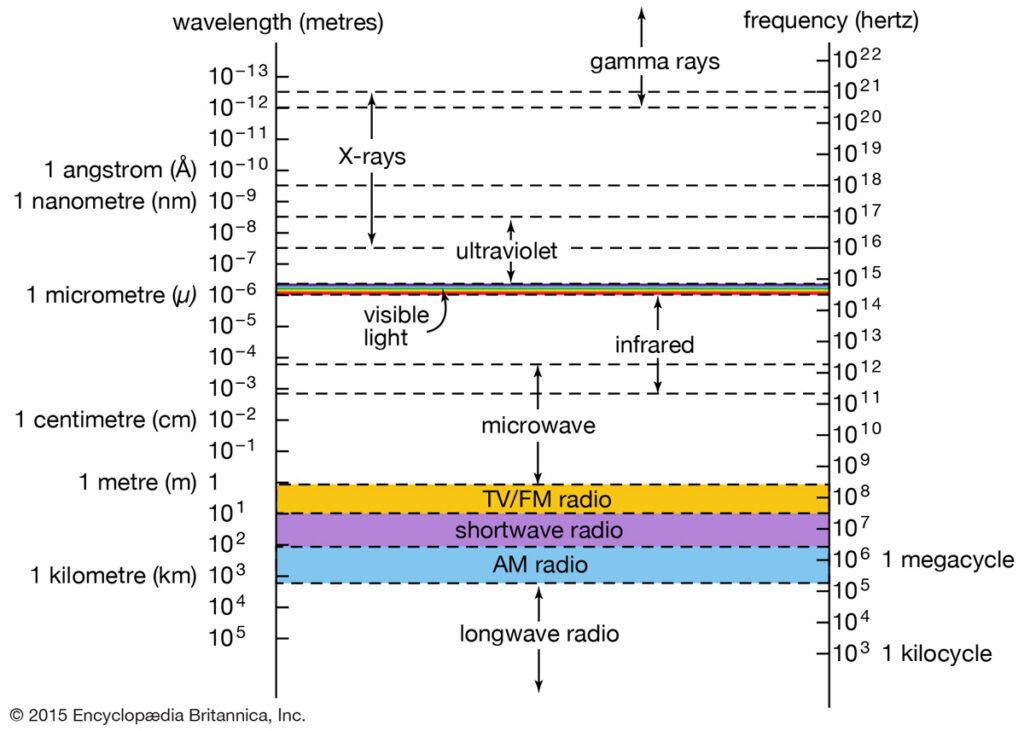
Diagram of UV radiation
Credit: Encyclopædia Britannica, Inc.

A sunburn isn’t a heat burn, like the kind you might get from grabbing a hot pan handle. Instead, it’s your body’s own response to damage caused by ultraviolet (UV) radiation that, while invisible, makes up about 5% of sunlight reaching the surface. Think of the visible wavelengths of light as the colors of the rainbow: red, orange, yellow, green, blue, indigo, and — finally — violet. UV is what comes next, hence “ultraviolet.” 

When UV rays penetrate the skin, they can physically alter cells, damaging them and your DNA. In response, the body launches an inflammatory reaction, increasing blood flow to the area and causing redness, tenderness, and swelling.

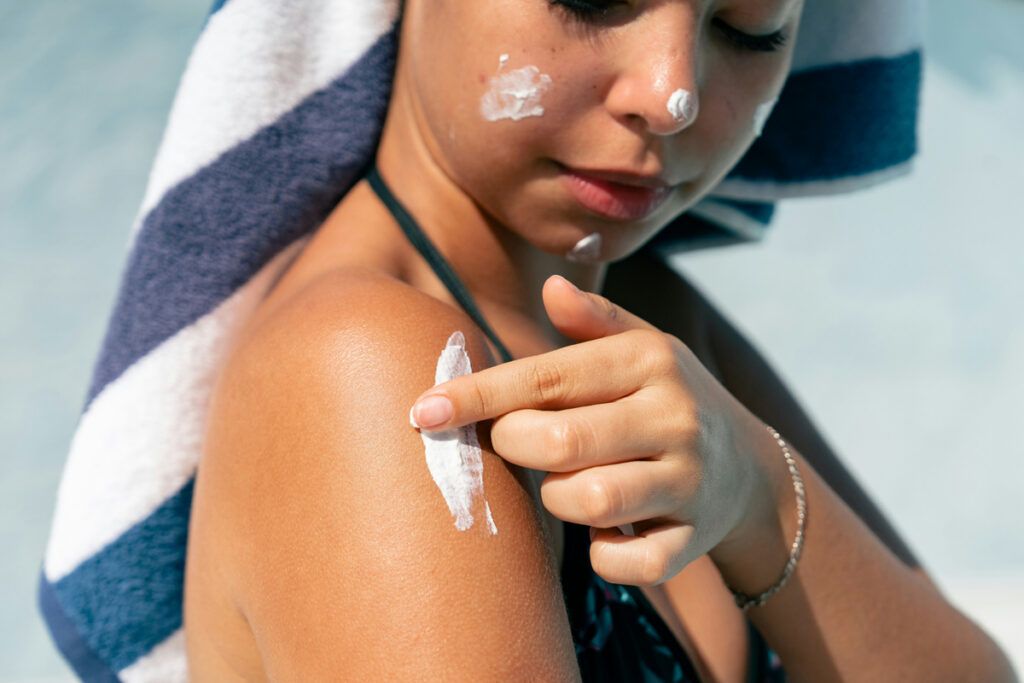
Sunscreen helps prevent sun damage in the first place by forming a protective film on the surface of the skin. This film contains special ingredients that serve as UV filters, like microscopic pairs of sunglasses for your skin cells. The filters interact with incoming ultraviolet radiation before it can penetrate deeply enough to wreak havoc.

Person applying sunscreen to shoulder
Credit: Fellipe Ditadi/Unsplash.com

Sunscreens are often divided into two categories: chemical and mineral. Chemical sunscreens contain organic UV filters — not “organic” in the grocery store sense, but meaning they contain carbon-based compounds (which can be unnecessarily absorbed into your bloodstream). Mineral (or physical) sunscreens contain inorganic ingredients, usually zinc oxide, titanium dioxide, or both. Many modern sunscreens combine ingredients from both categories.

For years, people were often told that chemical sunscreens absorb UV rays while mineral sunscreens reflect them. Scientists now know the story is more complicated. Most sunscreen ingredients, including the mineral filters zinc oxide and titanium dioxide, protect the skin primarily via the same process. And that process is absorbing UV radiation.

When a UV ray strikes one of these ingredients in your sunscreen, its energy is absorbed and converted into a tiny amount of heat. The amount of heat is so small that you can’t feel it, but it means the UV energy is no longer available to harm your skin. In a sense, sunscreen gives UV energy somewhere else to go before it can collide with your DNA.

The Myth of SPF

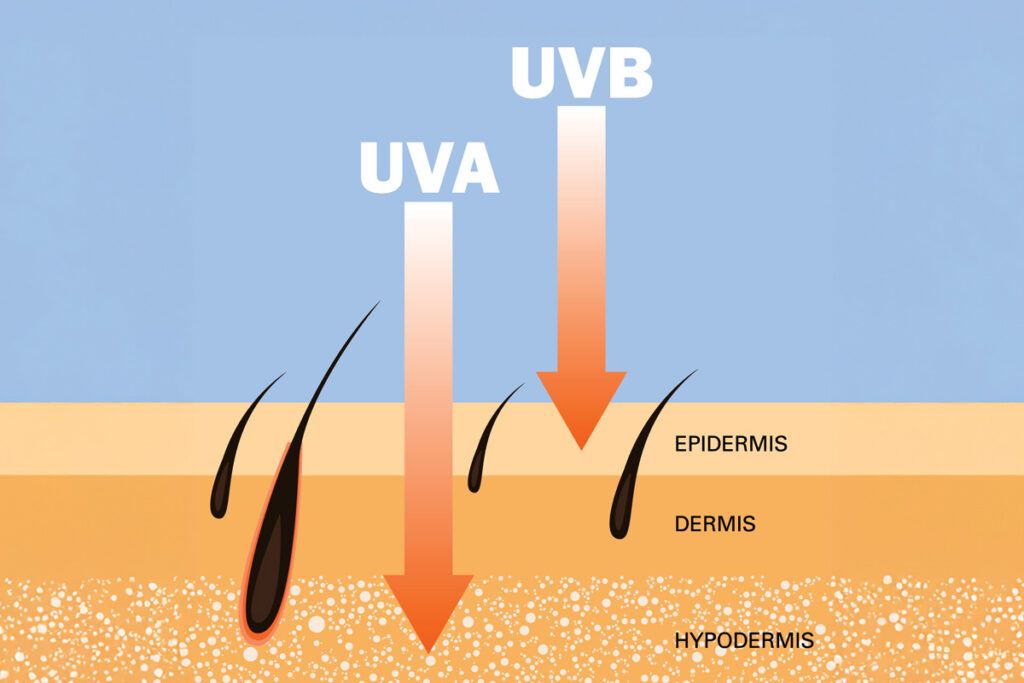
Illustration of how UV penetrates skin
Credit: ppdesign/stock.adobe.com

Not all UV rays are the same. UVB rays are the chief sunburn culprits, while UVA rays penetrate more deeply and contribute to wrinkles and other signs of skin aging. That’s why dermatologists recommend broad-spectrum sunscreens, which are designed to protect against both.

The SPF on your sunscreen bottle stands for “sun protection factor.” Many people think SPF measures how long you can stay in the sun without burning, but that’s a common misconception. Instead, it tells you how much UV radiation you can absorb before starting to sunburn. 

It’s an important distinction, because the amount of UV radiation you receive at any given moment depends on many factors, including the time of day, cloud cover, your skin type, and how much sunscreen you apply. Never assume you’re safe from burning for 30 minutes simply because you’re using SPF 30.

Sunbathing accessories by the pool
Credit: Curated Lifestyle/Unsplash.com

In general, a higher SPF provides greater protection against UVB rays, the main cause of sunburn. The Skin Cancer Foundation recommends wearing SPF 50+ when you’re outdoors for an extended time and SPF 30+ for typical daily use. It also recommends using a water-resistant broad-spectrum sunscreen. That’s because sunscreen isn’t some magical, impenetrable force field. 

Water (from sweat or the pool) will break down its formula, as will friction. Plus, people tend not to apply the recommended amount. Eventually, it will wear off, maybe sooner than you need, and some UV radiation will still reach your skin. 

That’s why dermatologists recommend combining sunscreen with other forms of protection, such as hats, sunglasses, protective clothing, and good old-fashioned shade. (Trees have been in the sunscreen business for a very long time.)

Short Answer

Sunscreen prevents sunburn by reducing the amount of ultraviolet radiation that reaches your skin. Its active ingredients absorb much of the UV energy before it can damage skin cells, making the inflammation and redness of a sunburn less likely.

HEALTH

Why Do Your Eyes Need to Adjust to the Dark?

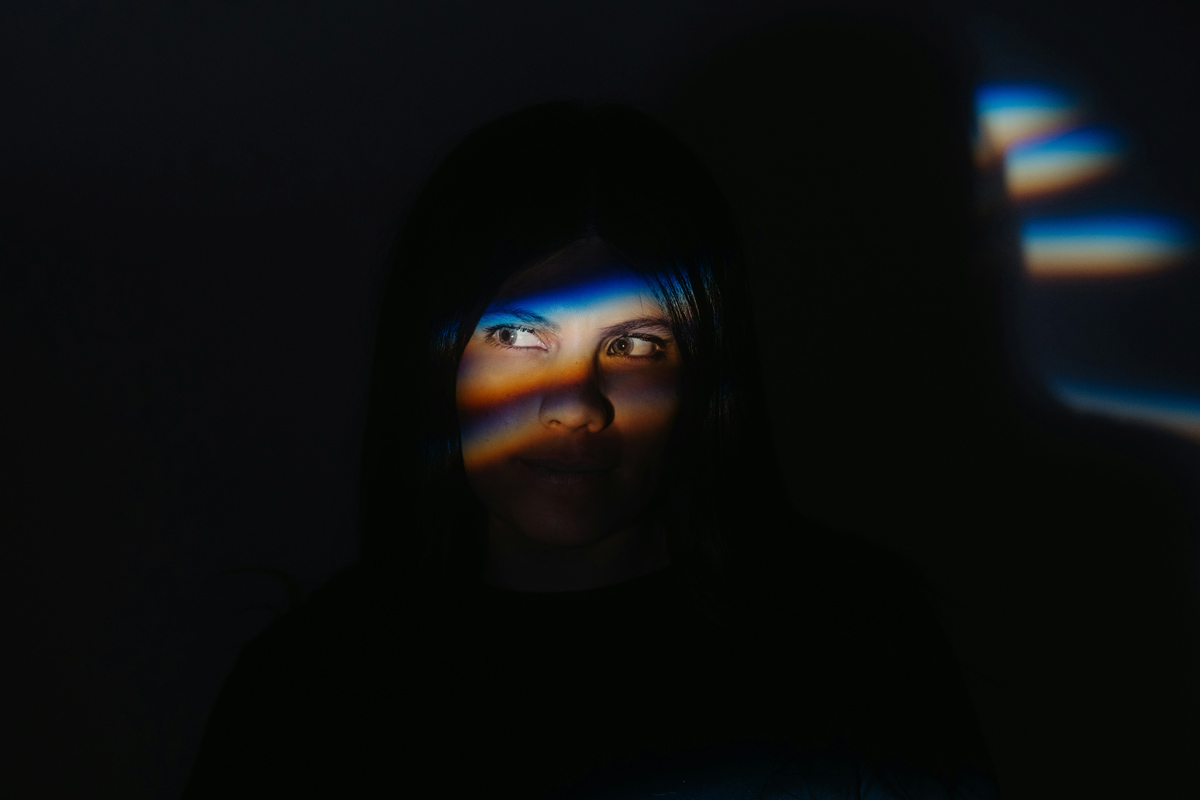
Person in the dark with light across their eyes
Credit: Jordan González/Unsplash.com
Erin Scottberg
Author
Erin Scottberg is a Brooklyn-based writer, garden designer, and houseplant expert — and the founder of Full Sun Studio (fullsun.studio), a garden design and plant consulting studio in New York City. She holds an Urban Horticulture Certificate from Brooklyn Botanic Garden, an NYC Street Tree Pruner License, and an NYC Master Composter Certification, and spent three years as Head of Content and Education at The Sill. When she's not working, you can find her creating in her textile studio, running craft nights in her neighborhood, or hanging with her rescue pup, Sunny. She's an ambitious DIYer, avid composter, and has never been able to walk by a thrift store without taking a look.

You know the drill: You wake up in the middle of the night, stumble toward the bathroom, and wait for your eyes to adjust. It feels like it takes a few seconds, but in reality, your night vision doesn’t hit its peak until about 30 minutes after the lights go out. Even then, one glance at your blindingly bright phone resets the whole process. 

That’s because your eyes adjusting to low light isn’t a mechanical process, and you’re not just “getting used to” the dark. Instead, there’s a specific chemical your eyes spend all day using up — and all night trying to rebuild.

In Rods We Trust

Diagram of the human eye
Credit: OSORIOartist/stock.adobe.com

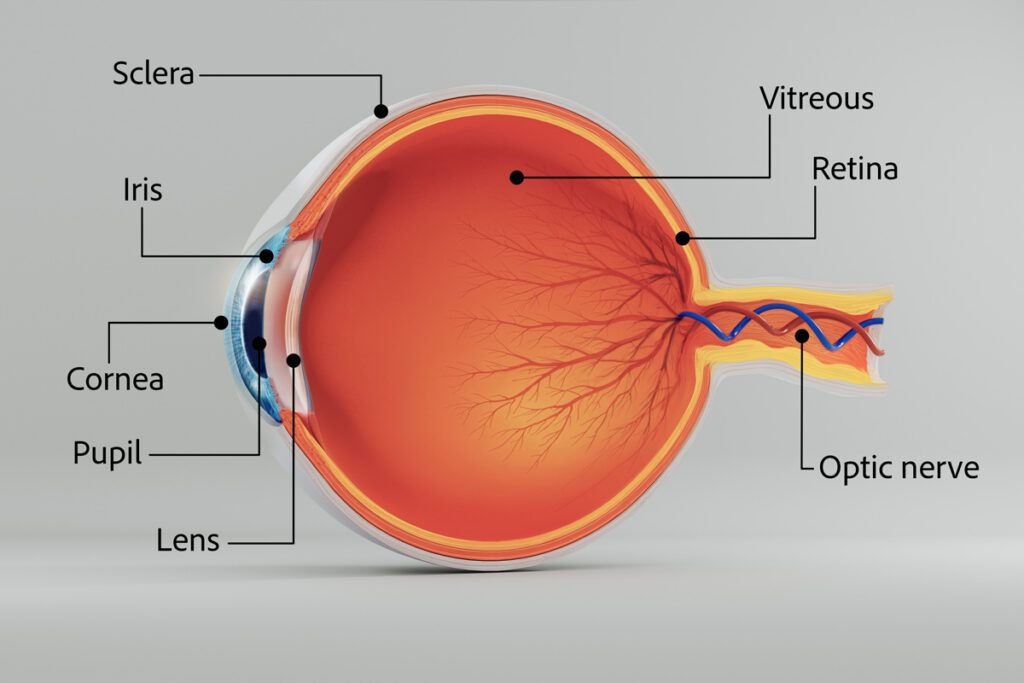
Light enters your eye through the pupil, the dark “hole” in the middle. Located in the back of your eyeball, the retina is the part of your eye that converts the light into the images we see. The retina has a light-sensitive layer lined with two types of photoreceptor cells: cones, which handle color and detail in bright light, and rods, which take over in the dark. 

A whopping 95% of photoreceptors are rods, which are far more sensitive to light than cones. They can’t see color at all, though, and aren’t great with details, which is why our night vision is never as good as our day vision). Rods rely on a protein called rhodopsin to do their magic, while cones use one called photopsins.

Here’s the problem: Both of these proteins break down when they’re exposed to light, in a process known as photobleaching. You’ve likely experienced concentrated bouts of photobleaching — for instance, after a day at the beach. Step inside after hours of practically staring at the sun and even an adequately lit room will seem dim and hard to see.

That’s because you’ve essentially overfed your light-sensitive rods, making those cells essentially offline until your eyes have a chance to rebuild their supply of rhodopsin. Even if you’re not at the beach, the same thing happens throughout the day, only more gradually.

The Speed of Dark

Person gazing at the stars
Credit: Joshua Earle/Unsplash.com

Your eyes get to work adjusting as soon as you step into the dark. First, muscles in your eye dilate, or widen, your pupils to let in as much light as possible. Your cones kick into gear first, reaching their peak sensitivity (which isn’t very much compared to rods) within about five to ten minutes. 

At this point, the rods — the ultrasensitive cells that actually make night vision possible — are still warming up. They need about 20 to 30 minutes to fully recharge. Until then, you’re working with a limited night vision. Once your rods are fully recharged, the difference is dramatic. 

Think about when you first walk outside at night and look at the sky (assuming you’re not in a bright city). At first, it just looks like a flat, black ceiling. But as time goes by, you’ll start to see stars and other details. That’s because after about 30 minutes outside, your eyes have become around 10,000 times more sensitive to light than they were when you first stepped outside.

Now you can see why waiting a half hour for your rods to get ready to work is worth it. But the downside is that all of that progress can be wiped out in seconds. A single bright light — including a glimpse at your cell phone screen, which is usually set to a brightness meant for daytime — breaks down the rhodopsin your rods just spent all that time rebuilding. 

Your night-vision goes down the drain and there’s no way to speed up the recovery. You just have to wait — or turn on a lamp.

Short Answer

Your eyes contain two kinds of cells: cones, which detect color and detail, and rods, which are highly sensitive to light and enable you to see in the dark. Rods rely on a protein called rhodopsin to function, which gets depleted in bright light. Your eyes need darkness to rebuild it, so when you walk into a dark room, it takes about 20 to 30 minutes for the rods to fully adjust. Looking at a bright phone screen at night will immediately deplete the rods’ rhodopsin, forcing your eyes to adjust all over again.

CULTURE

Does Your Voice Really Sound Like That?

Person talking into a microphone
Credit: Andrej Lišakov/Unsplash.com
Natalie LaBarbera
Author
Natalie LaBarbera is an editor and writer with bylines at InStyle, Food & Wine, People, PureWow, and Travel + Leisure. She has expertise in covering commerce and holds degrees in fashion studies and psychology.

Have you ever seen a video or heard a recording of yourself and thought, “That can’t really be what I sound like, right?” We’ve all been there, but it turns out you’re not being self-conscious or imagining things. 

The difference is not in your head. Actually, scratch that, it is in your head, quite literally. The reason a recording of your voice sounds different than what you usually hear is because of the relationship between your voice, your ears, and even your own skull.

Your Inner Voice

Person using headphones and recording app on their phone
Credit: Soundtrap/Unsplash.com

When we watch a video or listen to an audio recording, the sound we’re hearing is coming from a single source: the speakers. Sound waves travel through the air to our eardrums, which translate the sound waves into physical vibrations. A part of our inner ear called the cochlea then translates these vibrations into electrical signals our brain can interpret as sound. 

Anytime we listen to our own voice in a video or audio recording, this is how we’re hearing it. But when we’re hearing ourselves speak aloud in real time, our eardrums actually have to process two different sources of sound.

The first source is essentially the same as the above, in which the sound of our voice, which is created by vibrations in our vocal cords, travels through the air to our ears, gets turned into vibrations by our eardrums, and then turned into brain signals by our cochlea. 

Instead of originating from a speaker, it’s originating from our mouth, but the way the sound gets from point A to point B is the same. However, it’s the second source that really changes how we perceive ourselves.

Embarrassed person
Credit: Oswald Elsaboath/Unsplash.com

As we talk and sound waves travel through the air, the vibrations set off by our vocal cords also move directly through our skull. Since they’re already physical vibrations, they bypass the eardrum and head straight to the cochlea, which then tells the brain how they sound.

These bone-conducted sound waves have rich, lower frequencies that blend with the air-conducted vibrations in our eardrums. This means our cochlea perceives a mix of higher and lower frequencies as we hear our voice while speaking out loud. 

Meanwhile, everyone else is only perceiving our voice through the air, leaving only the higher-pitched frequencies — just as we do when we hear it played back to us, resulting in a discrepancy.

Naturally, many people find the experience of hearing their voice played back and having it sound different from the way it does in their heads off-putting. Not liking the sound of your own voice is actually such a prevalent occurrence that there’s even a psychological term for it: voice confrontation. The phenomenon may even be linked to elevated levels of social anxiety. 

So you’re not alone if you find yourself cringing at the sound of your own voice, which hopefully makes you feel at least a little better about it.

Short Answer

The inner ear interprets sound, which usually travels into the eardrum through the air. When you speak to someone, this is how they hear your voice, and it’s also how you hear your own voice when it’s coming from a recording. But, when we talk in real time, the vibrations of our vocal cords travel directly to our inner ear through our skull, bypassing our eardrums. These bone-conducted vibrations have a lower frequency and make our voices sound deeper in our heads.

TECHNOLOGY

Do Solar Panels Work at Night?

The moon over solar panels at dawn or dusk
Credit: Alexander Mils/Unsplash.com
Bess Lovejoy
Author
Bess Lovejoy is a writer and editor who lives in Seattle. She is the author of the book Rest in Pieces: The Curious Fates of Famous Corpses, and her writing has also appeared in The New York Times, The Boston Globe, The Wall Street Journal, Time, Lapham’s Quarterly, The Public Domain Review, Atlas Obscura, and elsewhere. She was formerly an editor at Mental Floss and SmithsonianMag.com, and currently teaches classes on research.

It seems like an obvious flaw: How can solar panels work when the sun isn’t shining? What do people with solar-powered homes do after sunset — just sit in the dark and twiddle their thumbs until dawn? Considering that sunlight is free and offers a 5-billion-year supply of energy, solar power is a seemingly ideal way to power your home — if it works at night, that is.

The bad news for night owls: Solar power does need energy from the sun to work. The good news? There are ways to take advantage of our star even when it’s on the other side of the planet. 

Researchers are constantly refining and innovating new ways to make solar power work at night. Some have even dared to ask: “What about moonlight?”

How Do Solar Panels Work?

Diagram of a solar panel
Credit: Merriam-Webster Inc.

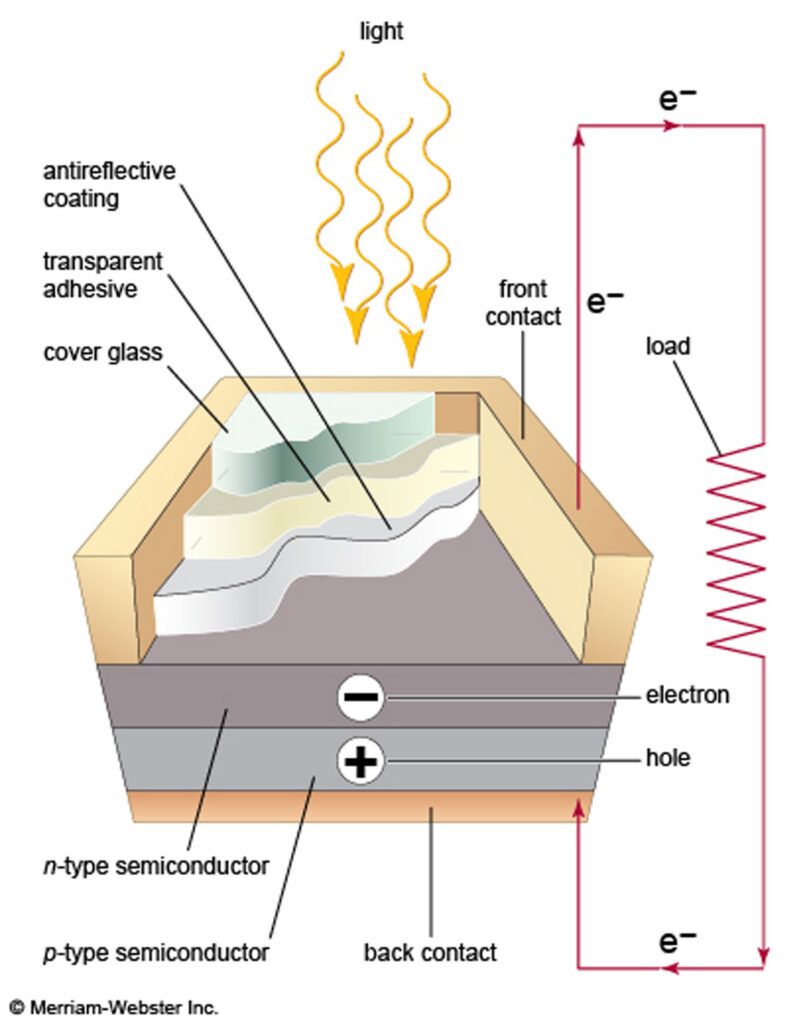
Solar panels generate electricity through the photovoltaic effect. Particles of sunlight called photons strike semiconductor material — usually silicon — and knock its electrons loose, creating an electric current. 

If ketchup is the energy we need and a glass bottle is the solar panel containing it, the photons in sunlight act as our hands, smacking the bottle to let the ketchup loose. With no sunlight hitting a solar panel, that ketchup isn’t going anywhere. A solar panel alone also can’t store any electricity it produces, so any solar power not being used in the moment goes to waste. 

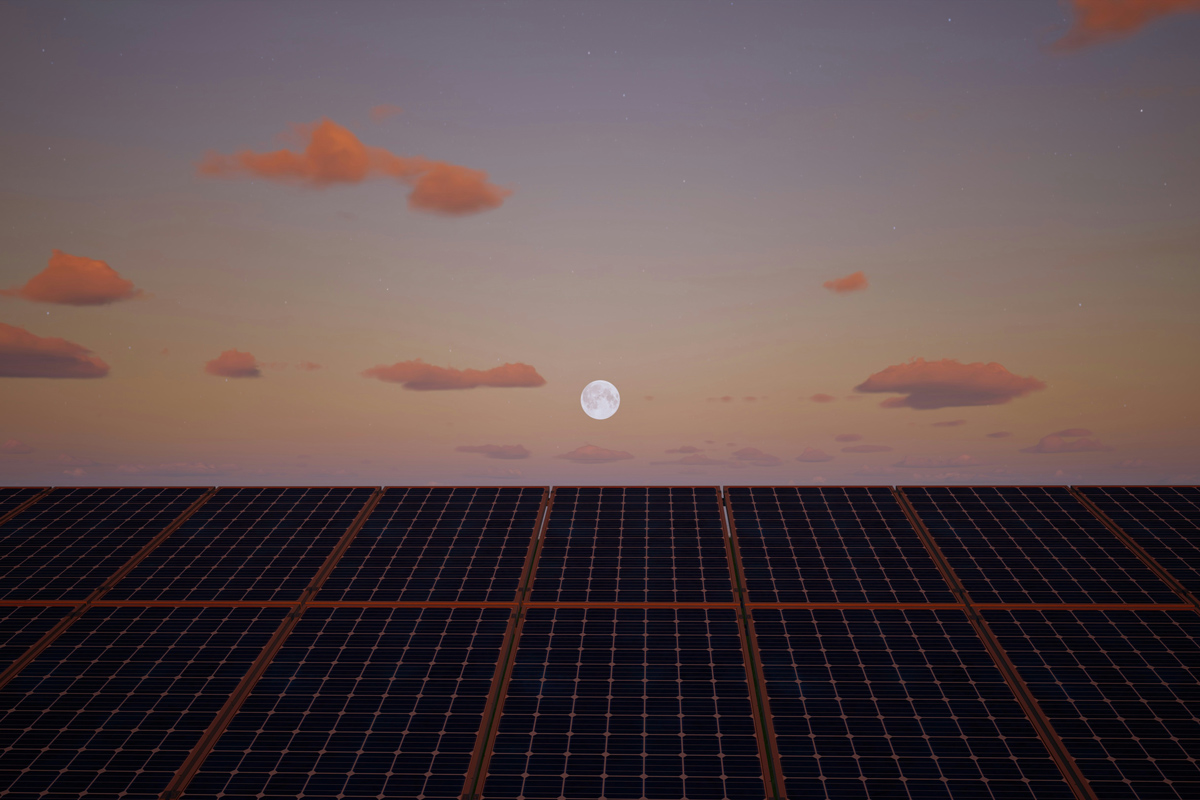
This has led some people to wonder about moonlight. After all, moonlight is just reflected sunlight — the same photons used to generate electricity in a solar panel during the day. So could moonlight keep a solar panel running overnight? 

Technically, yes — but only barely. Conventional solar panels can produce a tiny amount of electricity under a bright full moon, but moonlight is roughly 400,000 times weaker than direct sunlight. Instead of you smacking the ketchup bottle, you’re asking a newborn baby to paw at it with its tiny hands instead. The resulting power is far too small to run a home or meaningfully charge a battery. 

Not to mention, the moon isn’t even fully shining most of the time. Some nights it’s not there at all. Even conventional solar panels wouldn’t be much use if the sun called in sick multiple times per month. That said, there are still ways to utilize solar panels after the sun has set.

Saving for a Rainy Day

Solar panels
Credit: Getty Images/Unsplash.com

Today’s solar systems rely on something much more practical: energy storage. During the day, solar farms — vast arrays of panels fulfilling the job of a traditional power plant — often generate more electricity that what’s immediately needed by the areas they serve. Rather than that extra energy go to waste, it can be stored in batteries for later use. 

When the sun goes down, the system simply begins drawing from that stored electricity instead. Large battery farms perform the same job for entire communities as the solar panels they’re paired with, releasing surplus energy during the evening or on cloudy days. (Keeping with the ketchup analogy, you can think of these batteries as the little packets you keep in the fridge.)

Making all of this work is part of developing a “smart grid” — a modern electrical network that constantly monitors electricity supply and demand. Instead of simply sending power in one direction from a power plant to customers, the smart grid can route electricity in both directions between homes, businesses, batteries, and renewable energy sources in real time. 

If one neighborhood generates more solar power than it needs during the day, that energy can be stored or sent elsewhere to be used when it’s needed, even if that’s hours later.

Some homes are even becoming tiny power plants of their own. Solar technology has advanced to the point where it’s practical and affordable enough for many homeowners to utilize it, and even store their own daytime electricity for use after sunset. 

You can even put excess energy back into the grid and charge your utility company rather than the other way around. Even portable solar panels are commercially available that can be laid out in your yard or, for apartment dwellers, put on your balcony.

The Night Shift

Houses connected to a smart grid
Credit: Philip Oroni/Unsplash.com

Scientists and startups are exploring other ways to generate electricity after dark — and not from moonlight or starlight. One experimental technology developed by researchers at Stanford University takes advantage of radiative cooling — the natural process by which Earth releases heat into the cold of space. 

Modified solar panels equipped with thermoelectric generators can still work at night, converting a tiny portion of this escaping heat into enough electricity to keep small sensors and LEDs running.

Engineers have even proposed using satellites equipped with giant mirrors to reflect sunlight from space, directing it toward solar farms after dusk. The idea remains experimental, though, and has raised concerns among astronomers about light pollution and the night sky.

For now using solar power at night isn’t about adding more sunlight — it’s making better use of the sunlight we’ve already captured. As batteries become cheaper, grids become smarter, and new technologies continue to mature, solar energy will keep shining long after the sun disappears below the horizon.

Short Answer

Solar panels themselves can’t generate meaningful electricity at night because they require sunlight to release the electrons stored inside them. Instead, they can charge batteries throughout the day, which can then redistribute electricity at night when managed by increasingly sophisticated smart grids. Meanwhile, researchers continue to explore experimental technologies that can generate power from the sun after dark.

HEALTH

Why Do Paper Cuts Hurt So Much?

A paper cut on a fingertip
Credit: eyepark/stock.adobe.com
Darren Orf
Author
Darren Orf is a writer and editor living in Portland, Oregon, who covers science and the natural world for places like Popular Mechanics, National Geographic, and Smithsonian Magazine, among others.

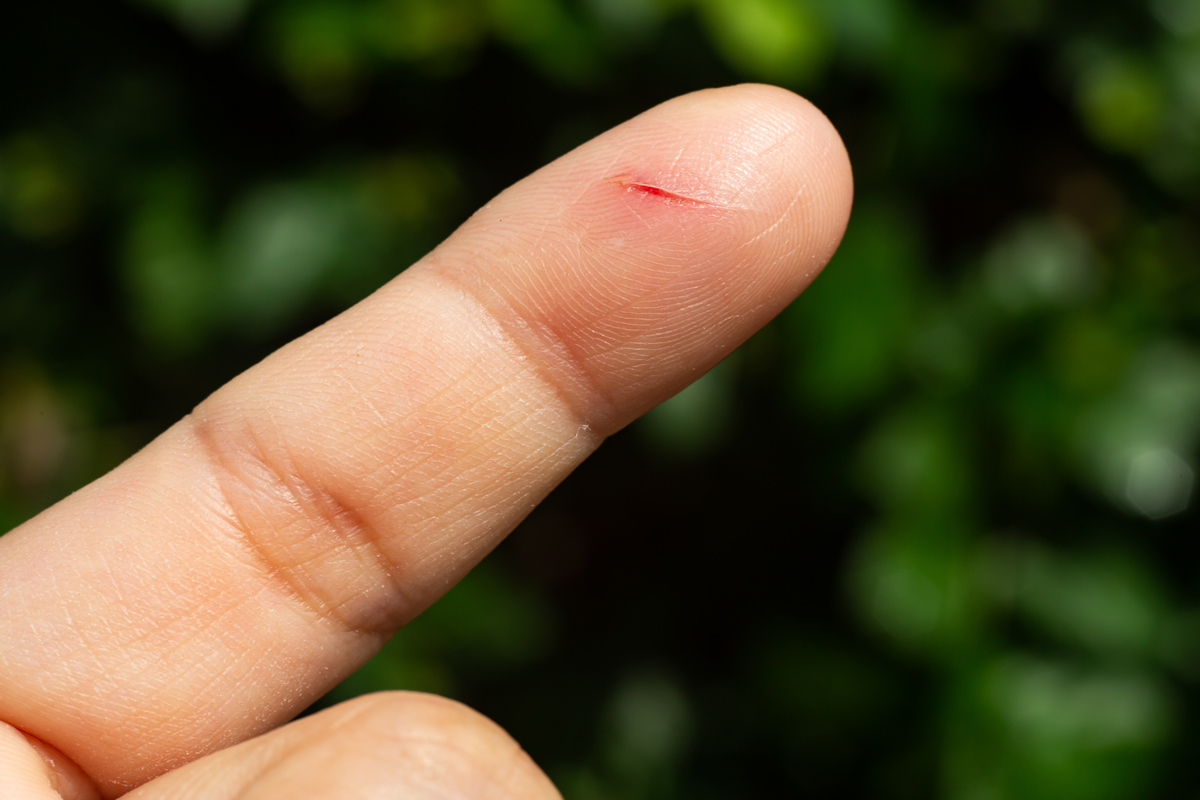
Paper cuts can strike from anywhere — while loading paper into your printer, peeling off a sticky note, or turning the page of your favorite book. Afterward, you can barely even see where this particular blend of cellulose fibers sliced into your skin, but you know it’s there because it hurts — a lot.

How can such a tiny slash feel so painful? The answer actually comes down to a mix of factors that come together to form a perfect storm of agonizing discomfort. Warning: It may be tough to read on without wincing once or twice.

Paper-Thin Razors

Extreme close-up view of a paper edge
Credit: Susumu Nishinaga/Science Source

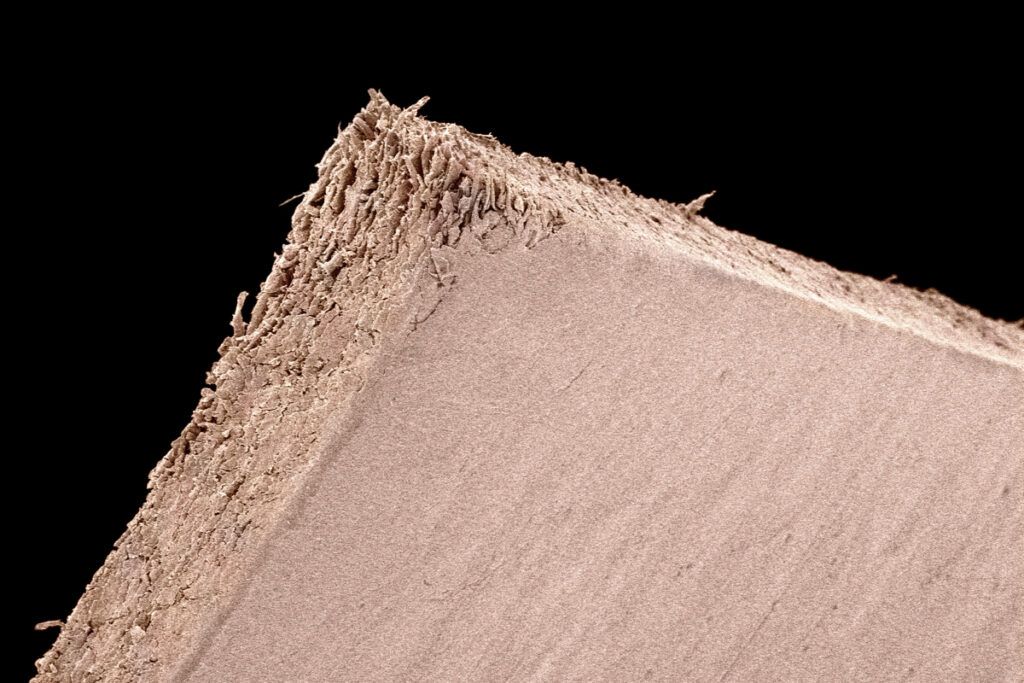
While paper is not typically seen as a sharp and dangerous weapon, its edge tells a different story when seen under a microscope, sporting sharp, jagged teeth. Though tiny, these razor-like points are why paper is more hazardous than it seems on, well, paper.

A straight-edged knife makes a clean cut, causing less overall damage to the skin than a serrated one. In effect, you’re being cut many times instead of once when you make contact with the edge of a piece of paper, with the multiple jagged points hooking into your finger and tearing at it as it runs alongside the paper.

That said, not all types of paper are equally dangerous. Scientists have calculated that paper cuts are most likely to occur from sheets with a thickness near 65 microns at an angle of around 20 degrees from the skin. Note cards, for example, are (usually) too thick to cut into the skin, while material like toilet paper is too thin and soft to hold an edge firm enough to injure you. The paper used in standard print magazines, though, are closer to 65 microns thick, so flip through one at your own risk.

Paper cuts also may sting more than larger cuts because paper can leave behind tiny fibers, as well as traces of chemicals used in paper manufacturing, that further irritate the open wound.

Bad Feelings

But the mechanics and composition of paper are only part of the problem. Because of the way we usually handle paper, paper cuts typically occur around sensitive areas densely packed with sensory neurons known as nociceptors — which specifically detect damage and pain. Researchers suggest that in early adolescence, the brain develops an oversensitivity in our fingers, meaning we essentially feel more in those areas. 

Our brain’s somatosensory cortex, which translates touch perceptions from our hands into signals the brain can interpret, is stimulated more when there’s a greater density of sensory nerves. You’re much more sensitive to touch or pain on your lips, which have many such nerves, than the middle of your back, where they are more spread out.

It makes sense our fingertips are loaded with these sensory neurons, since they’re a gateway to our sense of touch. They’re what we use to carefully grasp objects and feel subtle details on a surface.

But, this heightened sensitivity is a double-edged sword (or paper envelope). While running our fingertips across velvet feels especially satisfying thanks to fingers’ enhanced touch receptors, running them over the edge of paper is just the opposite, especially since they can sense its near-invisible sharp points. 

So when we feel a paper cut on our finger, we really feel it.

Short Answer

Under a microscope, paper has jagged, sawtooth-like edges that tear at the skin of your fingers. Paper also leaves behind plant fibers and industrial chemicals that can further irritate the cut. What’s more, your fingertips are densely packed with pain-sensing neurons known as nociceptors that make them more attuned to the tiny, sharp points of a paper’s edge, and send stronger pain signals to the brain compared to other parts of the body. 

CULTURE

Why Did You Hate Broccoli as a Kid?

Broccoli
Credit: Patrycja Jadach/Unsplash.com
Bess Lovejoy
Author
Bess Lovejoy is a writer and editor who lives in Seattle. She is the author of the book Rest in Pieces: The Curious Fates of Famous Corpses, and her writing has also appeared in The New York Times, The Boston Globe, The Wall Street Journal, Time, Lapham’s Quarterly, The Public Domain Review, Atlas Obscura, and elsewhere. She was formerly an editor at Mental Floss and SmithsonianMag.com, and currently teaches classes on research.

Maybe you spent years pushing broccoli to the edge of your plate, only to discover in adulthood that you genuinely enjoy it roasted with a little salt and olive oil. Or perhaps coffee and dark chocolate seemed unbearably bitter when you were little, but have since become daily must-haves.

It’s a common experience — and it isn’t just that your preferences have become “more sophisticated” alongside the rest of you (no shame if you still enjoy watching cartoons in your PJs, though). There are biological reasons your palate changes over time. 

So don’t worry — even if your children or grandchildren don’t like broccoli, there’s still hope for the future.

Your Taste Buds Grow Up, Too

A baby in their high chair being fed
Credit: Pablo Merchán Montes/Unsplash.com

Taste is more complicated than you might think. Your tongue can only detect a handful of basic tastes — sweet, salty, sour, bitter, and umami — but your brain combines those signals with aromas, texture, temperature, and even memories to create a wide range of subtle flavors.

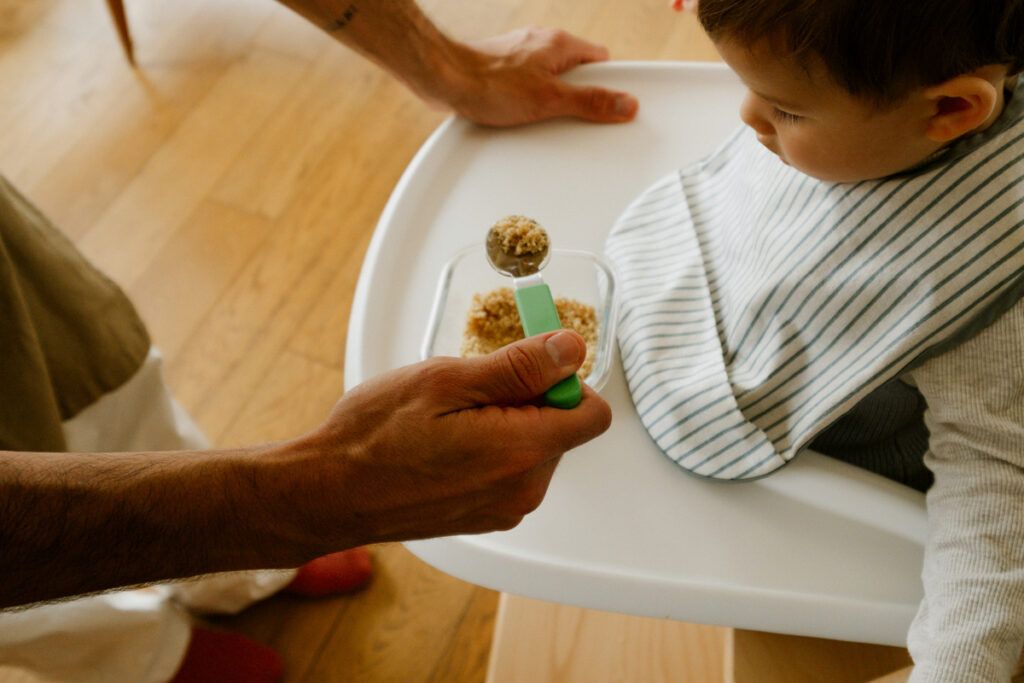
Similarly, the reason you may now like broccoli when the sight of it once made you retch involves a few different factors. Part of it has to do with evolution: Young children are naturally drawn to sweet and salty foods while tending to reject bitter ones, and scientists think this preference evolved for a good reason. 

Sweet foods, such as fruit or milk, often provide energy, while bitterness can signal toxins in nature. For a small child exploring the world, going for the calorie-dense sweet treats while being suspicious of bitter flavors may have been a useful survival strategy.

Holiday foods on a table
Credit: Kateryna Hliznitsova/Unsplash.com

As children grow into teenagers and adults, that built-in caution gradually fades. Experience plays a huge role — every time you eat a food without unpleasant consequences, your brain learns that it’s safe and remembers it for later.

Over time, repeated exposure can turn unfamiliar or disliked flavors into welcome ones. So if your gut told you early on that broccoli (or kale, asparagus, or other bitter-tasting foods) could possibly kill you, eventually — after you force it down a handful of times and find you don’t need to call poison control — your brain will admit, “Okay, maybe I was wrong about you.” 

Studies suggest it often takes around 10 to 15 tastings before people begin to genuinely like a new food. Which means that yes, parents, it’s worth it to keep trying with the broccoli.

Mouths, Microbes, and Memories

Your memories also influence taste. A food shared during holidays, family dinners, or celebrations can develop positive emotional associations that make it taste better the next time you encounter it. Everyday social contexts matter, too — Some people may begin to enjoy the taste of coffee because of its associations with the routines of adult life. (Its brain-boosting caffeine probably doesn’t hurt, either.)

Of course, our mouths also play a role in the development of our palate. Babies are born with about 10,000 taste buds, but the number in good working order decreases as we age. Think about how, over time, the bristles on a broom become less effective as they wear down and lose shape. A new broom, with a thick, stiff brush, will be much better for sweeping.

Similarly, all those taste buds in tip-top shape means that flavors can be ecstatic for kids — or unbearable, depending on the meal. But, those extremes become  much less pronounced by the time we hit middle age, making foods such as broccoli, Brussels sprouts, and coffee seem milder and easier to appreciate.

Broccoli and purple cauliflower
Credit: Michael Carruth/Unsplash.com

We simply don’t experience the same levels of bitterness as much as children. That’s why we also may start craving stronger or spicier flavors than we could have handled as tots.

Even your mouth’s microscopic residents may contribute to taste. Researchers have found that bacteria living in saliva can produce sulfur-smelling compounds from vegetables like broccoli and cauliflower. Some children’s saliva naturally produces more of these unpleasant aromas, making these vegetables taste especially off-putting. As people grow older, however, the bacteria living in their mouths can change, reducing such odors.

Science is all about experiments, so, next time you’re eating out, put your newfound knowledge of taste to the test. Try something from the menu you’ve never liked, even for decades, and give it another go — maybe this time you’ll find it delicious. 

(Except cilantro. There’s nothing you can do about that.)

Short Answer

Our sensitivity to bitter flavors, such as those found in broccoli, possibly evolved as a defense to protect children from toxic foods. It decreases with age, as the brain learns through repeated experience that once-avoided foods are actually safe — and enjoyable. Worn out taste buds, bacteria living in the mouth, and even memories can also reshape tastes over time.

NATURE

How Do Cats Always Land on Their Feet?

A cat jumping mid-air
Credit: furryfritz/stock.adobe.com
Mike Diaz
Author
Mike Diaz is a Los Angeles-based television writer and producer who got his start making docuseries for National Geographic. Most recently, he wrote for Magnum P.I. and NCIS: Hawai'i on CBS.

If you’ve ever lived with a cat, you know they’re little acrobats. Our feline companions are supernaturally fast, agile, and capable of jumping 8 feet vertically from a standing position. This means that nowhere in your house is off-limits, including odd places like the top of the fridge. 

The downside of a cat’s passion for bird’s-eye perches is that they occasionally (okay, maybe more than occasionally) get spooked and fall. But no matter how high the drop, a cat almost always lands on its feet — even when it starts off upside down. 

So how do cats always stick their landing? It’s not luck.

Raining Cats and Cats

Original images of a cat landing from 1894
Credit: Étienne-Jules Marey

A cat’s ability to seemingly defy Newtonian physics has beguiled scientists since the 1700s. Academia’s fascination with felines hit a fever pitch in the 19th century, when physicists in universities the world over began tossing cats through windows to watch them land. 

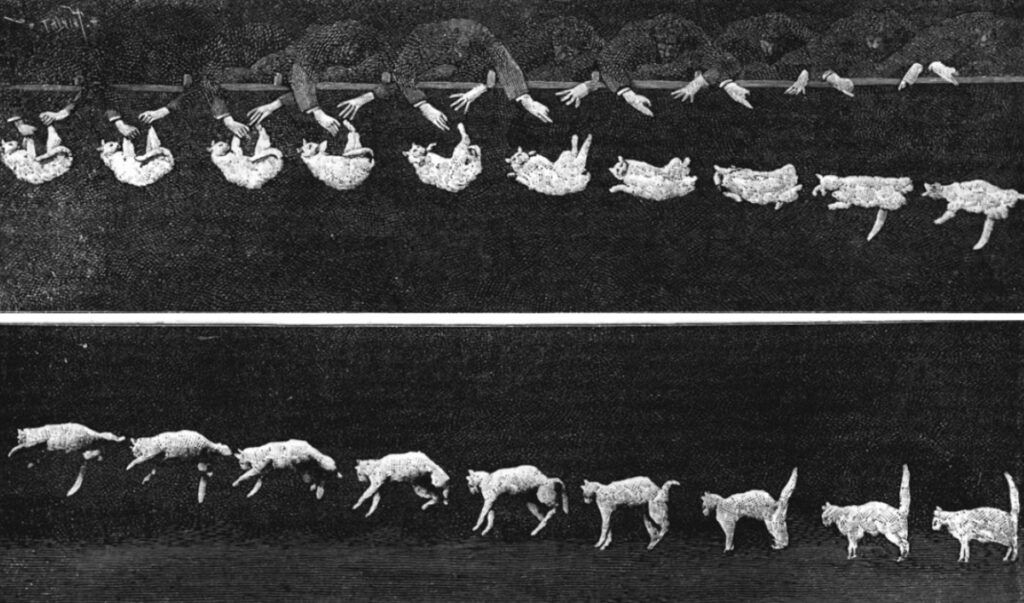
Now, we definitely do not recommend you try this with your furry friend at home. But the strange university pastime did lead to a scientific breakthrough in 1894, when physiologist Étienne-Jules Marey utilized a brand-new technology to find out how cats almost always land on their feet. 

Chronophotography, a precursor to motion pictures, allowed Marey to photograph cats falling upside down at 12 frames per second. The photos showed (rightfully) angry felines contorting their bodies midair to right themselves before landing. Marey concluded that cats quickly coupled the inertia of their own body mass with a midair twisting motion to flip themselves right side up before hitting the ground.

Before Marey’s experiment, many scientists believed that cats used ledges, tree branches, or human hands as fulcrums to generate the momentum needed to land on their feet. You’ve seen similar acrobatics at play during the Olympics, where gymnasts swing around bars, flip midair, and land on their feet like it’s nothing. 

But Marey’s photos disproved the fulcrum theory and showed that a falling cat is able to move its forelimbs and hind legs in opposing directions to generate a twisting motion rather than use any leverage. 

Twist and Shout (er… Meow?)

More than a century later, Japanese researchers from Yamaguchi University’s Laboratory of Veterinary Physiology and Biochemistry studied the properties of feline spines and proved Marey correct. Using deceased cats, researchers subjected the upper (thoracic) and lower (lumbar) regions to mechanical tests measuring strength, flexibility, and rotational capabilities. 

Simultaneously, they filmed live cats dropping from low heights onto soft cushions using high-speed cameras — a modern-day take on Marey’s chronophotography experiments. The results showed that a cat’s upper trunk is far more flexible than its lumbar region — and those regions can move independently. 

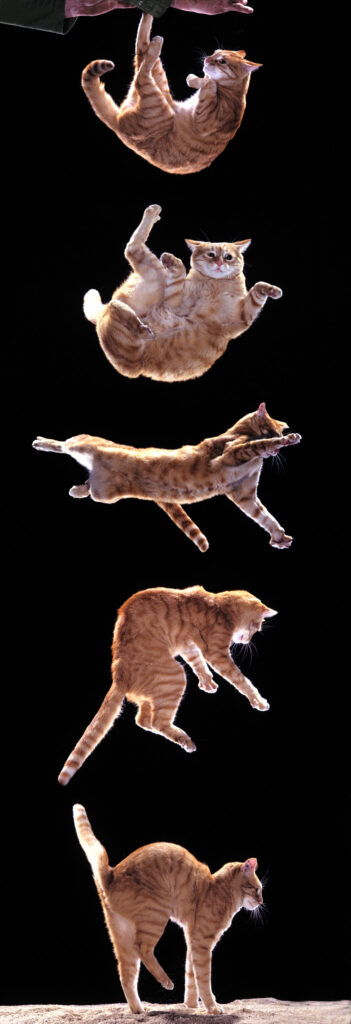
Slow-motion footage revealed that a falling feline will first reorient its head and forelimbs via its flexible upper trunk. Once the cat’s forelimbs are pointing down, the less flexible lumbar region will follow suit, righting the body. And voila, our angry tabby lands on its feet like nothing happened.

The motions of a cat mid-fall
Credit: Auscape—Universal Images Group/Getty Images

Another study found that cats falling from greater distances would, once reaching a terminal velocity of around 62 mph, relax and spread out their bodies to soften the impact. Since it takes falling about five stories to reach that speed, cats actually land more safely when falling from, say, a seven-story drop than a three-story one, since they have more time to prepare. One cat in the study even managed a 32-story drop with little more than a chipped tooth.

So if you get nervous seeing your cat perched on a tall banister or appliance, you can relax. Consider it a leap of faith in your cat’s own anatomy.

Short Answer

The upper and lower regions of a cat’s spine can twist in opposite directions. When a cat falls, its more flexible upper (thoracic) region twists first, positioning the forelimbs toward the ground. Then its lower (lumbar) region follows suit, allowing the cat to land purrrfectly on all fours.